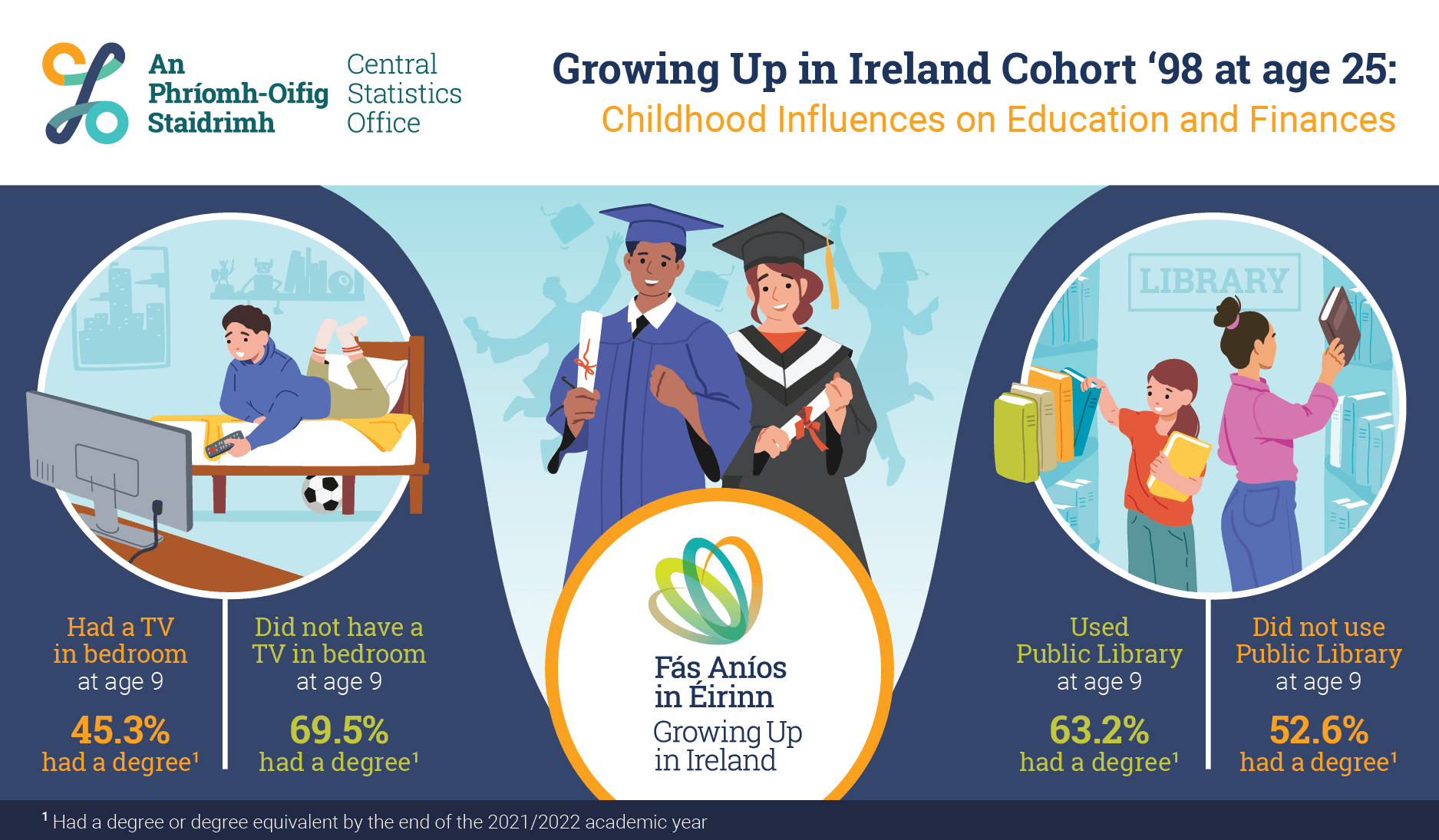
I partecipanti alla Coorte ’98 cresciuti in Irlanda che non avevano la TV in camera da letto all’età di 9 anni avevano maggiori probabilità di avere una qualifica di livello universitario o equivalente all’età di 25 anni
https://i.redd.it/y98c7ut2l8lg1.png
di NanorH

6 commenti
**Key Findings**
* Growing up in Ireland Cohort ’98 participants whose parents used the public library for them at age 9 were more likely to have a degree at age 25 (63%) than those whose parents did not use the library for them (53%).
* Respondents who did not have a TV in their bedroom at the age of 9 were more likely to have a degree level qualification or equivalent when they were 25, at almost 70%, compared with a 45% attainment level for those who had a TV in their bedroom.
* A parent’s expectation of their 9-year-old’s future educational attainment had an impact on their likelihood of having a degree. Almost 70% of those whose parents expected them to get a degree had done so by age 25. By comparison 37% of respondents, whose parents did not have this expectation, had a degree level qualification by age 25.
* Over 45% of those whose household income was in the lowest income category at age 9 had at least some difficulty making ends meet at age 25, compared with 24% of those in the highest income group.
* Respondents whose household income was in the highest income threshold at age 9 were less likely to have difficulty making loan repayments at age 25 than those in the lowest household income quintile.
https://www.cso.ie/en/releasesandpublications/fp/fp-guic98cief/growingupinirelandcohort98atage25childhoodinfluencesoneducationandfinances/keyfindings/
Thats pretty stark and a lesson to present and future generations. A degree isnt everything but a healthy home life is absolutley essential to a childs development.
Interesting! It’s so important to keep in mind too that statistics like this remove the majority of context that can influence the outcome. I didn’t have a TV in my room because we were poor haha
I’m sure someone will chime in saying the TV in a room is the problem, but I suspect it might be because some parents just got the tv to keep the kid quiet and out of sight. Thus a lack of parental involvement overall.
Imagine needing this level of data in order to comprehend the blatantly obvious. The same kind of discrepancy, except even larger, will now be observed in the post ~2010 generation between those who spent their teenage years with a smartphone and those without.
I’m one of those 45.3%, I loved looking at the teletext.