Taptaze bir Suriye’miz daha oldu.Amerika destekli kürtler karşısında baskıcı ve şii devlet.Girmişken Azerbaycan’a ulaşcak şekilde toprak kontrol altına alalım bari.
Weird-Student-9302 on

[deleted] on
[removed]
flyinghi_ on
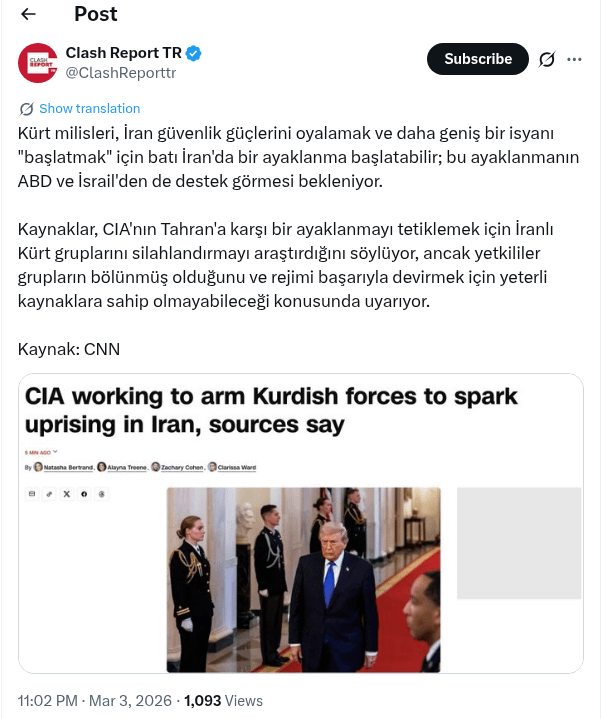
cia’in tek bildiği kürtleri mi kışkırtmak?
Whole_Obligation_776 on
Daha 3 ay önce Suriye’de adam Kürtleri sattı, hatta neredeyse peşkeş çekti herkese.
Eğer iran Kürtleri salak değilse, bir gram aldırış bile etmemeleri lazım.
architecTiger on
Kürtlerin şimdiye kadar bir devlet kuramamış olmalarının asıl sebebi sürekli kullanışlı aptal olmalarındandır.
Desperate_Access_484 on
bunlarin silahlari hangi sinirdan girebilir?
simde anlasildi amerikan pedofili bugun neden Hakan Fidan ile gorustugu
assprobably on
Bir emperyalist maşa kuvvetleri olarak silahlı kürt gruplar.
Kürtler için güney Azerbaycan bölgesine yoğun operasyon var. Bölgede Türklere etnik temizlik yapılmaya çalışılacak, sonra Azerbaycan dahil olacak derken olay bölgesel savaşa dönüşecek. Türkiye’de Erdoğan rejimi ise yine babası Trump’ın köpeği olarak ne isterse onu yapacak. Bize de yine havalı edit basarlar.

Odd-Instruction-4555 on
Böyle bir durumda teorik olarak Türkiye, İran yönetimi ile anlaşıp kendi sınırında tampon bir bölge kurabilir mi TSK ile girip?
el_turco on
>There is information published in the media that the US and Israel are coordinating with Kurdish fighters for operations inside Iran. The strategy of arming and coordinating Kurdish fighters for operations is not without strategic logic, but it carries genuine counterproductive risks, several of which are already materializing.
>The appeal of using Kurdish fighters is understandable. They offer US and Israeli planners a ground-level proxy force with organic motivation, local terrain knowledge in Western Iran, and authentic anti-regime credentials built over decades of resistance. On February 22, five major Iranian Kurdish opposition parties — the PDKI, PAK, PJAK, Khabat, and one Komala branch — formally united into the Coalition of Political Forces of Iranian Kurdistan, representing one of the most organizationally significant moments for the Iranian opposition in years. There are reports that weapons have been smuggled into Western Iran since 2025 to arm thousands of Kurdish volunteers, with US and Israeli strikes on security targets in Iran explicitly designed to degrade IRGC capabilities and create favorable conditions for a Kurdish ground operation. From a military cost-benefit perspective, it avoids US or Israeli boots on the ground while extending pressure on Tehran from a direction the IRGC must now defend.
>The coalition is more fragile than its formation suggests. Two branches of the Komala Party declined to join, and the coalition spans a wide ideological range — from secular nationalists to leftists affiliated with the PKK, which remains a US-designated terrorist organization. This creates a legal and political minefield: Washington would, in effect, be coordinating with groups affiliated with an entity it labels as a terrorist. The PDKI leader, Mostafa Hejri, acknowledged that it took eight months of negotiations merely to “set aside” longstanding differences, and there was immediate friction with the broader Iranian opposition — Reza Pahlavi publicly condemned the coalition as “separatist groups,” prompting Kurdish leaders to accuse him of suppressing Kurdish rights. This internal opposition fracture matters: a Kurdish ground operation rebranded as separatist by Persian nationalist opposition figures could weaken rather than build the broad-based anti-regime coalition that regime change actually requires.
>Iran has not waited passively. It has been bombing Kurdish rebel positions in Northern Iraq, and Kataib Hezbollah has explicitly threatened the Kurdistan Region of Iraq against hosting “hostile foreign forces”. Iran’s IRGC intercepted Kurdish fighters attempting border crossings earlier, with Turkish intelligence providing advance warning of the movement. The operational surprise that is essential to such an infiltration strategy appears already partially compromised.
>There is a broader credibility problem with external powers and the Kurds. The 1975 Algiers Agreement between the Shah and Saddam Hussein ended US and Israeli support for the Iraqi Kurdish revolt overnight, with devastating consequences. That abandonment is institutionally remembered across Kurdish political parties. Coordinating an armed uprising carries an implicit long-term commitment to Kurdish political outcomes — including autonomy arrangements in post-regime Iran — that neither Washington nor Tel Aviv has clearly committed to, and which Tehran’s eventual successor government (whatever its character) may refuse to honor.
>The strategy is not simply counterproductive — it is a calculated gamble with significant structural vulnerabilities. The Kurdish fighters represent a real, organized, and motivated force, and establishing air superiority over Western Iran does provide meaningful cover. But the Turkey-NATO intelligence leak problem is not a tactical glitch; it is a systemic vulnerability in the operation’s architecture. Combined with the Kurdish coalition’s ideological fissures, the risk of deepening Iraqi instability through Iranian-backed militia retaliation, and the potential to fracture the broader Iranian opposition by triggering Persian nationalist sentiment against a Kurdish-led incursion, the concept creates as many problems as it attempts to solve.
CivDiv izleyen 3 nöronlu bir primat zaten neden bunun yapıldığını anlar. Herif baya baya anlatıyor. Pezevenk amerikan askeri apo orospuevladının pankartı olan tünelleri savunduğu videoları utanmadan atıyor (eski savaştan). Bu yeni değil.
Ok_Sea_7105 on
CNN in dediği her hangi bir şeyi yiyen dünyadaki en enayi insandır ama neyse

14 commenti
Zaten rejime karşı birleşmediler mi ?
Taptaze bir Suriye’miz daha oldu.Amerika destekli kürtler karşısında baskıcı ve şii devlet.Girmişken Azerbaycan’a ulaşcak şekilde toprak kontrol altına alalım bari.

[removed]
cia’in tek bildiği kürtleri mi kışkırtmak?
Daha 3 ay önce Suriye’de adam Kürtleri sattı, hatta neredeyse peşkeş çekti herkese.
Eğer iran Kürtleri salak değilse, bir gram aldırış bile etmemeleri lazım.
Kürtlerin şimdiye kadar bir devlet kuramamış olmalarının asıl sebebi sürekli kullanışlı aptal olmalarındandır.
bunlarin silahlari hangi sinirdan girebilir?
simde anlasildi amerikan pedofili bugun neden Hakan Fidan ile gorustugu
Bir emperyalist maşa kuvvetleri olarak silahlı kürt gruplar.
Kürtler için güney Azerbaycan bölgesine yoğun operasyon var. Bölgede Türklere etnik temizlik yapılmaya çalışılacak, sonra Azerbaycan dahil olacak derken olay bölgesel savaşa dönüşecek. Türkiye’de Erdoğan rejimi ise yine babası Trump’ın köpeği olarak ne isterse onu yapacak. Bize de yine havalı edit basarlar.

Böyle bir durumda teorik olarak Türkiye, İran yönetimi ile anlaşıp kendi sınırında tampon bir bölge kurabilir mi TSK ile girip?
>There is information published in the media that the US and Israel are coordinating with Kurdish fighters for operations inside Iran. The strategy of arming and coordinating Kurdish fighters for operations is not without strategic logic, but it carries genuine counterproductive risks, several of which are already materializing.
>The appeal of using Kurdish fighters is understandable. They offer US and Israeli planners a ground-level proxy force with organic motivation, local terrain knowledge in Western Iran, and authentic anti-regime credentials built over decades of resistance. On February 22, five major Iranian Kurdish opposition parties — the PDKI, PAK, PJAK, Khabat, and one Komala branch — formally united into the Coalition of Political Forces of Iranian Kurdistan, representing one of the most organizationally significant moments for the Iranian opposition in years. There are reports that weapons have been smuggled into Western Iran since 2025 to arm thousands of Kurdish volunteers, with US and Israeli strikes on security targets in Iran explicitly designed to degrade IRGC capabilities and create favorable conditions for a Kurdish ground operation. From a military cost-benefit perspective, it avoids US or Israeli boots on the ground while extending pressure on Tehran from a direction the IRGC must now defend.
>The coalition is more fragile than its formation suggests. Two branches of the Komala Party declined to join, and the coalition spans a wide ideological range — from secular nationalists to leftists affiliated with the PKK, which remains a US-designated terrorist organization. This creates a legal and political minefield: Washington would, in effect, be coordinating with groups affiliated with an entity it labels as a terrorist. The PDKI leader, Mostafa Hejri, acknowledged that it took eight months of negotiations merely to “set aside” longstanding differences, and there was immediate friction with the broader Iranian opposition — Reza Pahlavi publicly condemned the coalition as “separatist groups,” prompting Kurdish leaders to accuse him of suppressing Kurdish rights. This internal opposition fracture matters: a Kurdish ground operation rebranded as separatist by Persian nationalist opposition figures could weaken rather than build the broad-based anti-regime coalition that regime change actually requires.
>Iran has not waited passively. It has been bombing Kurdish rebel positions in Northern Iraq, and Kataib Hezbollah has explicitly threatened the Kurdistan Region of Iraq against hosting “hostile foreign forces”. Iran’s IRGC intercepted Kurdish fighters attempting border crossings earlier, with Turkish intelligence providing advance warning of the movement. The operational surprise that is essential to such an infiltration strategy appears already partially compromised.
>There is a broader credibility problem with external powers and the Kurds. The 1975 Algiers Agreement between the Shah and Saddam Hussein ended US and Israeli support for the Iraqi Kurdish revolt overnight, with devastating consequences. That abandonment is institutionally remembered across Kurdish political parties. Coordinating an armed uprising carries an implicit long-term commitment to Kurdish political outcomes — including autonomy arrangements in post-regime Iran — that neither Washington nor Tel Aviv has clearly committed to, and which Tehran’s eventual successor government (whatever its character) may refuse to honor.
>The strategy is not simply counterproductive — it is a calculated gamble with significant structural vulnerabilities. The Kurdish fighters represent a real, organized, and motivated force, and establishing air superiority over Western Iran does provide meaningful cover. But the Turkey-NATO intelligence leak problem is not a tactical glitch; it is a systemic vulnerability in the operation’s architecture. Combined with the Kurdish coalition’s ideological fissures, the risk of deepening Iraqi instability through Iranian-backed militia retaliation, and the potential to fracture the broader Iranian opposition by triggering Persian nationalist sentiment against a Kurdish-led incursion, the concept creates as many problems as it attempts to solve.
[https://x.com/ruslantrad/status/2028951210586239187](https://x.com/ruslantrad/status/2028951210586239187)

CivDiv izleyen 3 nöronlu bir primat zaten neden bunun yapıldığını anlar. Herif baya baya anlatıyor. Pezevenk amerikan askeri apo orospuevladının pankartı olan tünelleri savunduğu videoları utanmadan atıyor (eski savaştan). Bu yeni değil.
CNN in dediği her hangi bir şeyi yiyen dünyadaki en enayi insandır ama neyse