Correlation: the darker the purple, the higher the concentration of stunning Nordic women.
utsuriga on
Yet another statistics where Hungary leading from behind, fuck yeah… …………….. …..*sigh*
thinktank_bacsi on
Orbánék szerint egy keresztény, családbarát nőnek a konyhában a helye.
ThrowawaypocketHu on
As a hungarian woman, I’m not surprised in the slighest.
This country hates us.
No_Conversation_9325 on
What’s up with Belarus? Wasn’t Lukashenko saying that politics is too serious of a job for a woman?
SuggestionMedical736 on
You guys know more collors and collorblind people exist yes?
Scarred_wizard on
I think this is something that’s blown out of proportion and ignores some key points:
First, women enter politics, especially top tier, much less. It’s a job that requires compromising your privacy, which will deter a fair share of women with underage children. As a result, there are far fewer female candidates.
Second, women make up half of the voter base, yet not half of the elected representatives, which means that women vote more for men than women as well. Especially when it comes to the more conservative parties that gain a lot of votes from older audiences (who are also more active in elections, at least in my country).
You can give priority votes – and female candidates of the Pirate Party had several women go up the ladder that way in the last elections – but the number of people who use them for this purpose isn’t that large. They’re used more in case several (typically smaller) parties enter under one banner, and people want members of a specific party to be elected.
And I don’t consider that a problem – for me, the key point is what priorities the party as a whole has. Who represents them isn’t something I’d think about, unless a candidate has been proven to be involved in something I consider problematic. I vote for a party, and for me, it’s their decision who they choose to represent their values.
Remote-Regular-990 on
Incorrect for Czechia – it’s 33% (67 out of 200) so a darker pink
riffraff on
neat, would be cool to know the proportion in the general population too, compared to the parliament (like, which sex is over represented? tho I personally think a 40-60 or 60-40 range is pretty good anyway)
Delicious_Promise_93 on
What’s the story with Ireland?
pronoobmage on
Hungary had more women in the Parliament but as it turned out they were just cannon fodder in Fidesz, and other women on the opposite side became banished over the years by Fidesz…

12 commenti
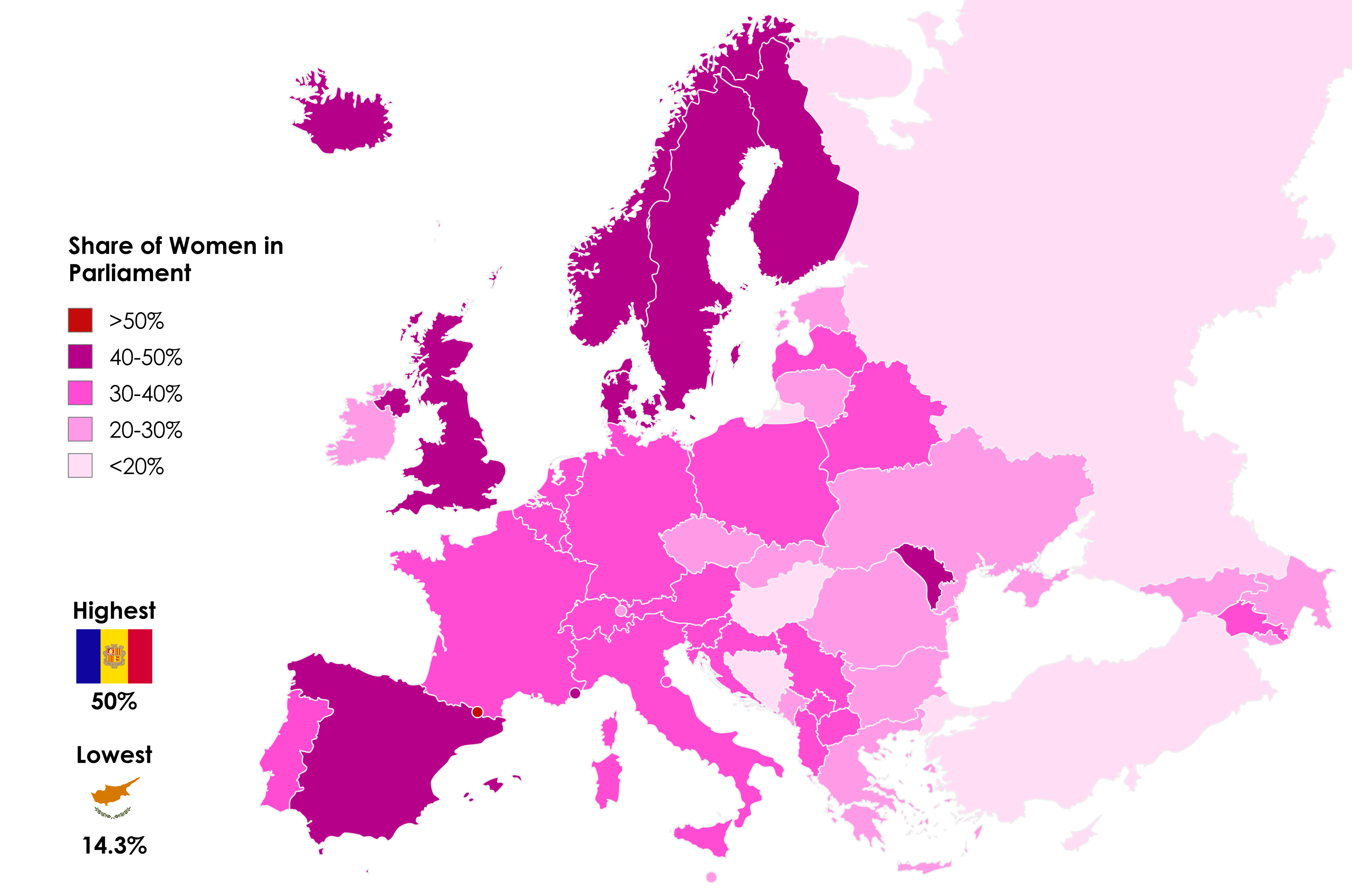
Only in Andorra the share of men and women are even, in all other European countries men outnumber women in parliament.
Highest: Andorra (50%) – Iceland (46%) – Monaco (45.8%)
Lowest: Cyprus (14.3%) – Hungary (15.2%) – Russia (16.4%)
European Average = 32.4%
Source = [https://www.ipu.org/resources/publications/reports/2025-03/women-in-parliament-1995-2025](https://www.ipu.org/resources/publications/reports/2025-03/women-in-parliament-1995-2025)
Correlation: the darker the purple, the higher the concentration of stunning Nordic women.
Yet another statistics where Hungary leading from behind, fuck yeah… …………….. …..*sigh*
Orbánék szerint egy keresztény, családbarát nőnek a konyhában a helye.
As a hungarian woman, I’m not surprised in the slighest.
This country hates us.
What’s up with Belarus? Wasn’t Lukashenko saying that politics is too serious of a job for a woman?
You guys know more collors and collorblind people exist yes?
I think this is something that’s blown out of proportion and ignores some key points:
First, women enter politics, especially top tier, much less. It’s a job that requires compromising your privacy, which will deter a fair share of women with underage children. As a result, there are far fewer female candidates.
Second, women make up half of the voter base, yet not half of the elected representatives, which means that women vote more for men than women as well. Especially when it comes to the more conservative parties that gain a lot of votes from older audiences (who are also more active in elections, at least in my country).
You can give priority votes – and female candidates of the Pirate Party had several women go up the ladder that way in the last elections – but the number of people who use them for this purpose isn’t that large. They’re used more in case several (typically smaller) parties enter under one banner, and people want members of a specific party to be elected.
And I don’t consider that a problem – for me, the key point is what priorities the party as a whole has. Who represents them isn’t something I’d think about, unless a candidate has been proven to be involved in something I consider problematic. I vote for a party, and for me, it’s their decision who they choose to represent their values.
Incorrect for Czechia – it’s 33% (67 out of 200) so a darker pink
neat, would be cool to know the proportion in the general population too, compared to the parliament (like, which sex is over represented? tho I personally think a 40-60 or 60-40 range is pretty good anyway)
What’s the story with Ireland?
Hungary had more women in the Parliament but as it turned out they were just cannon fodder in Fidesz, and other women on the opposite side became banished over the years by Fidesz…