
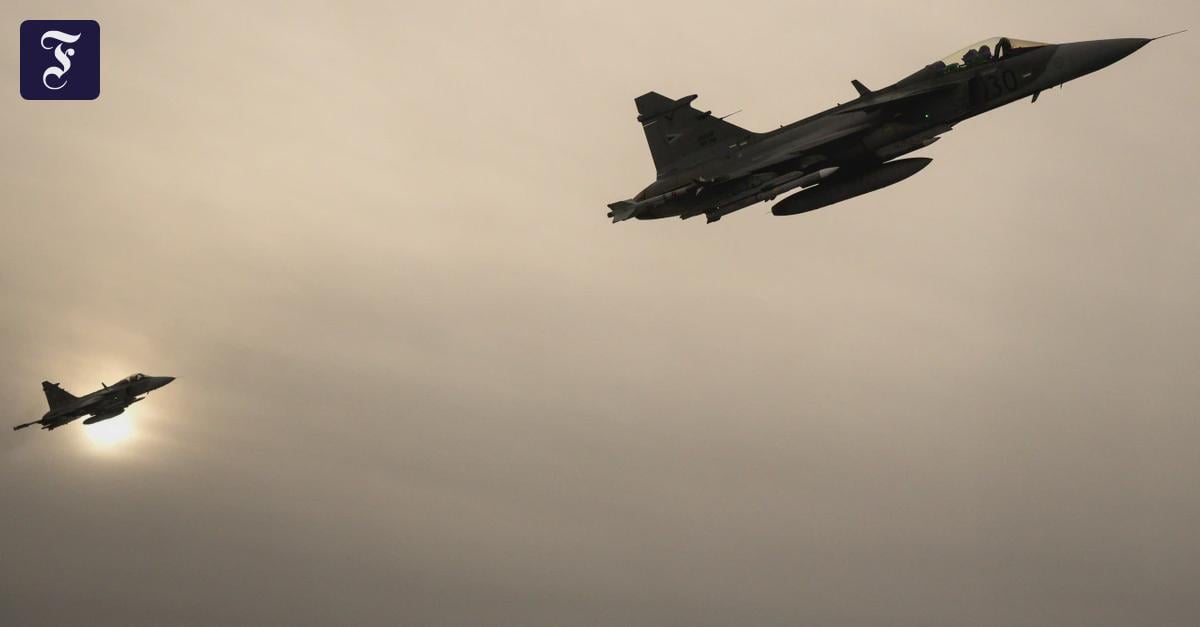
Il capo della Saab Micael Johansson: Siamo pronti per un futuro aereo da combattimento congiunto con i tedeschi
https://www.faz.net/aktuell/wirtschaft/saab-chef-micael-johansson-im-interview-ueber-europaeische-ruestungsprojekte-accg-110805783.html
di diamanthaende
11 commenti
Interesting interview with Saab boss Johanson about a potential FCAS alternative and the European military-industrial complex in general.
Here is a non-paywall link:
[https://archive.is/20251221113812/https://www.faz.net/aktuell/wirtschaft/saab-chef-micael-johansson-im-interview-ueber-europaeische-ruestungsprojekte-accg-110805783.html#selection-2563.0-2569.633](https://archive.is/20251221113812/https://www.faz.net/aktuell/wirtschaft/saab-chef-micael-johansson-im-interview-ueber-europaeische-ruestungsprojekte-accg-110805783.html#selection-2563.0-2569.633)
I will post a DeepL translation of it shortly.
**“We are ready for a joint fighter jet”**
As head of Saab, Micael Johansson leads one of Europe’s largest defense companies. Now he could become even more important for Germany.
Mr. Johansson, it has been almost four years since Russia invaded Ukraine. At that time, Europe promised to invest more in its defense. How far have we come so far?
We have built up our deterrence capabilities and better stocked our ammunition depots. But we still have a long way to go. We need better missile defense systems and must shift our focus even more from traditional systems such as tanks and guided missiles to new technologies. Different countries perceive the urgency very differently. Less is being done in southwestern and southeastern Europe. Others are really ramping up their production—I’m thinking of the countries in Scandinavia and the Baltic states, Poland, and Germany.
Many feel that progress on rearmament is still too slow—including the German defense minister, who has criticized the industry for this. Does he have a point?
The industry is used to having a lot of time and little money. We need to manage in a more decentralized way in order to grow. I tell my employees: Go out there and take risks. If you fail, okay, then learn from it and try again. We need a cultural shift towards speed being the most important thing. This applies to the entire system. Employees in the armed forces and procurement agencies are also used to completely different processes. Breaking down these structures and really speeding things up is quite difficult.
What would need to happen for new technologies to reach the troops more quickly?
In the case of drones, for example, it would make sense to dispense with a comprehensive and “perfect” definition of capabilities, as has been the case at the beginning of the procurement process up to now. Instead, several companies could be allowed to compete in parallel, demonstrating their capabilities in stages. Then the armed forces would get something they can actually use much more quickly. To achieve this, we need closer ties between the military and industry so that end users are involved in development. In the past, such closeness was considered problematic, but Ukraine has shown that it is necessary for modern capabilities.
You are talking to the Swedish Ministry of Defense about new procurement channels for drones. How would that work in practice?
The state would pay a monthly fee for our readiness to ramp up production at the push of a button. It would be like a subscription for drones. We would also commit to continuously modernizing the technology. The troops would initially receive something that is “good enough,” so to speak, and then we would gradually develop the product further—as with an iPhone. This could involve software, but also new sensors or weaponry. This would allow the armed forces to actually practice with the drones and develop deployment concepts.
Saab generates around 40 percent of its sales in Sweden. How important is the German market for you?
Germany is a key country for us in Europe. We have been a proud partner of the German armed forces for more than 40 years, have production facilities there, and work closely with companies such as Diehl Defence. We want to continue to grow in Germany. However, competition from the German defense industry is fierce, and the German army procures a lot domestically. For Saab, this means that we need to have an even stronger local presence and transfer technology, build capabilities, create jobs, and so on.
>Installing a different engine in a fighter jet would be a major undertaking and certainly not a cost-effective solution.
I’m glad he came out and say this so that all the people who think the GE F414 engine in the Gripen can be easily replaced can see.
Interesting interview with Saab boss Johanson about a potential FCAS alternative and the European military-industrial complex in general.
I posted a DeepL translation of the non-paywalled version below, can’t link to it as it is banned in this sub.
I think the most interesting part of the interview, besides the FCAS related parts, is the point that the US military-industrial complex is actually dependent on Europe, too, and not just as a market. This is a point that is often “forgotten”.
Amazing news!!!! Bravo!
Notice how they are all contacting Germany to join (UK, now Sweden), rather than France? With all the digs at Germany and Airbus as of late, I think the actual problem is rather France (Dassault).
**edit**: immediate loads of excuse answers and selective readings of the Saab interview. Seems no one read him say; “**I am sure that you see this in Germany in a similar way**: a cooperation must not mean that you become completely dependent on each other.”
Saab angling to get more contracts as it should be. The Swedish government so far has said no to any collaboration that would relinquish Sweden specifications (which are closer in weight to what France wants rather than what Germany needs)
It will be interesting to see if Saab makes the Swedish gov change their mind.
>another prerequisite is that we can continue to build fighter aircraft systems independently and do not have to hand over half of these competencies to another company.
It should tell you everything from it being even mentionned, same way as GCAP members are fine welcoming Germany as long as it is only a customer and does not disrupt anything.
>Saab definitely has the necessary capabilities. That is precisely why we are relaxed about possible collaborations; we are not dependent on a partner. Nevertheless, we are not closing any doors. We are ready to develop a joint fighter jet with the Germans – provided there is a clear political commitment from both governments. Another prerequisite is that we can continue to build fighter aircraft systems independently and do not have to hand over half of these competencies to another company.
That’s a pretty tall statement from a company that is not, in fact, able to build fighter aircrafts ‘independently’, unless by ‘build’ he means ‘assemble’. Just like Germany Sweden cannot independently build jet engines (Saffran and Rolls-Royce are the only European companies capable of that) and the Gripen is almost more foreign parts than Swedish: American engine, British avionics, Italian IRST and radar …
It’s great that they’re still doing their own thing as such a small country, but a German-Swedish-Spanish cooperation would still need to find an engine somewhere, or develop one (which takes ages).
This is fantastic! It’s a real benefit now that Sweden has joined NATO… I think there would be real synergies that will come from the greater integration of Sweden in the defence of Europe, Working with Germany and with France and other European partners. It’s important that Europe grows to be totally independent of the United States.
I’d say Välkommen från Tyskland.