
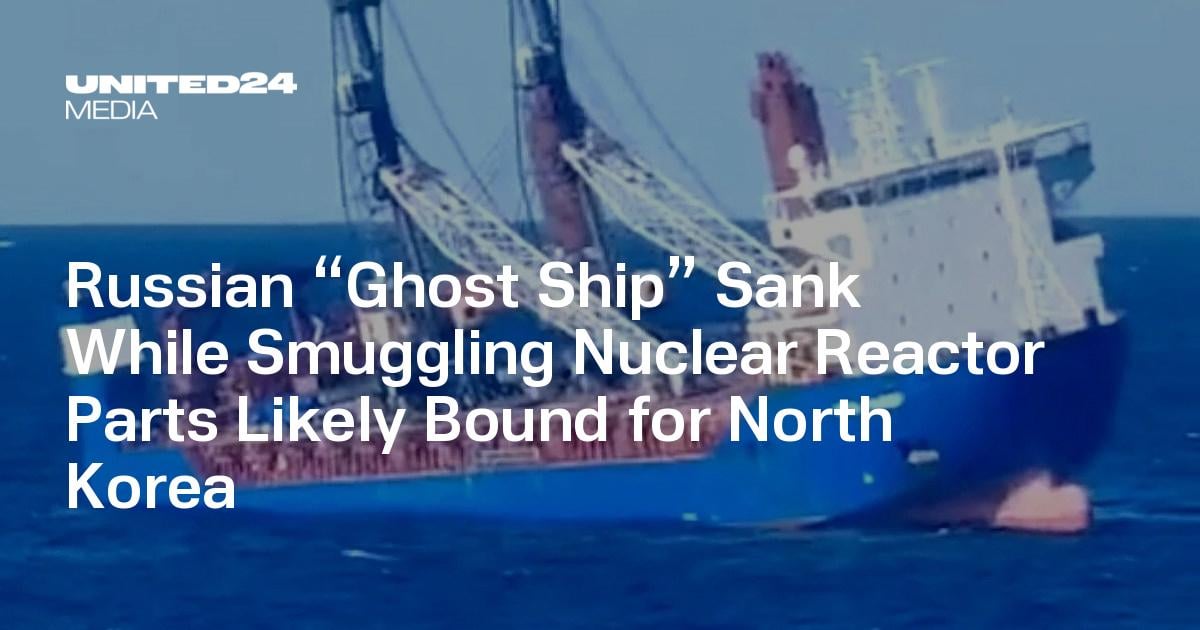
La “nave fantasma” russa è affondata al largo della Spagna mentre trasportava parti di reattori nucleari probabilmente dirette alla Corea del Nord
https://united24media.com/latest-news/russian-ghost-ship-sank-while-smuggling-nuclear-reactor-parts-likely-bound-to-north-korea-14622?ICID=ref_fark
di ByGollie
12 commenti
It’s that ship that sank a year ago, not a new one.
Who should be said “Thank you” now?
The VM-4SG reactor on board that ship is designed for nuclear submarines, so now we know how NK is so confident it can build a nuclear attack submarine.
[Spanish language article (paywalled)](https://www.laverdad.es/murcia/cartagena/barco-ruso-hundido-frente-cartagena-ocultaba-dos-20251228071129-nt.html)
The sinking happened exactly a year ago – and it was **sunk by a torpedo**, likely launched from a **western submarine**
> The mysterious sinking of the cargo ship ‘Ursa Major’, part of Russia’s so-called ghost fleet, 60 miles off Cartagena, fueled numerous conspiracy theories exactly one year ago, with the war in Ukraine and the power struggles between world powers as a backdrop. However, a year later, investigations by Spanish authorities have revealed that the reality far surpasses even the most optimistic scenario that could be written about an episode of hybrid and asymmetric warfare during years of reconfiguration of a new world order. Russian authorities claimed that the merchant ship, which was traveling an unusual route between St. Petersburg and Vladivostok through the Mediterranean with a supposedly low-value cargo, sank after suffering three explosions in its engine room, attributed to a terrorist act. But the official version, obtained by LA VERDAD, confirms that the incident had many more facets, elements, and protagonists than had been previously revealed.
>
> A submarine from a Western country may have caused the incident to prevent the clandestine delivery of two nuclear reactors to North Korea. The Russian armed forces are also believed to have played a role in destroying evidence, although the trail left between 3:00 PM on December 22nd and 1:00 AM on December 24th has allowed Spanish authorities to develop a theory that has gained official recognition.
>
> It all began on December 21st. That day, the maritime control and rescue center in Almería detected erratic movements in the course of a Russian-flagged cargo ship called the ‘Ursa Major’ sailing in its area of responsibility. On the 22nd, at 3:10 p.m., the same ship lost speed and veered sharply to port for no apparent reason, prompting controllers to contact it for the first time to find out what was happening. “Nothing, everything’s fine,” replied the officer in charge of radio communications. But the technicians in Almería weren’t reassured by the response and continued monitoring it. They weren’t the only ones watching this strange navigation. Western intelligence services were also keeping a close eye on it, since it was well known that the ‘Ursa Major’ belonged to the Russian phantom fleet—civilian ships at the service of the armed forces—and frequently transported weapons and ammunition to the Russian base in Tartus, Syria, during the civil war in that country.
>
> Spanish maritime authorities observed the cargo ship approaching the coast of Almería at a speed of two knots before its engines stopped. However, it still did not request assistance. It did so the following day, December 23, at 11:53 a.m. At that moment, a “mayday” call, or distress signal, was received at the Cartagena search and rescue center. The call had arrived via satellite from Australia and was relayed from the center in Valencia. The “Ursa Major” was in distress in international waters, 60 nautical miles (110 kilometers) from Cartagena. Given the lack of response from the Algerian authorities, who were turning a blind eye, the maritime captain, Óscar Villar, in accordance with international law, declared himself competent to coordinate the rescue and salvage operations. He immediately mobilized the tugboat “Clara Campoamor,” the fast rescue boat “Salvamar Draco,” and the Helimer 205 helicopter from Almería.
>
> Arrival of the shipwrecked men at the port of Cartagena. In the foreground, Captain Vladimirovich. JM Rodríguez
> The first rescuers to reach the ‘Ursa Major’ found the ship listing heavily to starboard. In his initial communication with Cartagena, the merchant ship’s captain, Igor Vladimirovich Anisimov, stated he was unsure of what was happening and had therefore ordered the crew to board a lifeboat. He reported fourteen sailors on board, but two were missing due to explosions in the engine room.
>
>
> Another merchant ship in transit through the area, the ‘Oslo Carrier III’, received instructions from the Maritime Authority to also assist the shipwrecked sailors until Spanish rescuers could take charge. Meanwhile, the Spanish Maritime Rescue Service informed rescue centers in Australia and Moscow of the ongoing operations. At that time, the authorities’ only concern was the safety of the survivors, as well as the potential oil spill in case of sinking. The ship was carrying 380 tons of heavy fuel oil and the same amount of diesel in its tanks.
>
> But the situation grew increasingly complicated. The shipping captain questioned Vladimirovich about the cargo. Vladimirovich claimed it consisted of 129 empty 40-foot (12-meter) containers, five 20-foot containers with spare hatch covers, two Liebherr cranes, and two clamps for an icebreaker under construction. At that moment, the Spanish authorities asked themselves the million-dollar question: Why would a ship cross half the planet to transport empty containers and parts that could be transported by road or rail, saving considerable time and money?
>
> The recent history of the ‘Ursa Major’ was troubling: it was routinely used to transport weapons and ammunition. Nothing new, but it added suspicion and unanswered questions to the situation. Furthermore, aerial images of the ship revealed two blue containers on the stern deck that didn’t match what the captain had declared in the cargo manifest. They also reviewed the video recorded with a tripod by the Helimer rescuer who entered the ‘Ursa Major’ in search of the two missing men: the second chief engineer, Nikitin, and the oiler, Yakovlev. The rescuer noticed a strange detail: the engine room door was locked tight. The ‘Ursa Major’ was still afloat. But the two mechanics were nowhere to be seen. Another mystery to add to the already complex situation.
>
> The fourteen survivors arrived at the port of Cartagena almost at midnight on December 23rd, terrified by what had happened and what might happen next. At the Santa Lucía dock, they were attended to by Red Cross personnel. While the initial paperwork for their repatriation was being processed, the maritime captain summoned Vladimirovich for questioning. It was a formality, but also a necessity given some unclear aspects of the situation. The interrogation, conducted under international law, was carried out by Villar, who discovered that the Russian sailor was withholding details. He asked for time to think and, with a worried expression, shared comments in his language with one of his officers. Villar pressed him, asking about the two blue bundles they were carrying on the stern, each estimated to weigh 65 tons. These would therefore be two loads almost impossible to transport along the winding roads of Russia, Kazakhstan, Uzbekistan, and Afghanistan between the two cities served by the ‘Ursa Major’. That mysterious undeclared cargo would justify a journey of more than 15,000 kilometers by sea between St. Petersburg and Vladivostok.
> Spanish authorities began to piece together the puzzle. Vladivostok is located in the Pacific, near the border with North Korea. Five months earlier, Putin and Kim
> Jong-un had agreed to assist each other in exchanging military personnel and weapons for nuclear technology, circumventing international agreements and sanctions against the North Korean regime. After much questioning and being warned about his responsibility, the captain of the ‘Ursa Major’ finally declared in writing that he was not carrying any dangerous cargo or weapons on board, although he did have “two manhole covers.” He stated that at 11:50 a.m. on the 23rd, there were three explosions on the starboard side. Near frame 41, at a height of about 35 centimeters, he found a hole approximately 50 centimeters by 50 centimeters, with the edges facing inwards. This was an unmistakable sign that the metal had been perforated from the outside in. This incident caused the ship to lose speed and, ultimately, control.
> The investigation and another statement from the Russian captain concluded that the mysterious cargo guarded aft of the ‘Ursa Major’ was not manhole covers, but rather the casings of two VM-4SG nuclear reactors. Aerial images also revealed coolant and steam pipes, among other components of the complete reactor system. What remains uncertain is whether both reactors contained nuclear fuel. In official documents, Spanish authorities assume they did not, based on what would happen hours later.
Who in their right mind sells these things to North Korea? Even by dictatorship standards Kim Jong Un is crazy.
Couldn’t have sent it from the east instead?
Wild mix of Russia, Spain, and North Korea in one story. Makes you wonder how many similar shipments we never hear about. Worth double-checking original reports though, headlines often oversimplify.
Now its a sunken ghost ship
Maybe I’m stupid, but why would Russia send stuff to North Korea via the Mediterranean sea? They share a border
Is this already an escalation or not?
Sight, Russia and north korea share a border, they don’t need to send, specially something so “sensitive”, half of the globe through the mediterranean where they can get interdicted by anyone.
Also, la verdad is an online tabloid with zero credibility, this is probably false. But hey united24 can use it to get some engagement….
Spain: “Please stop losing nuclear tech around me, not the first time”