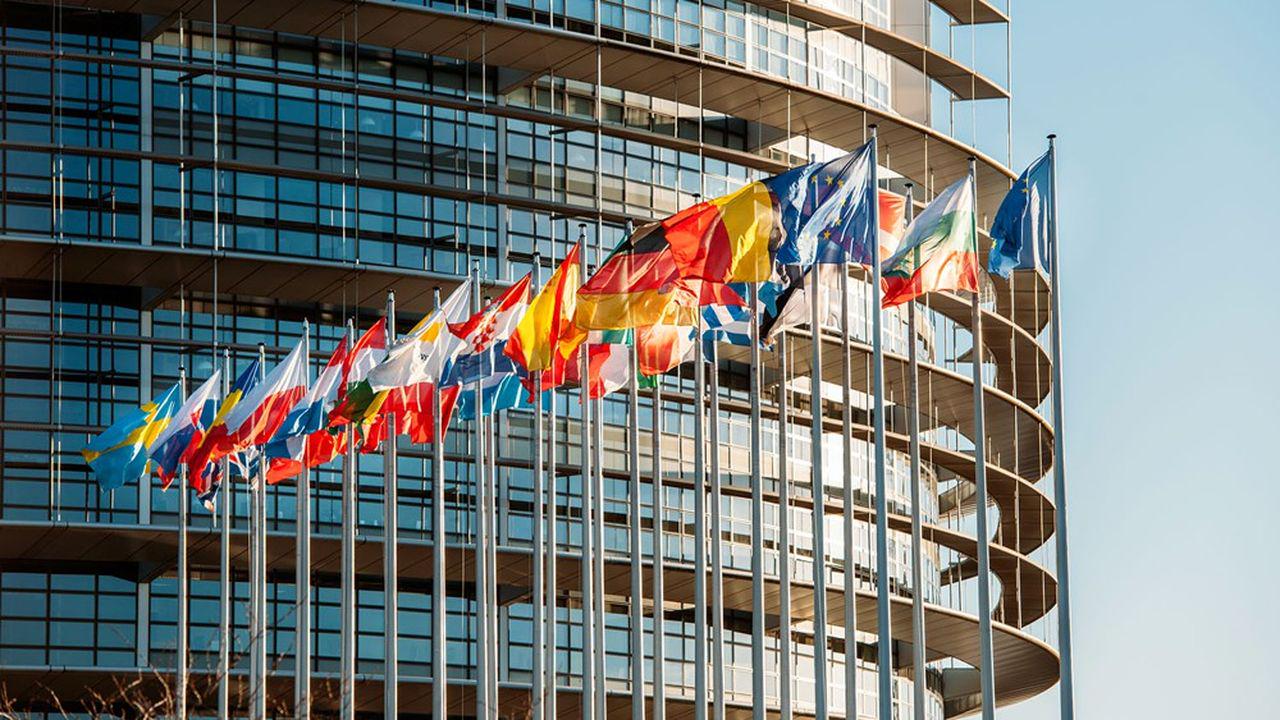
Con le spalle al muro, l’Europa deve abbracciare il federalismo
https://www.lesechos.fr/idees-debats/editos-analyses/au-pied-du-mur-leurope-doit-gagner-en-federalisme-2213698
di goldstarflag

Con le spalle al muro, l’Europa deve abbracciare il federalismo
https://www.lesechos.fr/idees-debats/editos-analyses/au-pied-du-mur-leurope-doit-gagner-en-federalisme-2213698
di goldstarflag
20 commenti
Economically, with 23% of global GDP, an enlarged Europe (including Britain and Switzerland) is almost on the level of the United States (26%) already and well ahead of China (16%). Its companies also have a strong presence on international markets: in the latest Fortune 500 ranking of the world’s largest companies, we are on a par with the American and Chinese giants.
But it is a fact, and we can ‘thank’ Donald Trump, Xi Jinping and Vladimir Putin for dispelling our illusions: at a time of this massive and belligerent return of empires, our political impotence cannot continue. With each crisis, Europe is slow to react. With each threat, it responds in a disorganised manner.
It must be said that its hybrid governance, based on three political bodies – the European Commission, the European Parliament and the European Council representing the states – leads to inertia and complexity that are hardly compatible with the demands of the moment. This has been evident in our procrastination surrounding the war, our naivety in the face of Beijing’s commercial aggression, and our differences over how to respond to Washington’s sabre-rattling.
The diagnosis has long been made, and we are doomed to decline if we do not react quickly and vigorously. To this end, strengthening the single market, reducing national regulations and bureaucracy, and integrating financial, telecommunications and energy systems are essential short-term objectives. But the real issues now go beyond the economic sphere alone. It is the political status quo that is no longer tenable, especially since many of our fellow citizens perceive today’s Europe as ineffective, talkative and illegitimate.
The other path, mentioned in particular by Mario Draghi, is that of moving towards true federalism, with a pragmatic first phase: a coalition of willing states ready to move forward together in strategic areas such as advanced technologies, defence and critical infrastructure. Deeper integration would see a strengthened European executive – while reaffirming the principle of subsidiarity – finally enabling challenges that transcend national borders to be addressed at the appropriate level and giving it a power to act that does not currently exist.
A survey conducted in Italy at the beginning of this year sheds some light on the situation: 61% of those questioned said they were in favour of moving towards a federal union – a position held by a large majority, including within Giorgia Meloni’s Fratelli d’Italia party. Only 4% of respondents are in favour of maintaining the status quo.
Europe doesn’t lack federal structures.
It lacks a reason for people to believe those structures work for them.
There’s too much nationalist ego for the EU to federalize. Perhaps if the major players had planned it before 1990.
its only politicians that dont want it cause it would be ridiculus and obsolete to have 27 presidents and 27 PMs
In such an arrangement, Europe’s smaller and less affluent countries risk feeling as they did under the USSR, where only the Kremlin’s opinion mattered and local discontent was successfully suppressed.
After all, everyone understands that all decisions will be made by just 5 or 6 European countries. The compromises will be struck between them, and the rest will be left with whatever scraps those powers deign to toss their way.
Yeah no. Too many different cultures and languages for federation to work.
No, it must not.
It is funny how the solution is always „more EU“. Are there really, truly no problems that would be better solved with „less EU“?
Example: interest rates should obviously not be the same in Germany and Greece
I feel like instead of focusing on federalization and possibly undermining the sovereignty of smaller member states, the EU needs to form a united military.
The EU needs to serve the member states, not the other way around.
No way
Why is this sub pushing for fed so bad???
Sounds like propagandists pushing federalism because they know it would be the end of the western alliance entirely.
They want a socialist color revolutions to bring in new governance that will sell Europeans out to China as vassals. If Europe goes along with this their lands will be colonized by globalist interests that want to tear the cultural heritage of Europe apart to be replaced with a unitary one world culture that cannot be questioned.
>With its back against the wall, Europe must embrace federalism
First and above Europe needs to make sure nazis, extreme-right and other shitheads cannot grab power when Europe would federalize. Looking at the USA as an example…
The EU acts as a Federal institution now. Why us Brits voted out……
You will embrace the death
Has it ever occurred to anyone that Europe is being driven into a corner, so it acts in certain ways and considers doing certain things?
I’m not arguing for or against federalization btw. Just feel like people may be jumping the gun…
No. Fuck this fedaral retardation that has been pushed on reddit the last week.
Seems like someone is grifting and cashing in on political turmoil to push this agenda.
Europe will NEVER federalize.
I think it should. But I speak four languages, have a strong grasp and my culture, and moved around Europe. I am not Europe, I am a special case. Nationalism, elitism and populism is way more prevalent in both people and politicians than redditors think (only because we tend to stay in specific bubble subs).
No fuck the undemocratic anti-nationalistic anti-European anti-white socialist totalitarian EU.