L’Europa non è così debole come sembra – Una nuova visione dell’integrazione europea sta lentamente ma inesorabilmente prendendo forma
https://www.ft.com/content/52d2b108-7a9e-4558-abb3-920adc60bf24
di goldstarflag

L’Europa non è così debole come sembra – Una nuova visione dell’integrazione europea sta lentamente ma inesorabilmente prendendo forma
https://www.ft.com/content/52d2b108-7a9e-4558-abb3-920adc60bf24
di goldstarflag
1 commento
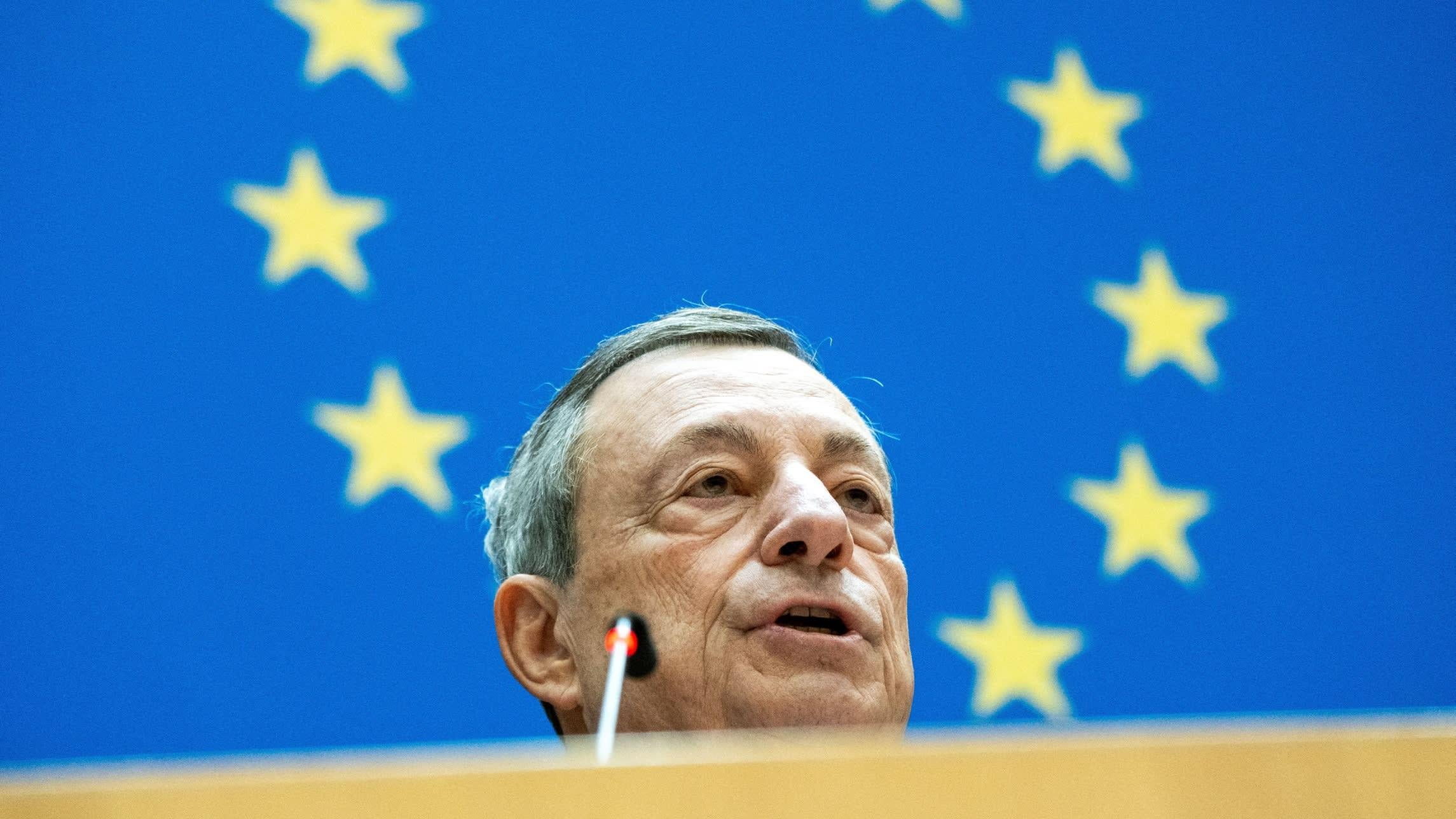
Former Italian prime minister and European Central Bank chief Mario Draghi says that, of those caught between the US and China, Europe alone can become a genuine power itself.
Many were mesmerised by Canadian Prime Minister Mark Carney’s Davos speech three weeks ago. He told “middle powers” to drop the pretence that the US-founded rules-based order delivered what it promised, and to pair up with like-minded countries when and where they could.
But in a speech in Leuven last week, Europe’s supreme elder statesman, Mario Draghi, saw Carney’s hand and raised it. The old order is indeed “defunct”, he said — but not “because it was built on illusion. It delivered real and widely shared gains.” What it could not survive was the willed weaponisation of economic interdependence. The EU’s response — strengthening domestic capabilities while seeking deeper relationships where possible — is very Carneyesque. But, Draghi warned, this can only ever be a “holding strategy”.
The reason? “Individually, most EU countries are not even middle powers capable of navigating this new order by forming coalitions,” Draghi said. “[But of] all those now caught between the US and China, Europeans alone have the option to become a genuine power themselves.” In short, Europe is not Canada: it must either accept the greatness being thrust upon it, or be divided and ruled.
But how? Draghi’s answer is a “pragmatic federalism” — where EU members willing to share more sovereignty opt in to unite in as many areas as they can find ways to progress in. On the ground, this approach is already being put to the test.
Take the Spanish-led “competitiveness lab” initiative, open to EU members keen to accelerate common rules for financial markets. Perhaps in reaction, the finance ministers of the six largest EU economies recently vowed to forge agreements between themselves. To rebut the inevitable charge that this is a wreckers’ initiative, however, the group had better produce serious progress fast.
In security and defence, the new Safe common borrowing facility covers only about half of EU countries (and includes a few non-EU ones). Strong proposals now exist for coalitions of willing European capitals to jointly fund and build strategic military capacities previously provided by the US. In macro policy, leaders have agreed to issue new EU bonds (for Ukraine) but with side payments to let unwilling countries in effect opt out.
The increasingly geopolitical approach to EU enlargement supports a similar “pragmatically federal” logic. As the FT reports, the high stakes surrounding Ukraine’s future have provoked discussion of turning the current accession process on its head. Instead of crowning a long process of EU alignment, membership would instead come first, but with only core rights and obligations. More would be added gradually as and when the new member gets through the required reforms at home.
Such a template could invigorate talks with other EU candidates, including Turkey, whose long-frozen relationship with the bloc has been showing faint hints of a thaw. A less binary membership path could also be attractive to Iceland, due a referendum soon, Norway and even the UK. If the eventual result is a larger EU but one of many speeds, it would be not by design but through the organic growing together of those wanting to do more in common.
Draghi offers two insights in response.
First, lack of unity is not an argument for waiting to act: “Unity does not precede action; it is forged by taking consequential decisions together, by the shared experience and solidarity they create, and by discovering that we can bear the result.” When Europeans dared to jointly push back against Donald Trump’s claim on Greenland, they were forced to “carry out a genuine strategic assessment”, and the “willingness to act” clarified “the capacity to act”.
Second, Europe’s necessity to bring people on board — the demands of a union of national democracies — is itself a precious value. Where the US system lets the executive ram its will through and China happily pushes the cost of its economic advance on to other economies, Draghi points out that “European integration is built differently: not on force, but common will; not on subjugation, but shared benefit”.
Europeans are, slowly but surely, waking up to what they are able to do. Something a senior EU minister said to me recently is typical of this shift: “Europe is not as weak as it behaves.”