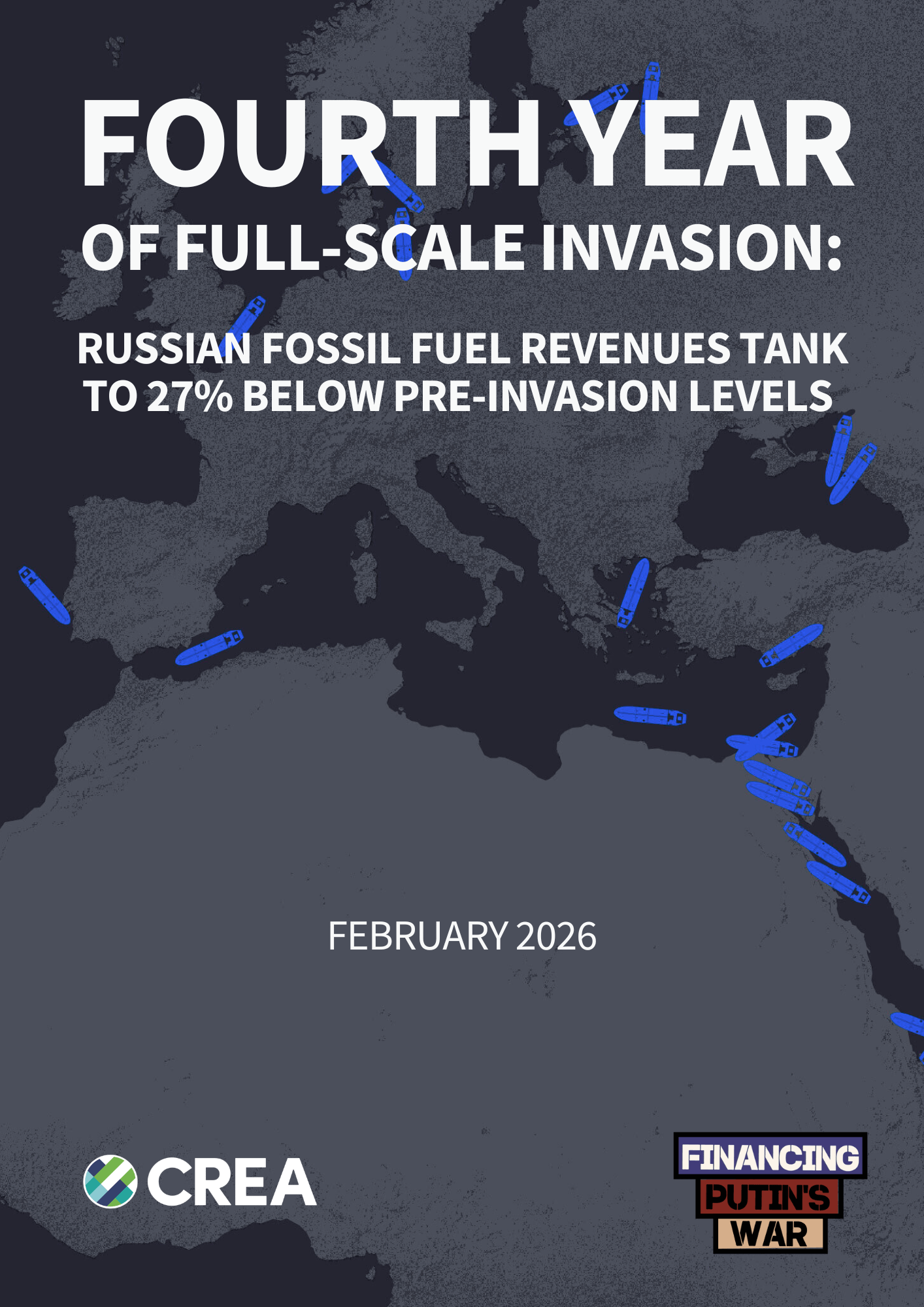
Quarto anno di invasione su vasta scala: i ricavi russi dai combustibili fossili scendono del 27% rispetto ai livelli pre-invasione
di OldKing7272

Quarto anno di invasione su vasta scala: i ricavi russi dai combustibili fossili scendono del 27% rispetto ai livelli pre-invasione
di OldKing7272
3 commenti
>This year marks four years since Russia launched its full-scale invasion of Ukraine and the Centre for Research on Energy and Clean Air (CREA) began [tracking Russia’s fossil fuel revenues and trends](https://www.russiafossiltracker.com/) that are [financing Putin’s war](https://energyandcleanair.org/financing-putins-war/) on Ukraine.
>One year ago, CREA pointed out that the [EU had spent more on Russian fossil fuels than aid to Ukraine](https://energyandcleanair.org/publication/eu-imports-of-russian-fossil-fuels-in-third-year-of-invasion-surpass-financial-aid-sent-to-ukraine/), and in early January of this year, [CREA’s Russian fossil tracker passed EUR 1 trillion](https://www.youtube.com/shorts/3YO4CSxRDQk).
>Despite these numbers, in the fourth year of the full-scale invasion of Ukraine, Russia’s revenues from fossil fuel exports dropped 19% year-on-year, and are now 27% below pre full-scale invasion levels. Russia’s revenues from fossil fuel exports in the fourth year of the invasion totalled EUR 193 bn, and the EU’s imports specifically totalled EUR 14.5 bn, a substantial 36% year-on-year reduction.
>[…]
>Sanctioned tankers transported virtually none of Russia’s seaborne crude exports in the first quarter of 2024. By the fourth quarter of 2025, they carried over 60%, illustrating how Russia remains dependent on sanctioned tankers and has been unable to replace them with unsanctioned tonnage. For Russian crude, volumes transported by G7+ owned or insured tankers held relatively steady at around 29% through the year.
>Russian revenues from crude oil sales dropped by a significant 18% year-on-year (EUR 85.5 bn) while volumes dropped by a less stark 6% (215 mn tonnes). Export volumes continued to remain 6% above pre-invasion levels, highlighting how G7+ sanctions on the ‘shadow’ fleet have failed to cut supplies, even while forcing deeper price discounts on their oil sales. The three largest buyers — China, India and Turkiye — accounted for 93% of Russia’s crude exports in this period, receiving a total 201 mn tonnes valued at EUR 79.7 bn.
>‘Shadow’ vessels operating under false flags grew from 12 at the start of 2025 to a peak of 109 in October — a more than nine-fold increase. By January 2026, they had declined to 81 and a mere three vessels adopted false flags in January, compared to 32 in July 2025.
>[…]
There’s still room to grow!
[https://inspectioneering.com/media/image/News/2026/EIA%20-%20Monthly%20Crude%20Oil%20Prices%20(1_5_26).png](https://inspectioneering.com/media/image/News/2026/EIA%20-%20Monthly%20Crude%20Oil%20Prices%20(1_5_26).png)
[https://www.eia.gov/todayinenergy/images/2024.02.12/main.svg](https://www.eia.gov/todayinenergy/images/2024.02.12/main.svg)
Whilst the sanctions do hurt their bottom line their revenue is still above 2019-2020 levels (2019 their fossil fuels revenue was ~$160 billion annually vs ~$230 billion in 2025), it seems the the biggest drop form 2022 wasn’t the sanctions but the gas and oil prices going down from their peak.