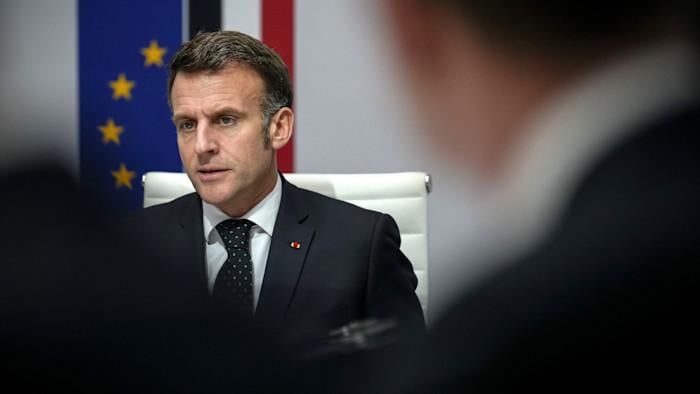
La Francia si offre per la prima volta di posizionare armi nucleari in Europa
https://giftarticle.ft.com/giftarticle/actions/redeem/43ec7fba-e8ac-4242-aa81-16eb0def9ab2
di dainomite

La Francia si offre per la prima volta di posizionare armi nucleari in Europa
https://giftarticle.ft.com/giftarticle/actions/redeem/43ec7fba-e8ac-4242-aa81-16eb0def9ab2
di dainomite
18 commenti
It’s a gift article so everyone should be able to read it, in case here’s the article too.
>Emmanuel Macron has said France could move temporarily nuclear warheads abroad for the first time, as he pledged to increase the size of the country’s arsenal.
On Monday, he laid out a new doctrine of “forward deterrence” that would involve deeper co-operation between France and seven other European countries including Germany and Poland.
It would also allow European partners to take part in exercises or deploy their conventional armies on support missions.
“Today a new step of France’s deterrence can now be taken. We are entering the path of what I call forward deterrence,” the French president said in a speech at the Île Longue base, which houses the country’s nuclear-armed submarines.
“It will finally provide for the temporary deployments of elements of our strategic air forces to allied countries,” he added.
Macron invited other European countries to engage in a “strategic dialogue” with France over nuclear deterrence in 2020 but his offer was largely rebuffed.
Russia’s full-scale invasion of Ukraine and doubts over US commitment to European defence following Donald Trump’s return to the White House last year have prompted an urgent rethink in European capitals.
The developments have prompted the French president to flesh out how France’s nuclear deterrent could help protect the rest of Europe.
France said in-depth talks had already been conducted with Germany, Poland, the Netherlands, Belgium, Greece, and Sweden, and they were willing to move ahead with deeper co-operation.
“This is genuine strategic convergence between our countries [aimed] at giving real depth to the defence of our continent,” Macron said.
But he emphasised that the key aspects of French deterrence, no shared decision-making and absolute autonomy for France, would stay the same.
Macron’s remarks came hours after a suspected Iranian drone struck a British RAF base in Cyprus, in the first such attack on European soil after US-Israeli air strikes killed Iran’s supreme leader, Ayatollah Ali Khamenei, over the weekend.
Ahead of the French President’s Speech on Nuclear Deterrence
Today, the President of the French Republic will deliver a long-awaited speech on France’s nuclear deterrence. Let’s be clear: this is not about politics or campaigning—it’s about the President’s constitutional duty and the strategic responsibilities of the office.
Every French president has addressed nuclear deterrence during their term. This is not a matter of personal choice; it is a highly regulated, expert-driven process, backed by decades of research by scientists, military strategists, and defense experts. The President does not act alone or on a whim in this domain.
A Few Fundamentals to Remember
Too often, public debate on this issue is poorly informed. So, let’s recall some basics:
• French nuclear deterrence is based on strict sufficiency. We possess around 300 nuclear warheads.
• Air-launched missiles (ASMP-A): About 50 of these can be carried by Rafale jets of the Strategic Air Forces (FAS). Each missile carries a 300 kt warhead (for comparison, the bombs dropped on Japan were 15 and 20 kt).
• Submarine-launched ballistic missiles (M51): Our nuclear-powered ballistic missile submarines (SNLE) carry 16 M51 missiles each, with each missile capable of carrying 8-10 warheads (100 kt each) and a range of over 8,000 km.
• At any given moment, at least one SNLE is on patrol out of the four we operate.
• Rapid response: Our FAS can be airborne with nuclear missiles in about 30 minutes.
The Logic of Deterrence
The purpose is to ensure that any potential adversary knows France can and will respond to an existential threat. The doctrine is clear: France reserves the right to strike first if its vital interests are threatened. This is partly because France is geographically closer to potential nuclear adversaries than the US.
How Would a Nuclear Crisis Unfold?
1. Diplomatic efforts to de-escalate.
2. Mobilization of FAS: Pilots and aircraft are put on standby, ready to launch within minutes. This is a strong signal to all nuclear powers.
3. Demonstration strike: A non-lethal strike (e.g., in the ocean) to show resolve.
4. Final decision: If necessary, a strike on strategic targets.
Why Sharing Nuclear Weapons Is Unlikely
Some speculate that France might share its nuclear arsenal with European allies. This is highly improbable for several reasons:
• Technical complexity: Integrating ASMP-A missiles onto foreign aircraft is not straightforward; it requires secret defense systems and extensive training.
• Presidential control: Only the French President can authorize a nuclear strike.
• Strategic independence: France’s nuclear deterrence is designed to be sovereign and independent.
Why European Allies Won’t Develop Their Own Nuclear Weapons
• Cost and time: Developing a nuclear arsenal is extremely expensive and time-consuming.
• Non-Proliferation Treaty (NPT): Violating the NPT could trigger proliferation elsewhere and risk preemptive strikes from adversaries.
• Technical barriers: Building and maintaining delivery systems (like our M51 missiles) requires advanced, specialized infrastructure.
In Conclusion
Informed debate is crucial. If you want to understand nuclear deterrence, consult official reports from the Ministry of the Armed Forces, expert analyses, and conferences—not pundits or partisan media.
Educate yourself. Form your own opinion.
Édit : written in French and translated by mistral AI le chat 🐱
Édit 2 : I translated it with a tool because its a very spécific topic and I didnt want to make mistakes in the vocabular when its such a precise vocabular
Merci
Good. Nuclear retaliation is the only thing that’s going to keep Russia from invading Europe.
The Netherlands hosts US nukes, i see no reason why 50% of those should not be replaced by french ones.
Saves the US money, increases France’s influence, and makes dutch protection more diverse.
That’s a strong statement. Let’s wait and see what consequences it brings.
The real news in this is that Macron is announcing that France’s nuclear arsenal will be increased. He intends to cover and protect Europe with *new* nukes, not just share and divide the current stockpile. That’s excellent.
And will his successor do the same ?
Danish PM having a press conference tonight on this. French nukes in Denmark perhaps?
good, this is the only language that that kremlin rat understands. and it’s also good that these capabilities are actually in the hands of reliable Europeans and not some volatile cowboy who treats the international relations arena like some dumb reality show.
Ideal. Mushroom baguettes for europe
pls gibs one to Estonia
worst case scenario – we can enrich our pickles with it
We’ll take some in Canada too, thanks.
We can station them in Windsor, right across the bridge from Detroit.
Gotta keep alive the French delusions of grandeur somehow
Lip service from Macron, who will be gone in 2027, is welcome but not sufficient. The EU needs more than one actor with operational control. Hopefully the EU isn’t naive enough to put all its eggs into one unstable basket again, but I suspect its another case of charisma triumphing over rationality.
It’s the right move. If Russia has deployed nuclear weapons in Belarus, nothing is stopping you from deploying them in the Baltic states. Best defense.
For those interested, here is the full speech translated live by France24 on [Youtube](https://youtu.be/qSIjEKTJt3I).
March 2025, the time for action is now