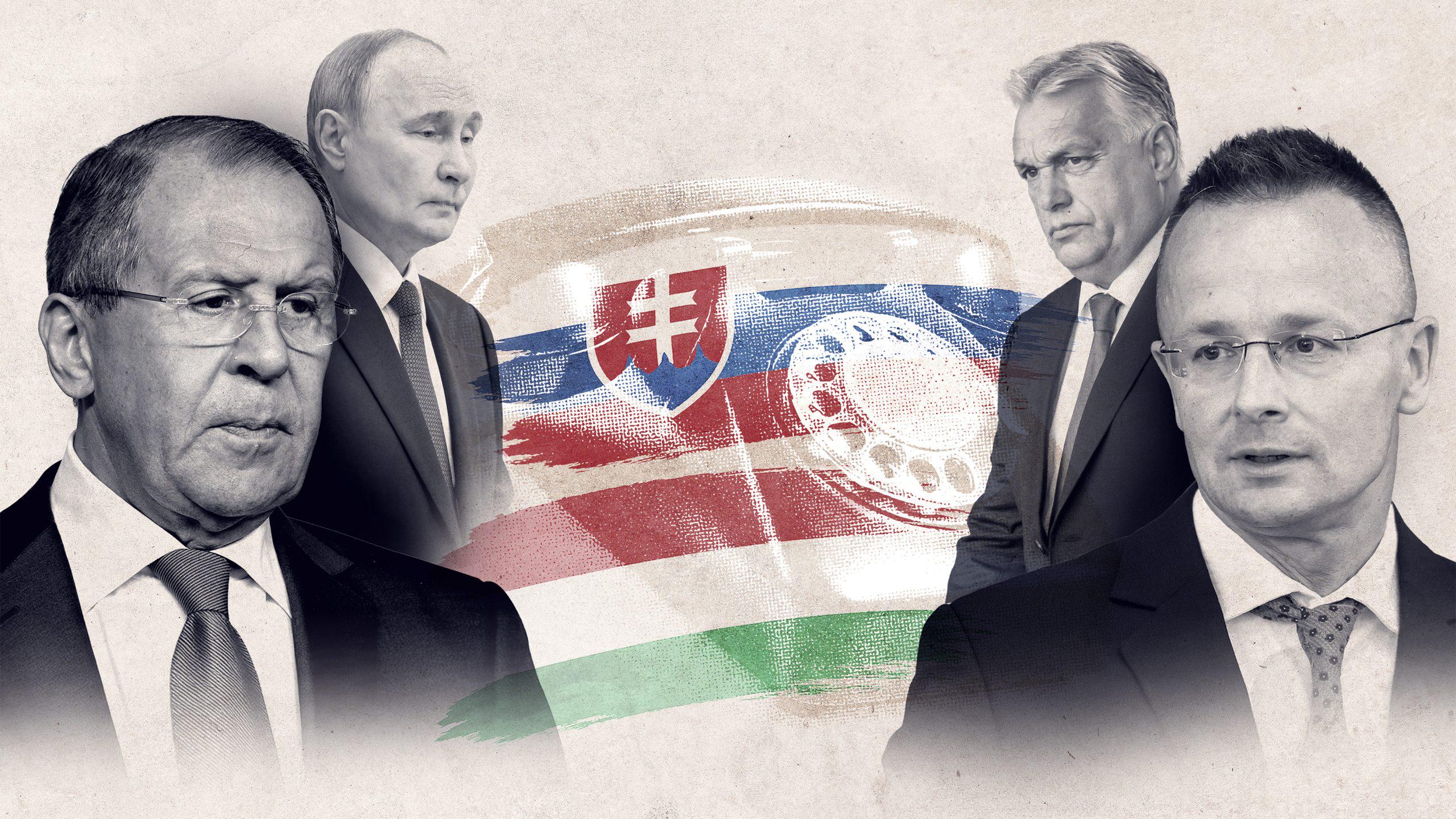
Hotline del Cremlino: l’Ungheria ha collaborato con la Russia per rimuovere oligarchi, aziende e banche sanzionate [VSquare.org]
Kremlin Hotline: Hungary colluded with Russia to delist sanctioned oligarchs, companies and banks
di Sky_HUN

Hotline del Cremlino: l’Ungheria ha collaborato con la Russia per rimuovere oligarchi, aziende e banche sanzionate [VSquare.org]
Kremlin Hotline: Hungary colluded with Russia to delist sanctioned oligarchs, companies and banks
di Sky_HUN
9 commenti
> The hotline between Péter Szijjártó and Sergey Lavrov provided Russia with strategic information on critical EU issues.
> We now have evidence that the Hungarian Minister of Foreign Affairs acted on behalf of the Kremlin, making efforts to delist sanctioned Russians, including the sister of Alisher Usmanov.
> In another conversation with Russia’s deputy energy minister, Szijjártó talks about doing his best to repeal an EU sanctions package and offers to try to save Russian entities from sanctions.
> According to Szijjártó, the Slovak government is also helping these coordinated Russian-Hungarian efforts.
> **1.**
> Just an hour after Hungarian Foreign Minister Péter Szijjártó arrived in Budapest from St. Petersburg on August 30, 2024, he received a phone call from his Russian counterpart, Sergey Lavrov. Lavrov said Szijjártó had been quoted all over the Russian media following his visit.
> “Did I say something wrong?” Szijjártó nervously inquired.
> “No, no, no. They were just saying that you are pragmatically fighting for the interests of your country.”
> The reason for Lavrov’s call was a request: the Russian oligarch Alisher Usmanov was looking to have his sister, Gulbahor Ismailova, removed from EU sanctions lists and Szijjártó had promised to help. Usmanov, a Russian-Uzbekistani tycoon, amassed his wealth in mining, industry, telecoms, and media. He has been described as one of Putin’s favorite businesspersons, one with “particularly close ties” to the Russian president.
> “Look, I am calling on the request of Alisher and he just asked me to remind you that you were doing something about his sister,” Lavrov said.
> “Yeah, absolutely,” Szijjártó answered. “The thing is the following, that together with the Slovaks we are submitting a proposal to the European Union to delist her. We will submit it next week and as the new review period is going to be started it’s gonna be put on the agenda and we will do our best in order to get her off.”
> Lavrov was happy and expressed his appreciation for Szijjártó’s “support and your fight for equality in all fields.”
> The main purpose of the conversation accomplished, Lavrov and Szijjártó proceeded to bond over their shared disdain of the European Union, particularly countries with a pro-Ukraine orientation.
> Both criticized Josep Borrell, then the EU’s High Representative of Foreign Affairs and Security Policy, whom Lavrov called his “biggest disappointment” and Szijjártó disparagingly characterized as the “European Biden.” The Spanish socialist, Lavrov noted, had been far more “reasonable” when he only represented the interests of Madrid as foreign minister, prior to his appointment to the European Commission, in which capacity a commissioner cannot prioritize his native country over the bloc in general. “So you cannot, you cannot name your country, but you must name your gender, right?” an incredulous Lavrov asked of Szijjártó, who had summarized these bureaucratic protocols.
> Before hanging up, the Hungarian cooed about the new Gazprom headquarters he’d visited in Russia, adding, “I am always at your disposal.”
> Seven months later, Ismailova was removed from the EU sanctions list.
> **2.**
> This call between the two foreign ministers, one of several between 2023 and 2025, highlights the exceeding comity between Szijjártó, who represents an EU and NATO member, and Lavrov, who represents a nation that has invaded and occupied a European country while waging a hybrid war that includes acts of arson and sabotage carried out against countries on NATO’s eastern flank.
> The calls traffic in sensitive information about the internal deliberations of both Budapest and Brussels, which are doubtless of interest to the Kremlin. They also provide clearcut evidence of how Russia is secretly behind the efforts of Hungary and Slovakia to hinder EU sanctions against Russian individuals or entities.
> In his exchanges with Lavrov, Szijjártó comes across as deferential, bordering on obsequious. “If you remove names and show these conversations to any case officer, he will swear that this is a transcript of an intelligence officer working his asset,” one senior European intelligence officer said after reviewing a printout of the conversations.
> Transcripts and audio recordings of the Lavrov-Szijjártó calls, as well as Szijjártó’s calls with other Russian government officials, were obtained and confirmed by a consortium of investigative news outlets consisting of VSquare, FRONTSTORY, Delfi Estonia, The Insider, and the Investigative Center of Ján Kuciak (ICJK).
> The apparent willingness of Szijjártó, as a high official of the Hungarian government, to quietly act in Russia’s interests at the EU level may help explain why Moscow is investing significant effort in keeping Viktor Orbán and his pro-Kremlin Fidesz party in power.
> Independent polling suggests Orbán is trailing badly ahead of the April 12 parliamentary election, with the center-right Tisza party, led by challenger Péter Magyar, holding a strong lead. As Orbán’s campaign struggles, Russia is reportedly stepping in to assist in covert ways, too.
> According to VSquare’s earlier report, the Kremlin has assigned Sergey Kiriyenko – a deputy chief of staff to Vladimir Putin and a key architect of Russia’s political influence operations – to covertly support Orbán’s campaign. Kiriyenko previously played an integral role in shaping election interference activities in Moldova.
> At the same time, Orbán’s campaign has increasingly echoed Kremlin narratives: staging provocations against Ukraine and accusing opposition figures and critics of acting as Ukrainian proxies or spies while dismissing or ridiculing allegations of their own ties to Russia.
> Szijjártó’s chumminess with Lavrov, while previously alluded to in the press, has never before been documented with leaked phone calls demonstrating the full extent of their collusiveness.
> Apart from delivering on what he was asked to do, Szijjártó routinely kept Lavrov informed of details of supposedly confidential discussions by European diplomats.
> For instance, in the same August 30, 2024 call with Lavrov, just after their discussion about delisting Ismailova, Szijjártó also revealed the details of the EU Foreign Affairs Council meeting that he participated in the day before.
> “And that was crazy, you know, when Landsbergis said that we contribute 12% of each rockets and missiles,” Szijjártó told Lavrov, referring to Lithuania’s then-foreign minister Gabrielius Landsbergis, who had argued that Russia partly finances its war through gas and oil profits from European customers such as Hungary and Slovakia.
> *Source: Lithuania’s foreign ministry*
> “I said, my friend, you are not right, because the Europeans contribute much more… it’s not only the Slovaks and us who are buying gas and oil from Russia directly but all of you who are buying the same from them through…India, Kazakhstan.”
> When reached for comment, Landsbergis confirmed the behind-the-scenes details of the EU foreign ministers’ meeting. “I can verify that this is a real exchange during one of the Foreign Affairs Councils,” Landsbergis said. “It seems that all this time Putin had, and still has, a mole in all European and NATO official meetings. If the integrity of these meetings is to be maintained, it would be appropriate to ban Hungary from all of them. Every generation has a Kim Philby” – a reference to the notorious Cold War-era KGB spy in the British Secret Intelligence Service. “Apparently Péter Szijjártó is playing the role with enthusiasm.”
> That analogy goes slightly deeper than mere rhetorical flourish. Philby and Szijjártó both received the highest Soviet or Russian award that can be given to a foreigner: the Order of Friendship. Szijjártó’s was officially awarded by Vladimir Putin, but physically bestowed upon him by Lavrov on December 30, 2021.
We need to kick them out of the EU and make an example out of it.
This is treason.They have to be arrested, both the PM and the Foreign Minister.
The sad part is this is reported as news. This is olds!
This is treason and an absolute affront to every European, especially Ukraine and the countries supporting UA. What the actual fuck.
Man, the strongly worded letter from the EU will be the harshest to date! No “pretty please with sugar on top”, just a regular “please stop colluding with our enemies u.u”
During the Hungarian revolution of 1956, the uprising was crushed by Soviet armored units and roughly 2,500 Hungarians were killed, and nearly 200,000 fled the country.
And now they are colluding with Kremlin by their own volition.
Quite the moral flexibility.
We have the Minister of Foreign Affairs nervously asking from a russian oligarch “did I do something wrong?:(”
Disgusting freaks I cant wait to vote
Szijjártó and Orban would have sold out Imre Nagy in a heartbeat.
Strange that “nationalists” support the former Russophile servants rather than their own interests. Good luck in the election for those who want to see a democratic and prosperous Hungary.
When Orban has the support of Putin, Trump, and Netanyahu it will unfortunately be needed