Allora e adesso: la vita in Irlanda nel 1926 e nel 2022
https://i.redd.it/peebidixjbwg1.png
di NanorH

Allora e adesso: la vita in Irlanda nel 1926 e nel 2022
https://i.redd.it/peebidixjbwg1.png
di NanorH
8 commenti
**Key Findings**
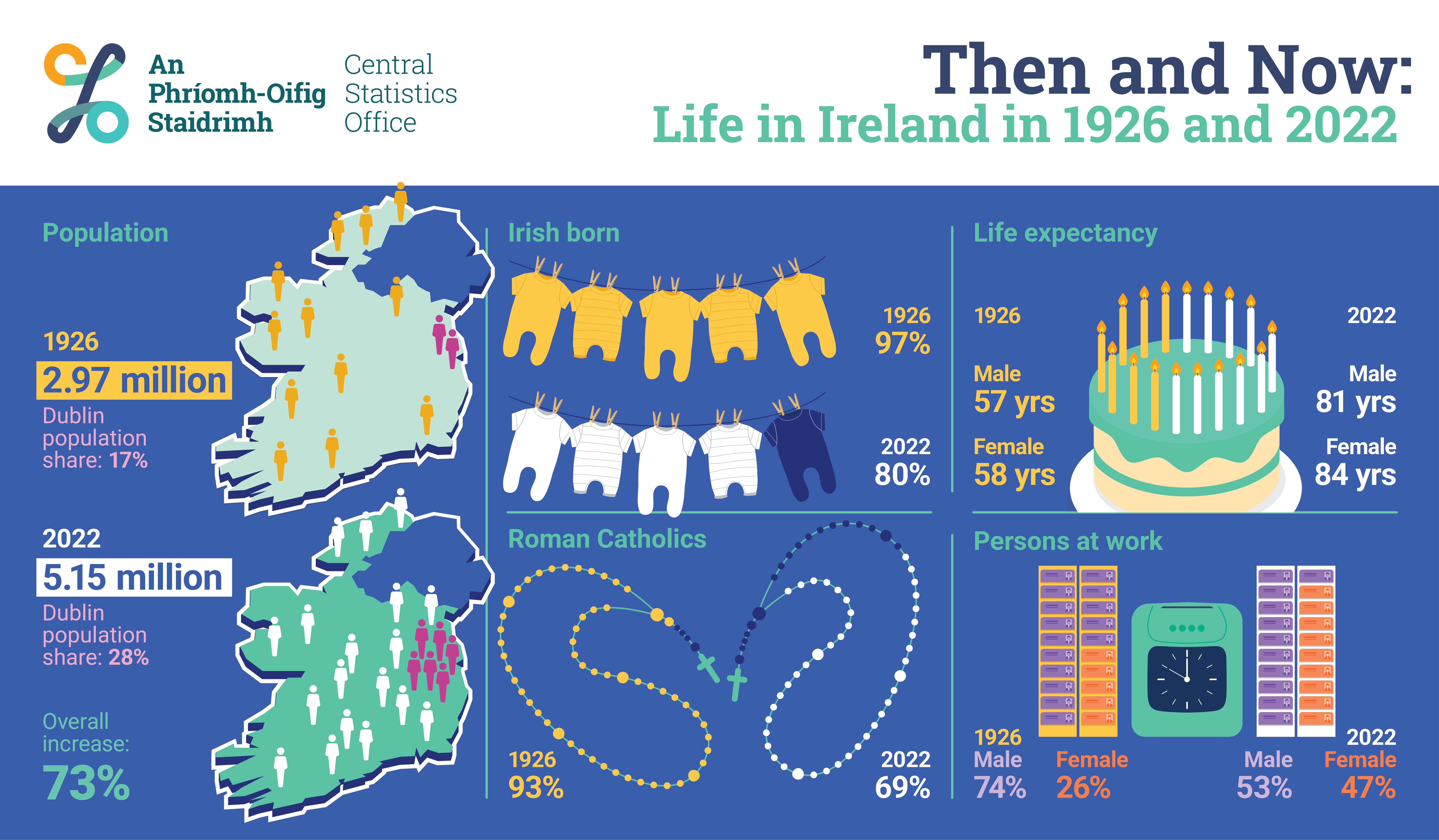
* Ireland’s population was 2.97 million in 1926, as recorded in the first census conducted by the Irish Free State. By 2022 it had grown to 5.15 million, an increase of 73% that marks a clear shift from long term decline to sustained population growth.
* Life expectancy at birth was 57 years for males and 58 years for females in 1926. By 2022 life expectancy at birth was 81 years for males and 84 years for females. In 2022, 7% of the population was aged 75 and over, compared with almost 3% in 1926.
* Dublin accounted for 17% of the population in 1926, while Cork was 12% and counties such as Mayo, Galway, and Donegal were between 5% and 6%. By 2022, Dublin’s share had risen to 28%, while Cork stood at 11%. In contrast the populations of Leitrim (-37%), Mayo (-20%), and Roscommon (-16%) saw double digit declines from 1926 to 2022.
* In 1926, 97% of people living in Ireland were Irish born and less than 1% were born outside Ireland, Northern Ireland, and Great Britain, reflecting very low inward migration. By 2022, the Irish born share was 80% and 14% of residents were born outside Ireland, Northern Ireland, and Great Britain, highlighting the diversification of the population driven by increased inward migration.
* Roman Catholics made up 93% of the population in 1926, while by 2022 this had fallen to 69%. Census 1926 did not record a separate category for people with no religion, and those outside the main denominations were instead captured under an ‘other’ category which accounted for less than 1% of the population. In 2022 people with no religion made up 15% of the population.
* In 1926, there were 1,307,662 people at work, with males making up 74% of the workforce and females 26%. By 2022, there were 2,320,297 people at work, comprising 1,241,353 males (53%) and 1,078,944 females (47%), showing both a much larger workforce and a far more even gender balance.
* Some 18% of the population were reported as having any Irish-language ability in Census 1926, while in 2022, 40% reported being able to speak Irish based on a broader measure that captured any level of spoken use, from daily to occasional.
* People in agricultural occupations made up the majority of the workforce in 1926, accounting for 51% of all workers. By 2022, this had fallen to almost 4% of those at work.
https://www.cso.ie/en/releasesandpublications/ep/p-tnli/thenandnowlifeinirelandin1926and2022/
The life expectancy is way lower than I expected. I wonder to what extent this is a function of child mortality – like what would be the life expectancy of an 18 year old ?
The work figures are very interesting to me I wonder does it take only people eligible to work or doe sit consider children and people past the age of retirement
✋🏻 is now the correct time to admit that, as a baptised and confirmed and largely inobservant but still believing Catholic (yeah don’t @ me) that I actually don’t know how you use rosary beads? Like I see aul ones clutching them in Mass but unless you’re doing actual decades of the rosary, is there more to it than that? I’ve felt this way since my Communion but have always been too afraid to say anything.
Anyone romanticising olde worlde Ireland only needs to look at the life expectancy figures. Some jump in the past 100 years.
I found a relative aged 87 back in 1926. If 58 was considered good going at the time this lad was like Yoda
Worth noting the population was dropping at this point, to its nadir in 1961. It wouldn’t surprise me if a lot of the changes/improvements above didn’t start happening back in the 20s but only from the 50s/60s onwards.
The big thing for those life expectancy figures is infant mortality. Once you got past 12 years of age it wasn’t massively different, but a lot of kids and especially babies died. No antibiotics and skinny little kids in cold damp housing.