
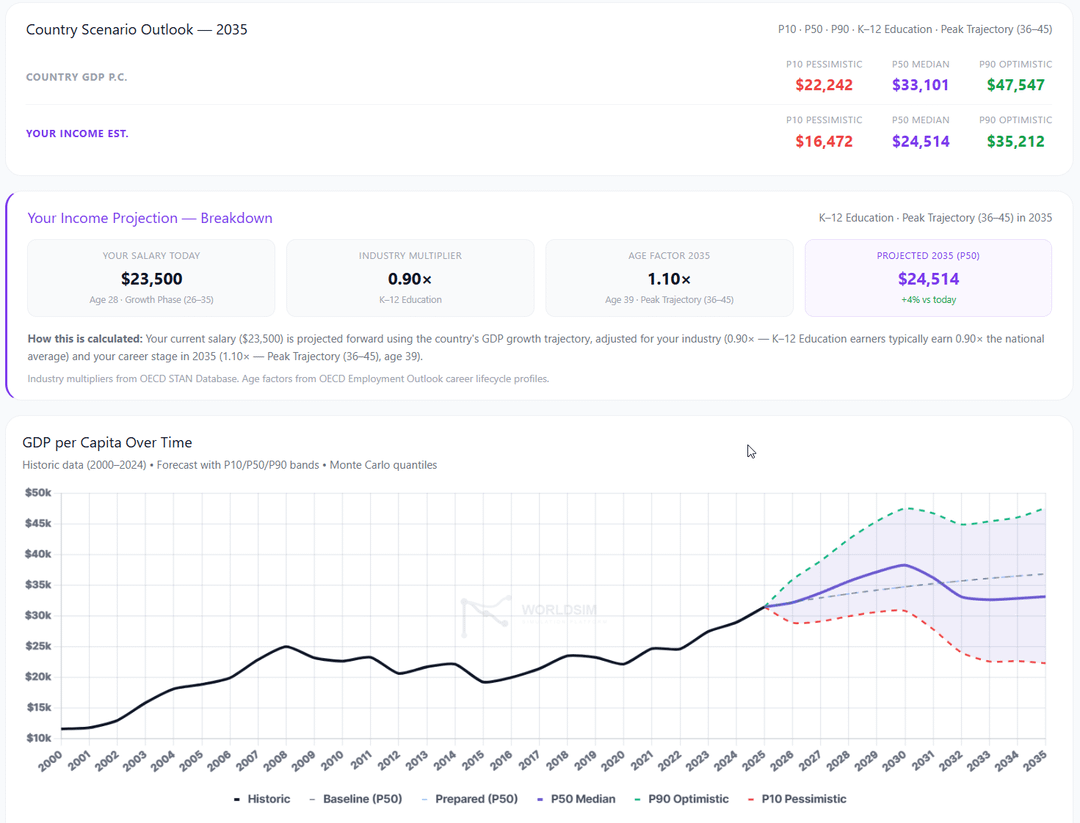
Ho eseguito una simulazione strutturale a lungo orizzonte sul Portogallo fino al 2035 (5.000 percorsi Monte Carlo, 26 indicatori economici, condizioni medie, nessuna ipotesi estrema). Il regime dello scenario al quale il modello converge: "economia stagnante."
Cosa mostra il modello in miglioramento:
• Disoccupazione: dal 6,5% al 5,4%. L’invecchiamento restringe il mercato del lavoro; il rapporto tra lavoratori e pensionati mantiene il bacino di posti di lavoro ristretto.
• Fertilità: da 1,44 a 1,53. In controtendenza rispetto al calo più ampio europeo (Spagna 1,12, Italia 1,18).
• Quota rinnovabile: dal 36% al 44%. La competitività solare aumenta gli incendi nei paesi a clima caldo oltre la soglia del 30%.
• Spesa in ricerca e sviluppo: dall’1,73% all’1,90% del PIL. Esportazioni ad alta tecnologia dal 6,8% all’8,5%. La regola della produttività digitale si attiva quando gli utenti di Internet rimangono al di sopra dell’85%.
• Migrazione netta: da 13,6 a 19,0 per 1.000. Gli afflussi di immigrati brasiliani, dell’Asia meridionale e di altri paesi hanno più che compensato l’emigrazione dei laureati portoghesi.
Cosa mostra il modello in peggioramento:
• PIL pro capite: da $ 31.415 a $ 33.101. Si tratta di un +5% sull’intero decennio, circa mezzo punto percentuale all’anno. Questo valore è inferiore al consenso del FMI WEO (circa 1,7–2% di crescita reale/anno) ed è il numero più discutibile in questo periodo.
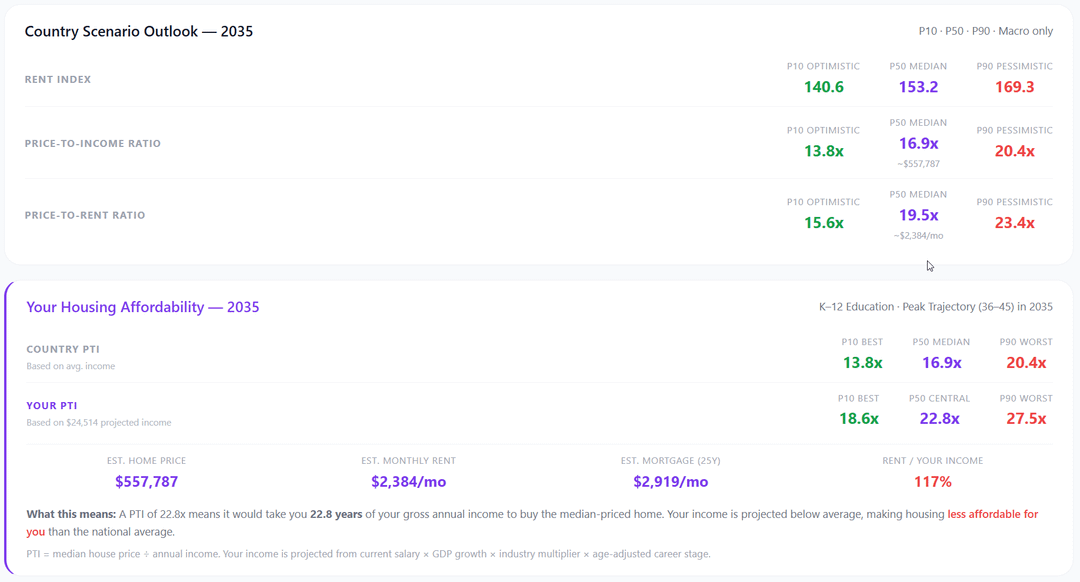
• Indice degli affitti: da 112 a 153 (+37%). Rapporto prezzo/reddito: da 11,6x a 16,9x. Prezzo di affitto: da 16,2x a 19,5x.
• Inflazione: dal 2,4% al 3,5%. Elettricità: da 0,236 a 0,268 dollari/kWh (+13%). Benzina: da 2,13 a 2,44 dollari al litro (+14%).
• Cuneo fiscale (lavoratore medio): dal 42,3% al 43,8%. Cuneo fiscale Occupazione La regola di trascinamento scatta dopo 3 anni sopra il 42%.
• Debito pubblico: dal 96% al 100% del PIL. Spesa pubblica dal 45% al 47% del PIL.
• Popolazione 65+: dal 23,0% al 29,8%. L’invecchiamento della popolazione attiva il drag rule (quota ≥25% per 5 anni), tagliando la produzione potenziale dal 2030 in poi.
Panoramica degli alloggi per il 2035 (mediana P50):
• Prezzo medio stimato della casa a Lisbona: €512.000
• Canone mensile medio stimato: € 2.190/mese
• Resa stimata del mutuo di 25 anni su una casa media: € 2.680/mese
• Prezzo dell’affitto: 19,5x (rispetto a 16,2x). Rapporto prezzo/reddito: 16,9x (notare che qui il denominatore è il PIL pro capite, che è più ampio del reddito disponibile effettivo, quindi l’accessibilità nel mondo reale è peggiore).
• Livello personale: oggi ho sovrapposto un insegnante di 28 anni delle scuole primarie e secondarie a Lisbona a 21.600 euro lordi (scala del Ministério da Educação 2024 per cinque anni di servizio). La sua proiezione lorda per il 2035 aumenterà a circa 22.500 euro. Il suo potere d’acquisto diminuisce del 28% in termini reali. L’affitto mediano a Lisbona, pari a € 2.190/mese x 12, equivale al 117% del suo stipendio lordo nel 2035. Rapporto prezzo/reddito personale per una casa media: 22,8 anni di stipendio pieno.
Un numero da segnalare: il +5% del PIL pro capite decennale è inferiore alle proiezioni del FMI e dell’OCSE per il Portogallo. Il modello cade più in basso perché l’invecchiamento, il cuneo fiscale e la pressione migratoria si trascinano anno dopo anno, mentre i fattori favorevoli al solare e alla ricerca e sviluppo si stabilizzano prima. Curioso se le persone sul campo pensano che il consenso o il modello siano più vicini alla realtà.
Per le persone che vivono in Portogallo:
Un affitto medio a Lisbona di 2.190 €/mese entro il 2035 sembra corretto, o vi aspettate che il mercato degli affitti si raffreddi man mano che i tassi di interesse si normalizzano e la domanda estera si attenua?
La fecondità sale da 1,44 a 1,53 mentre Spagna e Italia scendono ulteriormente. Ciò corrisponde a ciò che vedi sul campo o è il modello ad essere generoso a causa del mix migratorio?
Il modello produce tensione: la migrazione netta continua ad aumentare e la disoccupazione continua a diminuire, mentre gli affitti esplodono e i redditi reali ristagnano. Dove si vede questa rottura per prima, la rigidità del mercato del lavoro che spinge i salari verso l’alto, o la pressione immobiliare che spinge i nuovi arrivati (e i giovani locali) a ritirarsi?
https://www.reddit.com/gallery/1sqr3ht
di YiannisPits91
12 commenti
A 28 year old teacher with 21,600€? Sure thing
Oh yeah, you are dead
I mean, all the outcomes align.
Increased rent due to foreign policies wich in part promote high migration from poorer countries with high fertility rates. This said “conclusions” widen employeement pools due to a)people that would not need now need to work b)high financial pressure whilst unemployed c)high demand(wich we arguably already have in many sectors)
I do not believe in this conclusions, i do believe in a small decline or stagnation/Crysis/deflation/recession, specially on the housing sector.
I mean, we can talk about COVID and so on, but 2019-2022 cleaned a lot of capital/liquidity, and that “softpillow” that would soften harder times is gone. One swosh on the Next 5 years and this will be a rollercoaster.
There’s a strategy here in Portugal that is actually quite simple, the idea is to let homeowners make the most money possible with housing. That’s it. There’s no future plan, the managing class don’t care about those issues, if the cities are currently unlivable for families then others can just rent beds and work there that way. The type of analysis you made there it’s interesting but will not reach the managing class. Anyhow thank you for sharing it.
I was just thinking about this. K shaped economy all the way. Being selfish as any person can be, I just worry about getting my arse on the asset class and surviving all of this, but I’m afraid social tensions will only rise in the next 10 years and everything will suck for almost everyone.
Gostava de ver a AD fazer uma análise destas um dia de qualquer que seja o tema.
Nem o KPI “# alunos sem aulas a pelo menos uma disciplina” conseguem quanto mais uma análise como estas.
No problem, because there are also no poor students in Lisbon, we are moving everyone to the suburbs and leaving tourists and some workers in the city.
/s
TODAY, the average rent is already higher than the average salary. Why wait for 2035?
1. immigration is and will keep increasing
2. newer generation of children of immigrants is and will keep increasing birth rate
3. tech bros and entrepreneur class is starting to boom and will keep booming, attracting lots of foreign investment and creating wealth
4. Catholic values are and will be re-adopted by a non-negligible part of the population and increase birth rate a bit more; the same goes with Muslims , Jewish and Indus values. Fertility rate will be probably around 1.6 in 2035
5. retirement age will be pushed back, at least as a choice, and more of people will choose to work in their 70’s
6. in 2035 Portugal = the children of the entrepreneur class will start ruling the country – all aspects of it, from politics to education to medicine to tech to business and religion too; the children of immigrants will be working hard to raise their social status; the “traditional” Portuguese, the ones that were told by their parents, and believed it, that the best thing that ever happened in Portugal was the Carnation revolution, and that want lots of stuff without lots of work, will be an increasingly rare creature; population will be older but with lots of older people working as well
Salary will not grow 4% only, it will most likely follow the inflation rate more or less, which has been and will continue to be high. Even if salaries don’t follow the inflation they will for sure be more than 4% higher 10 years from now.
All the rest is plausible, rents (depending on where you live) already eat up most of you salary and are even higher than many lower salaries.
This is very interesting. Out of curiosity how much better would it be, for example, to live in Spain and work in Lisbon, and you have to comute, lets say twice a week.
Well, it seems that our government believes this is plausible and survivable… and blames productiviy (or lack thereof) while removing safeguards on at will employment.
This is embracing the K economy.