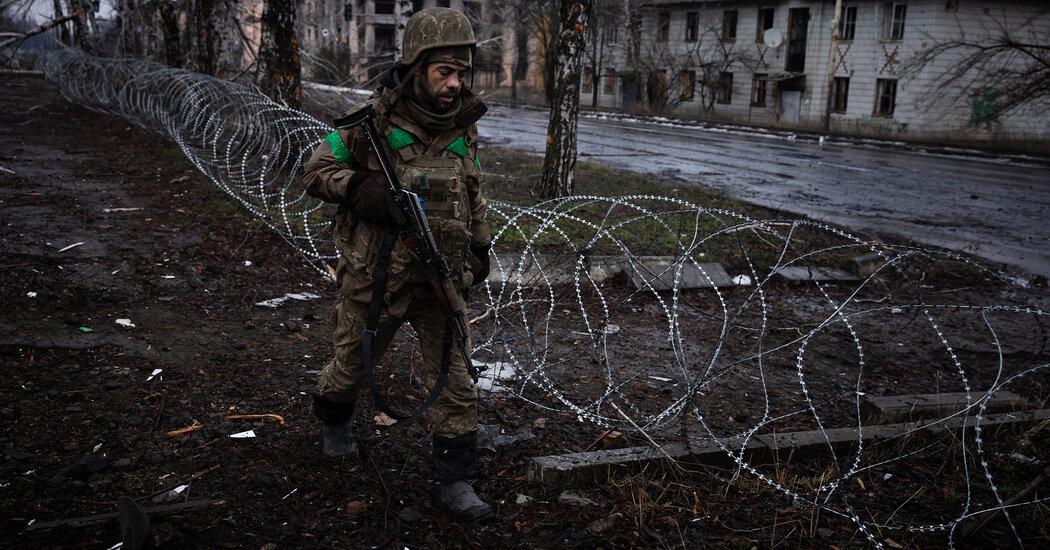
Le forze di Putin avanzano a malapena sul campo di battaglia
https://www.nytimes.com/2026/05/10/world/europe/russia-ukraine-putin-war.html
di Bernardmark

Le forze di Putin avanzano a malapena sul campo di battaglia
https://www.nytimes.com/2026/05/10/world/europe/russia-ukraine-putin-war.html
di Bernardmark
6 commenti
[removed]
President Vladimir V. Putin of Russia has sought to convince President Trump that his troops are marching toward inevitable victory in Ukraine, arguing that Kyiv should hand over the entire eastern Donbas region to avoid impending defeat.
But the situation on the battlefield tells a different story.
After making gains late last year, the Russian military has slowed to a crawl. In some parts of Ukraine, it has lost territory. At its average monthly rate of advance so far this year, it would take Russia more than three decades to seize full control of the Donbas, which the Kremlin has set as a condition for ending the war.
The slowdown may be temporary, and it is due at least in part to seasonal factors. Russian troops tend to pick up speed over the summer, aided by better weather and foliage that provides more cover from drones. In recent days, Ukrainian officials have warned that Moscow’s troops are gearing up for new offensives and have intensified operations across the front.
Still, Russia enters this push on the back foot. It has faced setbacks this year, including the loss of Starlink satellite internet access that helped guide its drones. The Kremlin’s throttling of the Telegram messaging app, as it tightens control over the Russian internet, has also hampered soldiers’ communications.
More broadly, Russia has yet to solve the fundamental problem of how to make big advances on a battlefield saturated with drones. The days of sending masses of troops charging through front lines in armored vehicles are mostly over.
Instead, the contest between Kyiv and Moscow is largely one of developing better drones, and better defenses against them. On certain parts of the front, Ukraine has gained the upper hand in recent months with rapid advancements in technology, production and tactics. But Russia is working furiously to catch up, building out a bigger drone force after rolling out a successful elite drone unit known as Rubicon.
Drones have forced Russian troops to change their strategy. Now they try to infiltrate territory gradually with small teams of soldiers, often on foot. This has resulted in an ever-growing swath of territory known as the “gray zone,” where troops from both sides are present and control is not clear-cut.
“The best they can do is these infiltration tactics and the targeting of the support networks pretty far behind the line — targeting Ukrainian drone teams and logistics support,” said Dara Massicot, a senior fellow at the Carnegie Endowment for International Peace. “But it doesn’t lead to rapid gains. They are kind of stuck.”
As the war effort stalls, it is putting the Russian government under increasing economic and political strain.
Mr. Putin’s approval ratings have fallen to their lowest levels since the start of the war, as the economy buckles under vast military spending and as mobile internet blackouts, imposed in part to prevent Ukrainian drone attacks, anger ordinary Russians.
Late Saturday, Mr. Putin suggested in a news conference the possibility of ending the war. “I believe the matter is coming to a close, yet it remains a serious thing,” he said. But at the same time, he struck notes of defiance, particularly against European nations supporting Ukraine.
For now, the Kremlin is fighting on. But its challenges on the battlefield complicate the narrative of imminent victory Mr. Putin has been selling to the Trump administration as it has brokered peace talks with Ukraine. Russia is looking to put pressure on Kyiv to cede the parts of the Donbas that its military has failed to capture.
Even as Russia struggled on the battlefield this March, Mr. Trump, in an interview with Politico, expanded on his earlier statement that President Volodymyr Zelensky of Ukraine had “no cards” by saying he now had “even less cards.”
On Thursday, the Kremlin’s chief foreign policy adviser, Yuri Ushakov, said that until Ukraine withdrew from the region, Russia saw no point in further peace talks. Ukraine has refused to hand over that territory, though negotiations have continued over turning it into some sort of international demilitarized zone.
While Russia has not figured out how to take and hold large swaths of land through infiltration, it may believe that a gradual push is a better approach anyway, Ms. Massicot said. That avoids the risk of big operations that could go wrong and raise questions about the prospects for victory, she added.
“I think it’s a combination of not having an operational solution and the Kremlin being satisfied with this level of political risk, and hoping that peace talks will negotiate away the difficult part, which is fighting for the rest of the Donbas,” she said.
“3-century special military operation”
Pch, just end this nonsense & go home Russia
Sadly, Russia knows Trump is tryign to pressure Zelensky into giving up Donetsk and that they have him on their side. That meeting in Alaska was a complete shit show–Putin just absolutely humiliated America on a world stage and Mr. Art of the Deal offered Donetsk on a plate to Russia so now, they’re not budging at all.
The only negotation should have been “stop the war now or we’re going to give Ukraine Tomahawks and ATACMS and let them fuck your shit up”
Imagine this moment without a russian spy as potus. It could have easily been turned into a russian strategic defeat.