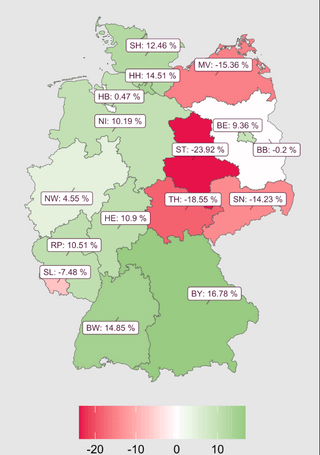
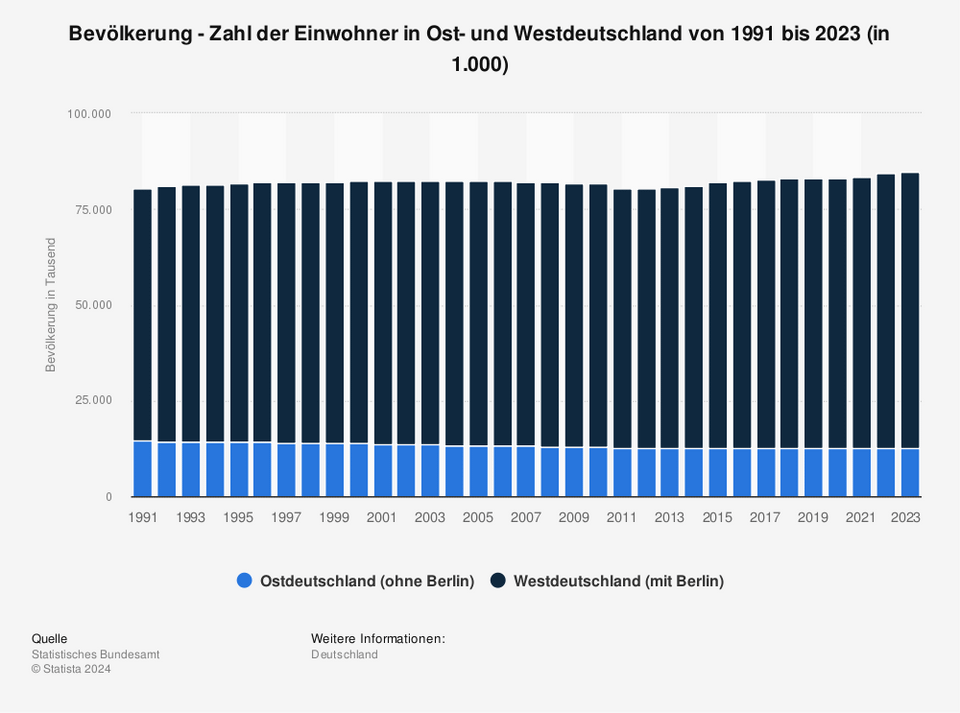
Cambiamento demografico nella Germania dell’Est e dell’Ovest negli ultimi 3 decenni
https://www.reddit.com/gallery/1f7vvw0
di Straight_Ad2258

Cambiamento demografico nella Germania dell’Est e dell’Ovest negli ultimi 3 decenni
https://www.reddit.com/gallery/1f7vvw0
di Straight_Ad2258
9 commenti
source: [https://de.statista.com/statistik/daten/studie/1058231/umfrage/zahl-der-einwohner-in-ost-und-westdeutschland/](https://de.statista.com/statistik/daten/studie/1058231/umfrage/zahl-der-einwohner-in-ost-und-westdeutschland/)
[https://de.wikipedia.org/wiki/Liste_der_deutschen_Bundesl%C3%A4nder_nach_Bev%C3%B6lkerungsentwicklung](https://de.wikipedia.org/wiki/Liste_der_deutschen_Bundesl%C3%A4nder_nach_Bev%C3%B6lkerungsentwicklung)
excluding Berlin, East Germany’s population has shrunk by 13.2% between 1991 and 2023, while West Germany+ Berlin saw a population increase of 9.6%
East Germany’s share in total German population went down from 18.1% to 14.9% between 1991 and 2023
all of Eastern Germany has now smaller population than Bayern
Berlin is often counted together with West Germany because half of it used to be part of West Germany during the cold war era, and because its similar to West Germany in terms of
* population change(Berlin is growing while rest of East Germany is shrinking)
* and ESPECIALLY politics: **AfD is currently polling at 12% in Berlin vs over 25% in rest of East Germany. AfD+BSW have together around 24% support in Berlin vs 40-45% support in rest of East Germany**
Berlin is growing while the rest are shrinking or stagnant. **In a decade ,Berlin could overtake Sachsen to become the largest state in population in the (geographical) East**
i wonder how much of the high rate of AfD and BSW support can be traced to selection bias, namely emigration of highly educated and skilled people from East Germany to Berlin or West Germany
this has been already a huge shift even before the reunification, as millions left in what was called Republikflucht. In some cohorts in Eastern Germany, 20-25% of population born in 1950s and 1960s left for West Germany even before the reunification, and to that you can add the share that left after
what is of huge interest is to what extent who left would have voted differently than those who stayed
also, East Germany has a lot of immigrants from Russia and Kazakhstan(ethnic Germans from USSR) ,who tend to vote for AfD or BSW, while West Germany’s migrants are a voting bloc for SPD
finally ,the population decline is set to continue for East Germany, barring an increase in immigration, so its share in German population will shrink further and further in the future . Only exception is Brandenburg, which is growing nowadays due to people moving out of Berlin to live there(if you check the map,Brandenburg completely surrounds Berlin).
It will be interesting to see whether the trend of Berliners moving to Brandenburg will start to dillute the share of votes of AfD or BSW in the future( it kind of already does, as AfD polls at 24% in Brandenburg vs 30% in rest of East Germany
That is why the results of the recent elections don´t really matter. In whole East-Germany only 15 M people live comparing to 84M in whole Germany. It´s not going to have serious consequences on a federal level.
East German states also have the lowest amount of foreign population at ca. 5%
https://www.bpb.de/kurz-knapp/zahlen-und-fakten/soziale-situation-in-deutschland/61625/auslaendische-bevoelkerung-nach-bundeslaendern/
The phenomenon certainly exists but I think its importance is overstated.
After all, right wing populists reach 30 % and more also in European countries that didn’t experience a similar population change in the last 30 years like Austria, France or the Netherlands.
I think the much more relevant cleavage is that between urban and rural areas.
The new German states are just much more rural than the old states and have fewer big cities.
The big cities in Saxony leipzig and Dresden and university towns like Jena are politically closer to cities elsewhere while rural areas in the old states face similar challenges that frustrate people in the new states.
Surely voting for right wing extremists will make them more attractiv for investors, young people, esp. young women etc.
Surely, voting for neonazis like Höckler will make Thüringen a more prosperous place
/s
I don’t get it. Dresden and Leipzig look super cool to live in. And not as expensive as some other cities.
I mean, I would also not go into the Nazi infested territories
East side is going really bad !