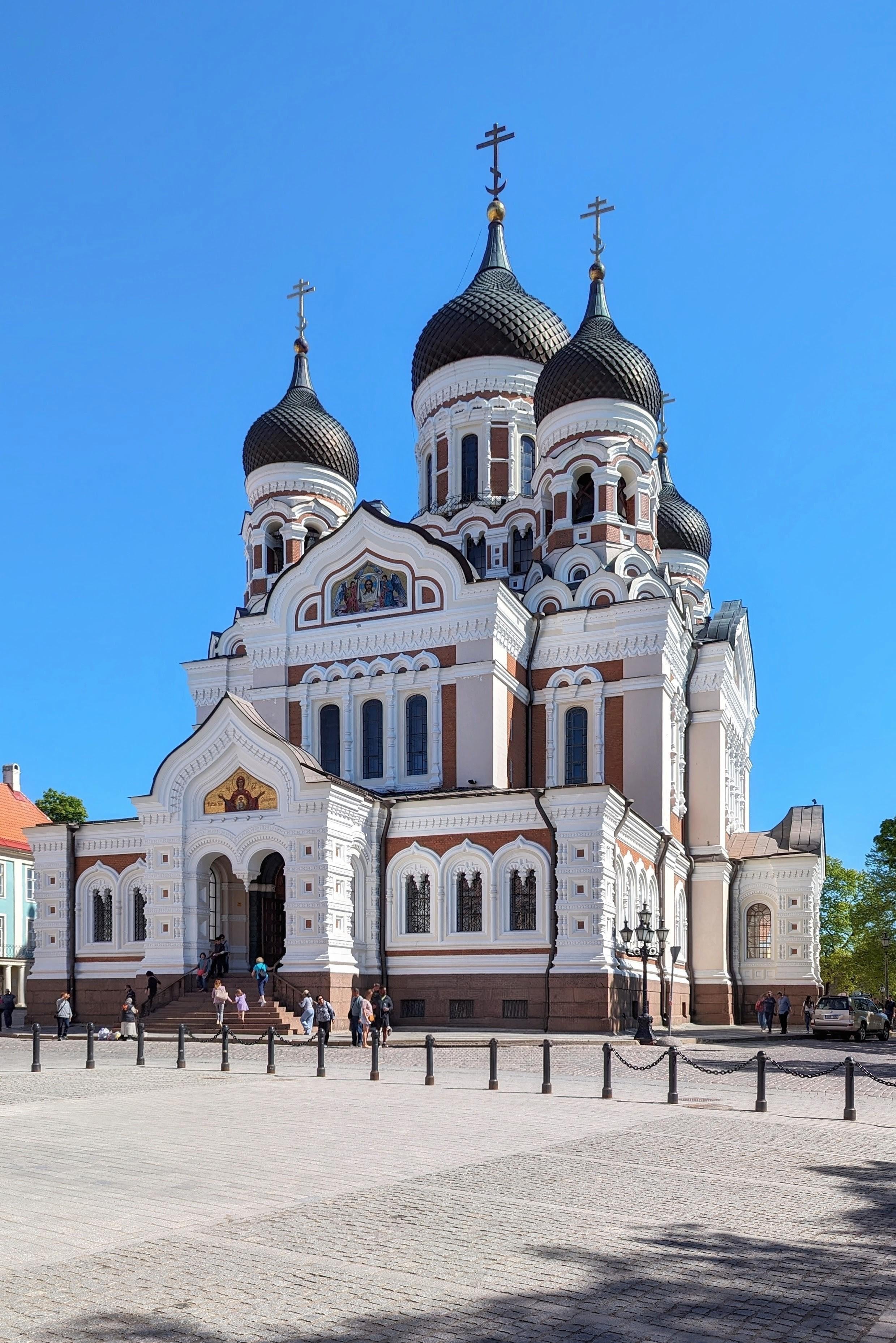
This church is massively hated by Estonians as it was built in 1900 as a symbol of Russian imperialism. Estonians are not traditionally Orthodox and this was built at the top of the otherwise German-looking medieval old town. There were even serious plans of demolishing it in the 1920s.
When ordering its construction, the Russian governor said the following:
>…so that from the sea and from the land the cross of the Russian Cathedral would shine high above Tallinn as the symbol of victory of Orthodoxy!
Vidsich on
a symbol of russian colonialism
Aracet24 on
I didn’t know that the Russians stole the architectural style of gipsies
ex1nax on
Should be torn down.
Xepeyon on
A thread about this building appeared about a year ago, IIRC. There were probably about as many Estonian users wanting to keep it as wanting to have it demolished.
Background-Pear-9063 on
The Estonian state should appropriate it and gift it to the Ukrainian church.
ImTheVayne on
It doesn’t look bad but we obviously don’t like this building.
Accomplished-Gas-288 on
Warsaw also had a St. Nevsky Cathedral dominating the city, built in 1894-1912. It was demolished after regaining independence.
[https://www.whitemad.pl/piekny-symbol-rosyjskiej-dominacji/](https://www.whitemad.pl/piekny-symbol-rosyjskiej-dominacji/)
I still really like how it looks despite its troubled history.
IamWatchingAoT on
I would at the very least change its name considering Alexander Nevksy is one of the biggest propaganda symbols in Russia vs West, especially in the Baltics.
TraditionalEqual8132 on
The building is beautiful, also on the inside. It was build at the end of the 19th century. Not yet Soviet, but part of Russia. Clearly served as a powerful symbol for the state and its religion. Times have changed and now – in my mind – it only serves as a cultural symbol of times long gone by. An oddity, signifying possibility for change, improvement, growth. How a small people can have agency and strive for independence from an oppressive state and its religion. Let it be there to be enjoyed for its architectural value, its history. And let is continue to face the building opposite it; the Riigikogu, the Parliament building of a democratic nation.
Fire99xyz on
Visited it and was pretty bland on the inside tbh
Cultural_Piece_7855 on
A beautiful building, a Christian temple open to everyone to pray to God or to visit as a touristA beautiful building, a Christian temple open to everyone to pray to God or to visit as a tourist

15 commenti
This church is massively hated by Estonians as it was built in 1900 as a symbol of Russian imperialism. Estonians are not traditionally Orthodox and this was built at the top of the otherwise German-looking medieval old town. There were even serious plans of demolishing it in the 1920s.
When ordering its construction, the Russian governor said the following:
>…so that from the sea and from the land the cross of the Russian Cathedral would shine high above Tallinn as the symbol of victory of Orthodoxy!
a symbol of russian colonialism
I didn’t know that the Russians stole the architectural style of gipsies
Should be torn down.
A thread about this building appeared about a year ago, IIRC. There were probably about as many Estonian users wanting to keep it as wanting to have it demolished.
The Estonian state should appropriate it and gift it to the Ukrainian church.
It doesn’t look bad but we obviously don’t like this building.
Warsaw also had a St. Nevsky Cathedral dominating the city, built in 1894-1912. It was demolished after regaining independence.
[https://www.whitemad.pl/piekny-symbol-rosyjskiej-dominacji/](https://www.whitemad.pl/piekny-symbol-rosyjskiej-dominacji/)
Then the Soviets came after WW2 and built another symbol of Russian dominance in Warsaw, the Palace of Culture and Science, which is still standing (https://en.wikipedia.org/wiki/Palace_of_Culture_and_Science). They did the same in a different Baltic capital, Riga (https://lv.wikipedia.org/wiki/Zin%C4%81t%C5%86u_akad%C4%93mijas_augstceltne)
I still really like how it looks despite its troubled history.
I would at the very least change its name considering Alexander Nevksy is one of the biggest propaganda symbols in Russia vs West, especially in the Baltics.
The building is beautiful, also on the inside. It was build at the end of the 19th century. Not yet Soviet, but part of Russia. Clearly served as a powerful symbol for the state and its religion. Times have changed and now – in my mind – it only serves as a cultural symbol of times long gone by. An oddity, signifying possibility for change, improvement, growth. How a small people can have agency and strive for independence from an oppressive state and its religion. Let it be there to be enjoyed for its architectural value, its history. And let is continue to face the building opposite it; the Riigikogu, the Parliament building of a democratic nation.
Visited it and was pretty bland on the inside tbh
A beautiful building, a Christian temple open to everyone to pray to God or to visit as a touristA beautiful building, a Christian temple open to everyone to pray to God or to visit as a tourist
Absolutely
Vot Tak Vot
Hopefully the baltics come to holy Orthodoxy