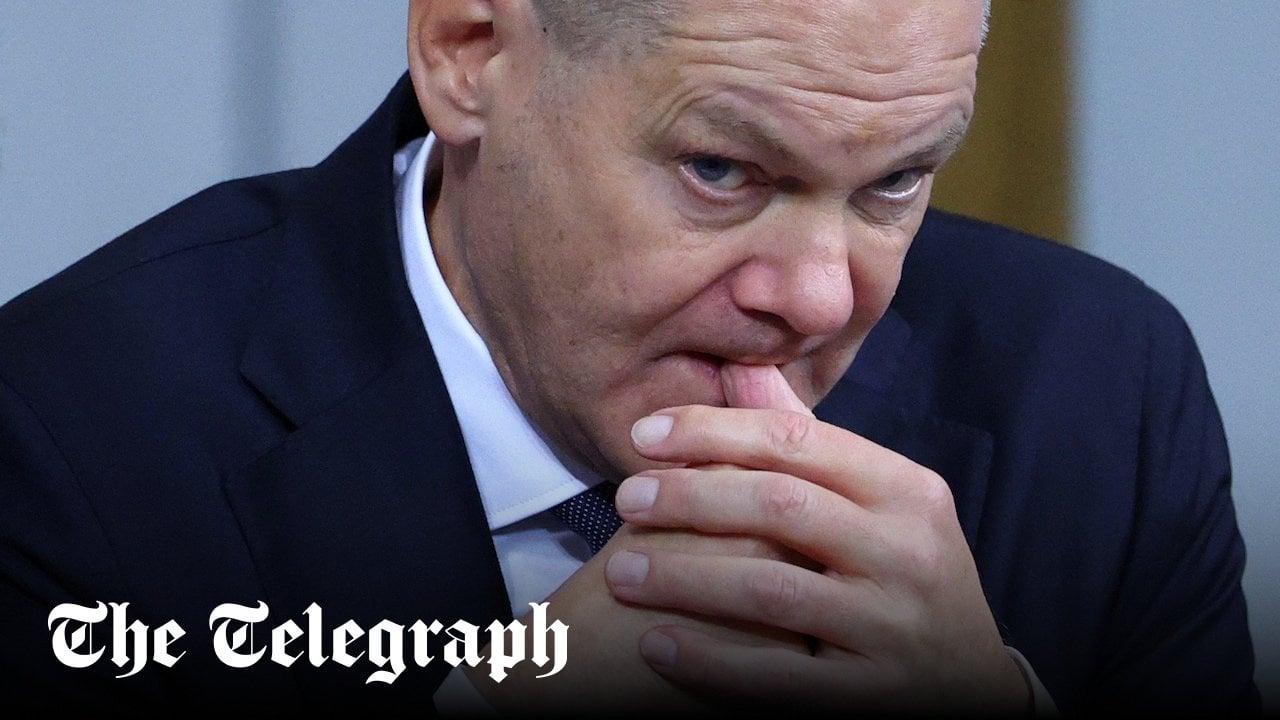
Nel suo discorso al Parlamento la cancelliera tedesca accusa gli altri partiti di voler bloccare gli investimenti necessari
https://www.telegraph.co.uk/world-news/2024/12/16/scholz-loses-vote-of-no-confidence-germany-election/
di ControlCAD

Nel suo discorso al Parlamento la cancelliera tedesca accusa gli altri partiti di voler bloccare gli investimenti necessari
https://www.telegraph.co.uk/world-news/2024/12/16/scholz-loses-vote-of-no-confidence-germany-election/
di ControlCAD
19 commenti
> Olaf Scholz, the German chancellor, has lost a vote of no confidence in parliament, setting the country on course for an election in February.
> The loss comes after the collapse of Mr Scholz’s “traffic light” coalition, based on the party colours of three parties, Scholz’s Social Democrats, the Free Liberals and The Green Party.
> Friedrich Merz, the conservative Christian Democrat Union (CDU) leader, had previously slammed the chancellor as “the low point in the 75-year history of the Federal Republic of Germany”.
> Mr Merz said: “He leaves Germany in a deep crisis, isolated in Europe, and politically adrift.
> “European leaders have stopped taking Scholz seriously. He either remains silent for hours or lectures the world without listening.”
> The chancellor had himself asked Germany’s parliament to declare that it has no confidence in him, taking the first formal step towards securing an early national election.
> Addressing parliament, Mr Scholz framed the snap election as an opportunity for voters to set a new course for Germany, casting it as a choice between a future of higher investment and one of cuts that he said the conservatives were promising.
> Mr Scholz, who served as finance minister for four years in a previous coalition with the conservatives before becoming head of a new government in 2021, accused other parties of wanting to block the investments Germany needed.
> “Shortsightedness might save money in the short term, but the mortgage on our future is unaffordable,” he told lawmakers.
> In parliament, Mr Scholz outlined plans for massive spending on security, business and social welfare, but Mr Merz demanded to know why he had not taken those steps in the past, asking: “Were you on another planet?”
> Mr Scholz argued that his government had made great progress over the past three years, including boosting spending on the German armed forces, which he said previous CDU-led governments had left “in a deplorable state”.
> He said: “It is high time to invest powerfully and decisively in Germany.” He warned about Russia’s war in Ukraine, saying that “a highly armed nuclear power is waging war in Europe just two hours’ flight from here”.
> But Mr Merz fired back at Mr Scholz that he had left the country in “one of the biggest economic crises of the postwar era”.
> Mr Merz said: “You had your chance, but you did not use it… You, Mr Scholz, do not deserve confidence.”
> Mr Scholz’s Social Democrats face a grim outlook in public opinion polls.
> The party’s approval rating stands at just 16 percent, far behind the conservative CDU/CSU bloc at 31-34 percent and the far-Right AfD party at over 20 per cent.
> Mr Scholz is now expected to visit Frank-Walter Steinmeier, the German president, to request the dissolution of the Bundestag.
> Mr Steinmeier has 21 days to make a decision. If the Bundestag is dissolved, new elections are likely to take place on Feb 23, 2025.
> Mr Scholz will remain as caretaker leader until the election.
Wasn’t it expected? He has no majority, wasn’t it obvious literally to everyone?
To absolutely anyone who needs to hear this:
This situation definitely reflects a significant political and economic change in Germany, but it’s not a doomsday scenario.
Scholz losing the no-confidence vote and the collapse of the coalition are big events, but they’re part of how parliamentary systems operate. Democracies are built to handle these crises through elections, and that’s exactly what’s happening.
Economically, there are real structural challenges. Inflation and the energy crisis are putting pressure on households and industries. That said, the country’s industrial base is still strong
Politically, the rise of the AfD is concerning, and the current polling numbers suggest public dissatisfaction. But we’ve seen similar trends across Europe, and mainstream parties still have the opportunity to course-correct through policy changes, especially addressing energy prices and the cost of living.
[removed]
Lindner. The walking joke.
Good
Please guys who should I vote for I recently turned 18 😭🙏🏻
FYI: This was the expected (and intended) outcome.
[removed]
If in upcoming election CDU leading a coilition government comes into picture, what changes in priority can we expect?
Our democracy works. Thats a good thing
He aimed for that, as the current parliament isn’t able to govern the country. The hope is to find a possible majority after the new election.
This may be splitting hairs, but of course this wasn’t a vote of *no* confidence: it was a vote of confidence.
A vote of no confidence is when an opposition party tables a motion that the government has lost the assembly’s confidence. In Germany, this is only possible if a candidate to take over the chancellorship is proposed, making the vote a popularity contest between the incumbant and a challenger.
A vote of confidence is when the chancellor asks the assembly to confirm whether or not they have confidence; if he loses he has the right (but not the duty) to ask the president to dissolve the Bundestag and call for new elections. It’s intended to be a way for the chancellor to gauge whether or not he can count on the Bundestag’s support for something, but because this is one of the very few ways of forcing an early election it’s often misused for that purpose.
If you lose a vote of no confidence doesn’t that mean that you win confidence?
So happy to see the traffic light coalition collapse.
Yeah… it will be election campaigning every Christmas season now.. isn’t that awesome?
Never understood how this guy made it to president. Looking at him he looks more like someone you might meet at a post stamp collectors convention than the leader of EU largest country.
Perhaps an *Alternativ fur Deutschland*?
To be fair, it could hardly be called “loosing” or even a “vote”.
This was quite literally what everybody, including Scholz, wanted. There have been quite a lot f negotiations between the parties regarding this for the last few weeks.
This wasn’t the government going “Oh, we don’t like Scholz, get rid of him.”
This was a tactical political maneuvre to get german politics back on track