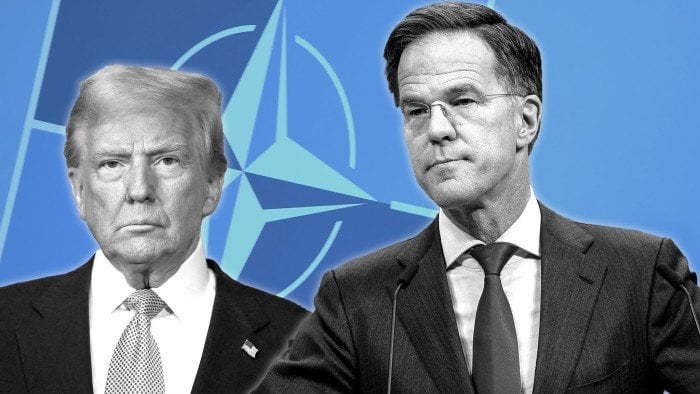
I membri europei della NATO discutono l’obiettivo del 3% per la spesa per la difesa
https://www.ft.com/content/c4942166-c61b-46ec-832f-1671aecf1b02
di Just-Sale-7015

I membri europei della NATO discutono l’obiettivo del 3% per la spesa per la difesa
https://www.ft.com/content/c4942166-c61b-46ec-832f-1671aecf1b02
di Just-Sale-7015
14 commenti
As it’s paywalled, but alas somewhat of a ‘scoop’ not covered by other pieces rn, here’s somewhat extended quote.
>Four people involved in the preliminary talks told the Financial Times they were discussing the steep rise from 2 per cent of GDP, a move that would put intense pressure on already strained national budgets and that has raised misgivings in many capitals.
>
>**The confidential talks, which began during a meeting of alliance foreign ministers last week and could yet fail to reach full agreement, envisage a short-term pledge to hit 2.5 per cent and, by 2030, a target of 3 per cent, three of the people said. The new commitments would be formally agreed at next year’s summit in the Netherlands.**
>
>Mark Rutte, the alliance’s secretary-general, declined to comment when asked about setting a new target, but said he would push for it to be “much more” than the existing benchmark.
>Rutte said it would be “good” to agree a new target at The Hague summit, despite fiscal pressures in Europe that have toppled the German and French governments in the past two months.
>“With all the tasks facing us, in terms of the defence of Ukraine and Nato’s minimum capability requirements, this discussion is going to come, whatever happens,” a German official said. “And the next Nato summit would be the perfect time for it.”
>
>A commitment to 3 per cent would also be a “good signal to the US and to Trump”, the official said. Germany met the 2 per cent target this year for the first time.
>
>The UK is set to spend about £60bn, or 2.3 per cent of GDP, on defence this year, and the government has pledged to raise that to 2.5 per cent. Prime Minister Keir Starmer has not said by when this will happen — only that a pending strategic defence review would set out a “road map” for hitting that target.
>
>Defence officials and analysts openly admit that even spending 2.5 per cent would not be enough for the UK military to modernise itself, continue providing its full suite of capabilities — including the nuclear deterrent — and meet Nato’s updated plans.
>
>“The UK can’t meet its current Nato ‘ask’ at 2.5 per cent of GDP,” one senior British military official told the FT.
>Italy, which spends 1.49 per cent, is already subject to the EU’s Excessive Deficit Procedure for breaking Brussels’ budget rules. Prime Minister Giorgia Meloni’s government has committed to reaching Nato’s current target of 2 per cent of GDP by 2028.
>
>Spain, at the bottom of Nato’s spending league with 1.28 per cent of GDP on defence, has sought to dilute the focus on the 2 per cent threshold.
>Prime Minister Pedro Sánchez reminded foreign correspondents this week that Spain exceeded a second goal of devoting 20 per cent of defence spending to research and development, and contributed large numbers of troops to Nato missions.
>
>The US spends about 3.4 per cent of GDP on defence.
2 steps ahead already.
Should be more like 6%. It would massively stimulate national economies.
I still don’t support a 2.5% target and certainly not a 3% target. This is politics based on pleasing Trump rather than Europe’s own needs.
The only major European economy that currently spends >2.5% is Poland. Italy+Spain isn’t even close to 2%. Most countries barely meet the 2% target and that’s with the Ukraine war ongoing and Germany still using their 100b fund.
Europe is at ~€330 billion already or about a 75% increase. Europe now needs more people. It takes time to recruit and build up new capacities.
I will argue that at ~€330b Europe is already at a level of spending where our security needs can be met. And for every billion we spend on military we have a billion less to spend on schools, healthcare, infrastructure etc.
If Europe is going to commit to such an insane increase it should be based on solid studies about our defense needs.
IMHO spending target was good minimum requirement. But moving forward abilities and responsibilities should be set. Otherwise it will simply inflate costs on simple, pretty, expensive projects without tackling the real difficult and unpopular questions – like laws for civilians to e.g. include shelters in new housing etc.
If Europe wants its own fully independent arms industry with nearly all of its own weapons produced in house, something *at least* above 2.5% should be the goal.
Of course Trump assumes the extra spending will be buying American weapons, because he’s an idiot, but what he doesn’t know or understand can’t hurt him.
Let us make it an even 5
What a dumbass proposal. There is no reality in which this will happen, but what it will do is offer Trump a renewed opportunity to attack NATO again.
I don’t think the budget is the problem. The EU military spending is already close to €300B annually and 2 million soldiers. This is _enough_.
The problem is how it is used. There is not enough coordination between militaries and Europe is highly reliant on foreign equipment. These problems need to be solved rather than just throwing money around.
3% versus a country that changed their whole country to a war-economy is sadly not enough.
Why not go for 5%, it will be painful now, but in the long run cheaper, and can be adjusted downward in a couple of years.
does it really matter? countries that want to spend more will spend more and countries that have other priorities will not.
3 % of GDP doesn’t sound mucj, but what does it mean in terms of national budgets? I think for Slovenia it’s around 12 % of the budget.
What’s the point on increasing the defense spending when we can’t even make a law to prevent Orban from vetoing every single decision?