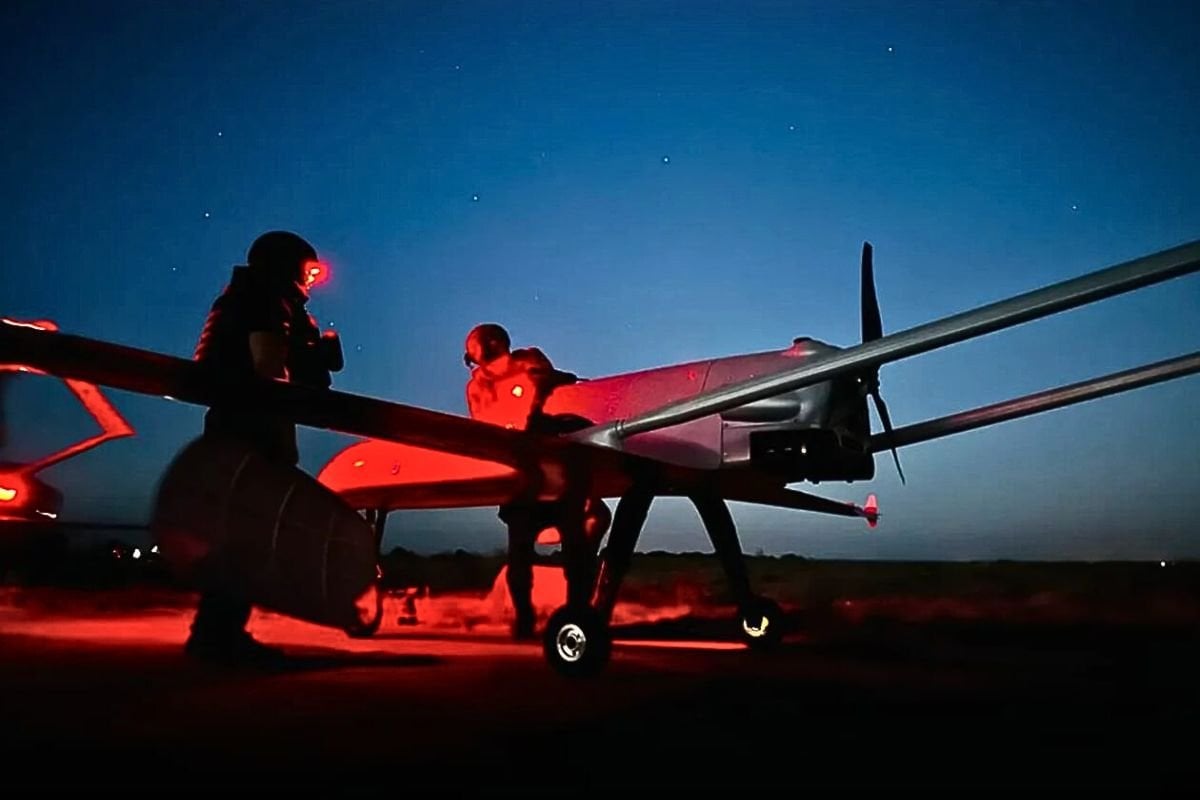
L’Ucraina sviluppa un drone con una gamma di 3.000 km
https://mil.in.ua/en/news/ukraine-develops-drone-with-a-3-000-km-range/
di Mil_in_ua

L’Ucraina sviluppa un drone con una gamma di 3.000 km
https://mil.in.ua/en/news/ukraine-develops-drone-with-a-3-000-km-range/
di Mil_in_ua
5 commenti
Im looking forward to the Bavovna in Omsk
2 stroke diesel I assume, pusher propeller. High aspect ratio wings lower lift induced drag vortice loses and also this has winglets, smooth contour between the body and wing root reduces interference drag.
The wing also makes sense in either a high or low position and is likely a single beam structure, which is stronger and lighter not requiring an O ring to attach, which is a heavy component.
A lot of the features described earlier for long range drones are visible with this. I’d guess the landing gear drops away for further drag reduction.
I wonder what model the engine is. In theory the 2 stroke diesel can get 2kW/kg, and is a major source of mass that limits range or payload, so you want high efficiency but also high power density.
I suggested before a few designs with these features and one could be based on Burt Rutans Long-Ez, but with detaching trolley undergear. It’s quite simple to design a cradle on wheels, when the craft gets to take off speed it lifts up off the front and back parts of the cradle. The cradle supports the fuselage.
The Long Ez has imperfect wing tip devices being angular at the root causing considerable interference drag, but they also function as the rudder. Analysis has been done to make them curved which showed sizable estimated speed improvements.
This gets rid of the tail plane. Front canard can be placed under the nose and attach at a single point, which reduces drag along the fuselage. Or it can just attach on the sides like most of them do.
It also can assist with a nose-up ground effect when taking off potentially.
It’s useful to increase take off speed, which allows smaller wings and better flight speed without fuel penalties and there-by not just range, but range under cover of night, speed through efficiency improvements is paramount. I have suggested that we would use a modified lorry trailer, and the front cab is removed above the engine, and covered. There’s workshops that can do this, and it would be remote operated.
The main wing avoids with such an arrangement the need for flaps or ailerons. As these cover a large part of the span they cause drag over a large wing area, a point of design improvement in the kittyhawk heaviside, which has exceptionally low drag. It appears their drone wing is the same from the picture. The front canard can generate some positive lift, unlike the typical tail arrangement which requires negative lift and thereby needs a larger and heavier main wing. Canard can be all moving surfaces. Or they can be neutral, simply acting as pitch and roll control.
Detachable flaps are a concept that could attach to the trailing edge of the main wing at certain points. These would be single use to help climb with wings that otherwise don’t generate enough lift except at cruising speed, to lower drag.
I suggested also a more complicated way to increase range using wing tip electric pusher propellers driven off a compounding turbo expander on the engine. This would reduce lift induced drag and provide thrust and yaw so that the rudder can be reduced in size and drag. Since this sits on the exhaust it can also muffle noise.
Additionally there’s two groups who have claimed big propeller efficiency improvements, by using prandtl propellers, which means they unload the tips. This also improved efficiency by 15 to 20% and reduced noise.
This design holds a lot of potential, with a 2 stroke diesel [https://en.wikipedia.org/wiki/Rutan_Long-EZ](https://en.wikipedia.org/wiki/Rutan_Long-EZ) and a few aerodynamic tweaks, such as those suggested above, some already run through CFD analysis.
We’d also remove the cockpit bubble.
But I noted at the time even without these improvements it gets over 3000km range. May not be with comparable altitude though. It would also have a useful payload.
I considered a tail behind the pusher propellor but eschewed this since it can interact with prop wash and increase drag.
I first thought they were talking about fpv drones and I thought “HOW TF CAN THAT THING FLY 3000 KM?!” I was wrong, but still, very amazing
What a hunting-range. It could do a lot i think.
Long range is good, but ability to produce these in large quantities is crucial