Respinto da Trump, Europa e Cina pesano legami economici più stretti
https://www.washingtonpost.com/world/2025/04/04/europe-china-trade-talks-trump-tariffs/
di svga

Respinto da Trump, Europa e Cina pesano legami economici più stretti
https://www.washingtonpost.com/world/2025/04/04/europe-china-trade-talks-trump-tariffs/
di svga
8 commenti
Spurned by Trump, Europe and China weigh closer economic ties
Jilted European allies are scrambling to hedge their bets in a world where economic and political alliances have been turned upside down by the United States.
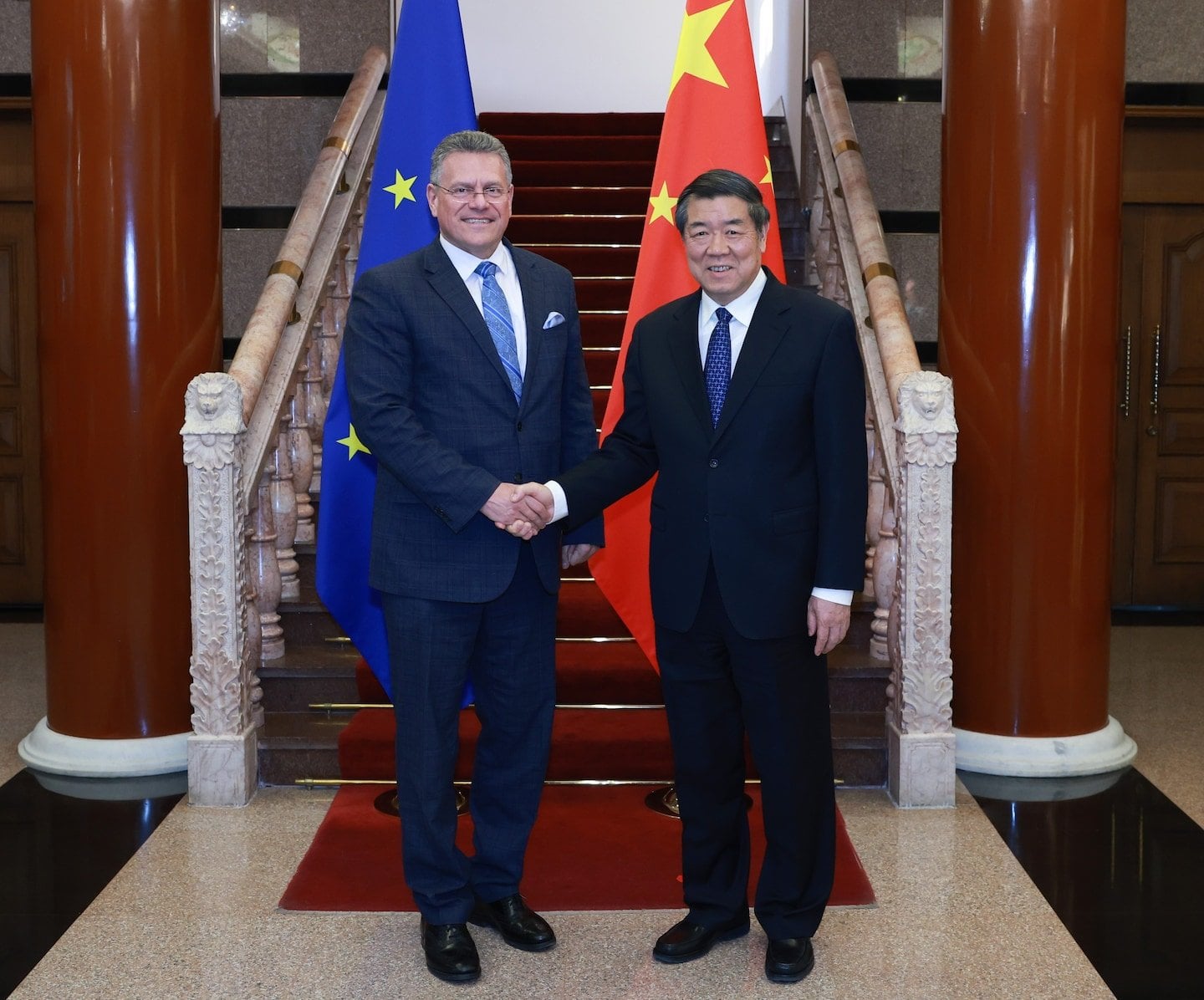
ROME — Hours after failing to stave off U.S. tariffs during meetings in Washington last month, the European Union’s trade representative landed in Beijing to a warmer reception. After meetings with Chinese officials, Maros Sefcovic, the trade representative, heralded E.U.-China ties, with both sides signaling their intent to deepen “trade and investment.”
The trip illustrated how the Trump administration’s jilted allies in Europe are scrambling to hedge their bets in a world where alliances, both economic and political, have been turned upside down by the United States.
Europe has long looked warily on China’s economic power, discouraged from engaging by the U.S. but also out of a homegrown sense of distrust. But as Trump levies crippling tariffs on Europe, China and the rest of the rest of the world, the E.U. is cautiously looking to Beijing as one way to achieve what it now calls a need to “diversify” its economic partners in the face of U.S. aggression.
Led by Spain and Hungary, some countries in the 27-nation E.U. are actively pushing the bloc away from its stated policy of “de-risking” — a view of China as a strategic competitor that presents as much peril as potential for profit. But in a possible thaw in long tense trade relations, the E.U. and China agreed this week to restart talks on one of the thorniest issues dividing them: European tariffs on Chinese electric vehicles. Brussels imposed the levies last year after concluding Chinese automakers were being unfairly subsidized by the government.
China and the E.U. should “jointly resist unilateralism and protectionism to protect the multilateral trading system,” Vice Premier He Lifeng told Sefcovic last month, according to an official Chinese readout.
But if the recent trade talks in Beijing showed anything, it’s that China also provides no easy answer for Europe.
The trip failed to deliver on a key European demand: assurances that a flood of cheap Chinese goods, suddenly facing massive tariffs in the U.S., won’t end up on European store shelves and auto lots. Noah Barkin, a China-E.U. expert at the German Marshall Fund who was briefed on the Beijing meeting, said the bigger message delivered by Lifeng was that China is self-sufficient and doesn’t need to bend to Europe to weather Trump’s trade storm.
“One might view the breakdown in the transatlantic relationship as an opportunity for China, but I think China views it as a sign that Europe is increasingly weak,” Barkin said. “Its best friend is gone. And so, from China’s perspective, its leverage has risen with Europe and that has made it even less willing to compromise.”
Europe, like the U.S., shoulders a massive trade deficit with Beijing, totaling 292 billion euros in 2023. Europe’s main exports to China, its second largest trading partner after the U.S., are machinery, transport equipment and chemicals.
Though China introduced tariffs on European brandy in response to the E.U.’s levies against Chinese electric vehicles — and has threatened more on pork and beef — it has largely refrained from imposing significant tariffs on the bloc’s goods. Europe is not a major source of some of China’s biggest U.S. imports, like soybeans. But the E.U. could become an alternative for some agricultural products, like corn, as well as for pharmaceuticals and other goods, Barkin said.
The challenge remains accessing a Chinese market where domestic companies have become ever more competitive against imports of all sorts.
In Europe, the debate on China happens as the Trump administration is presenting a dramatic challenge to a bloc the U.S. president loves to hate. On Wednesday, President Donald Trump described America’s trade relationship with Europe as “pathetic” while announcing a 20 percent tariff on European goods that, along with those already announced on cars and steel, could hit exports of German cars, Italian leather and French wines.
For the Europeans, it was a reality check. Following the U.S. elections in November, European officials blithely considered Trump a threat they could contain — seeing him largely through the prism of his less disruptive first term. Now, Trump’s unmasked contempt for Europe has sent chills across the continent, spurring calls for a rapid military buildup to counter the Russian threat at a time when American assistance is no longer a given.
But beyond security, Europe finds itself in a tight economic fix. Its largest economy — Germany — spent the past two years in recession. Now, Germany and the rest of the E.U. is staring down the barrel of tariffs on 70 percent of the exports they send to the U.S.
In response, the E.U. has resorted to triage, preparing to unleash retaliatory measures as a precursor to what are likely to be fraught trade negotiations with Washington. Europe is also accelerating free trade talks with Malaysia, Indonesia and, most importantly, India.
There are other signs of urgency, too. France for months has been seeking to block ratification of a landmark free trade deal inked last year between the E.U. and Mercosur, the South American trading bloc. On Friday, however, Paris floated what could be a long-awaited compromise — pushing for an “emergency break” on agricultural goods if European farmers are hit too hard.
For Europe, no trading partner besides the U.S. holds more promise — or challenge — than China.
In an earlier era, Germany seemed to crack the code to doing lucrative business with an Asian giant known for taking more than it gives with its trading partners. But in recent years, much of that changed. In China’s domestic market, once booming sales of German cars began to decline as Chinese automakers, particularly of electric vehicles, overtook the Europeans in terms of cache and technology. In Europe, Chinese companies feasted on homegrown industries — especially once high-flying European manufacturers of solar panels and wind turbines.
Europe is now facing a technology and competitiveness gap with Chinese companies at a time when China’s domestic market remains exceedingly difficult to penetrate, and its own slowing growth is hurting once-booming sales of European luxury goods, from Birkin bags to Ferragamo shoes.
Europe also still can’t quite figure out what it wants from Chinese investment. The Financial Times reported last month that E.U. officials had launched a probe into whether the Chinese government provided unfair subsidies for a BYD electric vehicle plant in Hungary — a move that could lead to fines or worse.
In Spain, the fastest-growing economy in western Europe and the recipient of large-scale Chinese investment, officials lauded the opening last year of a joint venture between China’s Chery and Spain’s EV Motors. But the electric car plant is largely doing final assembly with parts imported from China — falling short of the kind of technology transfers the Europeans crave.
As Trump took office, the Europeans had initially sought to offer Washington a united front against China. Germany’s chancellor-in-waiting, Friedrich Merz, dubbed Beijing part of an “axis of autocracies” that, with Russia, presents a danger to Europe’s liberal democracies. Merz pointedly warned German businesses against investing in China.
“The decision to invest in China is a decision with great risk,” Merz said in January.
Yet Trump’s tariffs may cause Merz to dramatically soften his line. European Commission President Ursula von der Leyen already has in recent policy speeches. One person familiar with the discussions said that the European Commission is planning a high-level delegation visit to Beijing later this year.
Spanish Prime Minister Pedro Sánchez last month said he would visit China in April, marking his second trip there since September and one that comes on the heels of nearly $10 billion in investments announced by Chinese companies in Spain.
Europe has “realized that the further the U.S. pushes them away, the closer they need to work [with] China,” said Victor Crochet, a Brussels-based trade lawyer doing extensive work in Asia.
Based and trade-pilled. Uyg-what? Never heard of ‘em
I’m not sure it’s a good idea to trade an oligarchy for a dictatorship.
Europe should just focus on strengthening ties within it’s own countries.
Most tech is made in China with a US price tag slapped on. Why not cut out the middle man? I do remember reading someone describing the US and China as the two legs of the same economic monster but hey ho, the US has performed an amputation and the economic monster now needs another leg.
Europe needs a new consumer market, not try to compete with another export led economy at China’s scale. China is an overproducer of most goods at much lower cost than anything Europe will be able to sell at scale. The Germans tried this with Mercedes and BMW. The Chinese copied their designs and are selling them cheaper, causing those companies’ sales numbers plummet in China. China is a golden trap.
A delay, this can be made up for, cf China, from a pragmatic point of view, yes in the short term, there is a rapprochement which will take place and then Europe is learning, that yes alliance, but also having its own forces, I would not be surprised by a re-confrontation of the BRICS with Europe at the center
Bad idea. China is not the partner you want for balanced trade There are sufficient other candidates for closer economic ties
I would say there is a limit to this partnership as relations were relatively rocky prior.
Both may cooperate, but I don’t see anything further than that. Generally Europe has already indicated that they are on team-USA, and China is going to focus more on the global south.