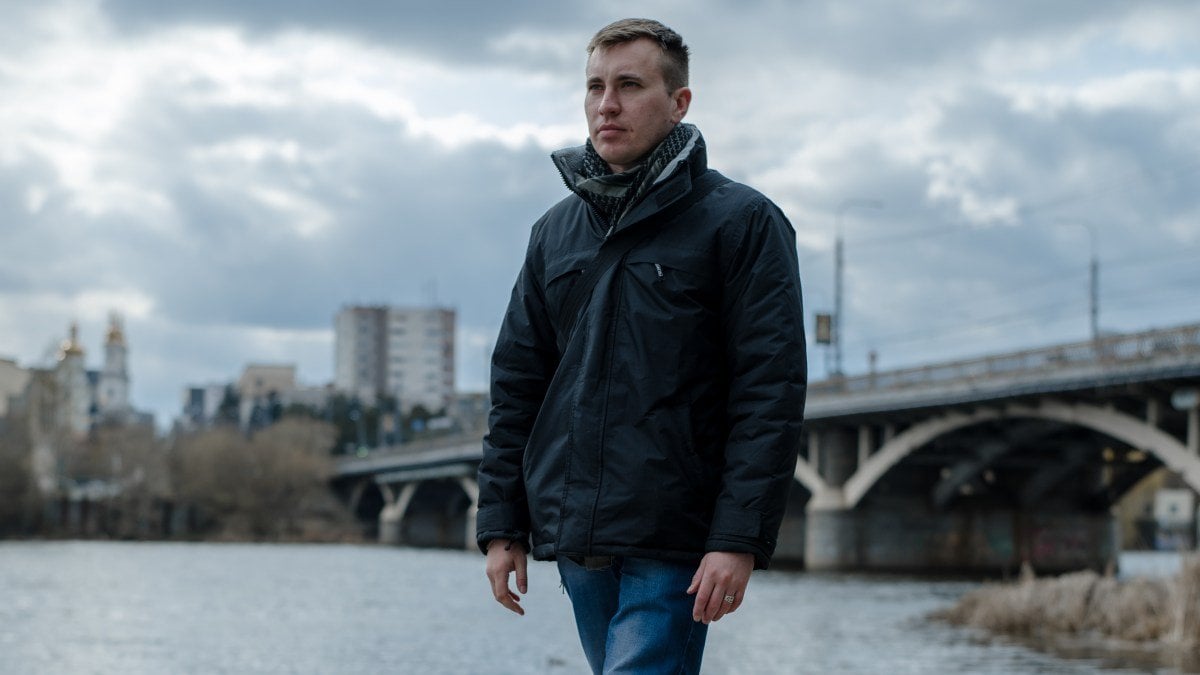
Ero un prigionia in Russia – le guardie suonavano musica pop prima dei battiti
https://www.thetimes.com/world/russia-ukraine-war/article/pow-prisoner-putin-swaps-87j9p5nsw
di TimesandSundayTimes

Ero un prigionia in Russia – le guardie suonavano musica pop prima dei battiti
https://www.thetimes.com/world/russia-ukraine-war/article/pow-prisoner-putin-swaps-87j9p5nsw
di TimesandSundayTimes
3 commenti
https://archive.ph/bMh7L
archive.ph
I was a PoW in Russia — guards played pop music before beatings
8 – 10 minutes
On the night the Ukrainians were released, there was a brief moment at the border when they glimpsed the Russians for whom they were being exchanged being driven in the opposite direction. “There was no hatred,” Oleksandr Gudilin recalled. “Only a kind of curiosity to see what state they were in compared to us.”
Then, in the cold December darkness, he began to see crowds of people lining the roads, cheering and waving blue and yellow flags. It was the moment of deliverance that Gudilin, 34, had thought about constantly for nearly three years.
But he experienced no joy. To survive he had learnt to suppress all feeling.
For the people of Ukraine, few questions that hang over the ceasefire negotiations are more emotive than the fate of those trapped in Russian captivity. Since the start of the invasion in 2022 more than 4,000 Ukrainian captives have been released in prisoner exchanges. But thousands more are still in Russian hands, along with an estimated 16,000 civilians from occupied territories who have been imprisoned without trial or charge. Ukrainian officials say Russia has also abducted 20,000 children.
Soldiers with hands raised walking in Mariupol.
Russian TV broadcast video of Ukrainian soldiers being detained in Mariupol
President Zelensky has said that their release is a condition for any truce but the Kremlin has given no such guarantees and continues to play for time while escalating its military operations. Last week President Trump’s envoy to Ukraine, General Keith Kellogg, suggested that the country be partitioned “almost like Berlin after World War Two”.
For Ukraine, there is a particular urgency to returning those imprisoned. It is clear from the testimonies of the released — gathered by Ukrainian and international human rights organisations — that Russia pays scant regard to the Geneva Convention in its treatment of PoWs.
Stories of physical, sexual and psychological abuse are common. Prisoner executions are rising sharply, with 79 reported killings between last August and February this year, according to a recent UN report. The reported total since 2022 is 150.
Gudilin’s experience attests to this systematised brutality.
He was captured on April 12, 2022, while defending his coastal hometown of Mariupol, and spent 1,000 days locked inside the savage void of the Russian penal system. On December 30 last year he was part of a prisoner exchange involving over 150 soldiers from both sides, one of the biggest swaps of the conflict.
We meet in Vinnytsia, a city in central Ukraine where he has relocated due to Mariupol’s occupation and where he is receiving rehabilitation. He is still coming to terms with what he endured.
“There are periods of time that my memory has completely blanked out, and I don’t understand why,” he said. “But there are also other times, often moments of extreme stress or emotion, that my memory has recorded with vivid precision.”
He remembers, for example, the night he thought his hair would turn white listening to the sound of Russian guards battering prisoners with fists and metal piping, knowing it would be his turn in the morning. Or the feeling of constant hunger, and the terrible disappointment of waking from a dream in which he was eating his favourite meal. Or the Russian pop song Forever Young, Forever Drunk, which one commandant would play as he selected who to beat.
Gudilin was working as a journalist in Mariupol when Russia launched its full invasion. Sensing that war was imminent, he had six months earlier joined the Territorial Defence Forces, a reservist contingent, which provided him with basic training.
In the early hours of February 24, 2022, he was woken by the sound of artillery shells raining down on the city. He packed his bags and went straight to headquarters, where he was assigned to a unit with nine other reservists.
Their role was initially to guard critical infrastructure and military sites. But by early March, with the city surrounded and the Russians closing in, the reservists — who a month earlier had been cashiers, businessmen and reporters — were fighting alongside and against professional soldiers.
Oleksandr Gudilin, serving in Mariupol, March 2022.
Gudilin serving in Mariupol, March 2022
After a fortnight of skirmishing in ruined streets, Ukrainian forces retreated into Mariupol’s fortress-like steelworks — half going to Azovstal and the other to Illich. Gudilin went to Illich, a vast 14 sq km site. Every morning, he would wake at 4am and venture out into the maze of production lines to fight off waves of enemy attackers.
“After each day, when you come back alive, you were so tired but you would feel an incredible euphoria knowing you had survived,” he said. “You’d drink a cup of instant coffee and it would taste like the best coffee in the world. Gradually though, that feeling would wane as you realised that your luck is not eternal and tomorrow it may run out.”
Armored convoy of pro-Russian troops in Mariupol.
A Russian convoy moves through Mariupol, April 2022
CHINGIS KONDAROV/REUTERS
It soon became clear that no amount of luck was going to save them.
After two disastrous attempts to break out of the plant, on April 12 the 1,200 soldiers defending Illich were ordered to surrender.
From there, they were taken to a Russian military base in Sartana, just outside the city, where as soon as he arrived he was kicked in the kidneys by a guard. “And from that moment I realised that there would be no Geneva Convention,” he said.
After a few days in Sartana, Gudilin then embarked on “a tour of the Russian Federation”, moving from prison to prison every few weeks and months. Beatings were routine in all of them. At a camp in Kamensk-Shakhtinsky, near Ukraine’s eastern border, “we would be beaten while we were getting dressed, while we were eating, and when we were going to sleep”.
Violence towards captives seemed more than anything to be a “matter of course”, he said, though there were some guards who took obvious pleasure. For example, the commandant who played Forever Young, Forever Drunk, once flooded a cell with tear gas after a prisoner complained that he was cold.
After a year of constant relocation, he was moved to a prison in Horlivka, in the occupied Donetsk region, where he would spend the majority of his internment. Here conditions were better. Beatings were less frequent and PoWs were freer to move around the jail and interact with one another.
To stay busy, they organised weekly lectures in which the prisoners would talk about their professions before the war. He also took classes in English from another prisoner.
Over the years Gudilin witnessed many others being swapped, and it was never clear as to why some were chosen and others were not. At the end of 2024 the head of the camp asked him if he wanted to be exchanged. When he said he did, they offered to send him back to Russian-occupied Mariupol, where they would provide him with a flat and a job. “I declined that kind offer,” he said, with a smirk.
His first thought upon returning was to rejoin the army, even though as a former PoW he is one of the few Ukrainians entitled to leave the military during wartime. But since then, he was offered a short contract with an aid organisation and said he wanted to spend some more time in civilian life before choosing whether or not to rejoin the army.
He remained convinced that Ukraine must keep fighting with the help of its western allies. “No truce with Russia is possible because Russia never follows the conditions of any agreements,” he said. “They will only use this time to gain more power and come back again later.”
Oleksandr Gudilin, a Mariupol defender, sits on a staircase.
Gudilin in his new town of Vinnytsia, where doesn’t know many people
VIACHESLAV RATYNSKYI FOR THE SUNDAY TIMES
Gudilin was at pains not to wallow in the horror of what he lived through. At one point, when I compared his experience to life in the Soviet Gulag, he disagreed. “I’ve read [the Soviet dissident Aleksandr] Solzhenitsyn and there are some overlaps,” he said. “But in the Gulag people were dying on a daily basis. In prison people only died occasionally.”
Readjustment to normal life has not been easy. In Vinnytsia he knows few people, besides his parents who moved here too. Unexpectedly trivial situations, like paying for items in a shop, can sometimes throw him.
“But what helps me the most is knowing I am responsible for myself again,” he said. “I can now do all the things that I would think about when I was imprisoned, silly things like being able to read a book and jot down my favourite quotes. It may be small, but that’s freedom.”
The question now is whether, or how soon, those small freedoms can be secured for the thousands of Ukrainians still lost in President Putin’s internment archipelago.
Additional reporting by Viktoria Sybir
russians try to inflict trauma that lasts longer than captivity. They want to associate music with beatings, they want people to panic in what should be a normal, enjoyable setting.
[removed]