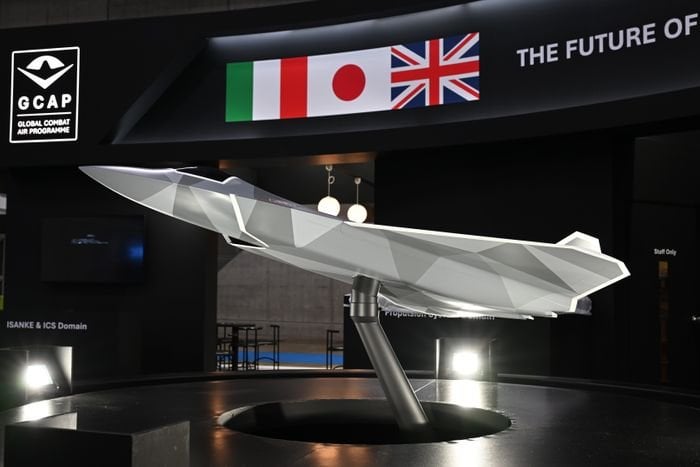
Programma GCAP: l’UE approva la joint venture UK-Italy-Japan per il jet da combattimento di sesta generazione
GCAP programme: EU approves UK–Italy–Japan joint venture for sixth-generation fighter jet
di Agreeable-Street-882

Programma GCAP: l’UE approva la joint venture UK-Italy-Japan per il jet da combattimento di sesta generazione
GCAP programme: EU approves UK–Italy–Japan joint venture for sixth-generation fighter jet
di Agreeable-Street-882
8 commenti
The European Union has given formal approval to a joint venture involving BAE Systems (Holdings) Limited, Japan Aircraft Industrial Enhancement Co Ltd, and Leonardo S.p.A. The newly formed company will act as the prime contractor and lead systems integrator for the Global Combat Air Programme (GCAP).
The partnership aims to develop a sixth-generation combat aircraft, primarily for the governments of the United Kingdom, Italy, and Japan. According to the European Commission, there is also potential for sales to other governments or jurisdictions in the future.
Ownership of the joint venture will be equally divided, with each partner holding a 33.3% share. The company will be headquartered in Britain, and its first CEO will be from Italy.
GCAP is a collaborative multi-national initiative with the ambition to deliver a next-generation fighter aircraft by 2035. The aircraft will form the central component of a broader ‘system of systems’ designed to operate across air, land, sea, space and cyber domains.
The fighter will be fully digital and capable of executing missions alongside other assets through an integrated command, control and communications system. This infrastructure will incorporate artificial intelligence, supercomputing, a combat cloud, and high-speed, cyber-resilient datalinks to support rapid and secure data sharing.
GCAP is expected to generate significant technological advancement and economic growth in all three partner countries. It will support highly skilled employment and foster industrial development across the aerospace and defence sectors, involving companies such as Avio Aero, Elettronica, and MBDA Italia along with universities, research centres, SMEs and start-ups.
France, Germany, and Spain are concurrently developing a separate next-generation fighter project, raising questions among industry experts about Europe’s ability to sustain two major defence programmes. Despite this, GCAP is considered one of the most advanced and strategic initiatives in the Aerospace, Defence and Security sector, aimed at ensuring technological sovereignty for future generations.
Next on Top Gear: Clarkson tries to parallel park the sixth-gen fighter jet in a London alley.
Why did we need EU approval on this? The EU bureaucracy is braking all countries projects, probably all the propaganda about “EU times” maybe was true but in reality it doesnt replace the “x nation time” but just adds to it
Aston Martin-Ferrari-Toyota
Let’s hope for a successful venture!
I don’t think Italy actually needs the EU’s approval, and I know the UK and Japan don’t.
Reasonable competition in such projects is necessary, so I don’t see reasons EU to have make both projects to the prototype stage, but then choose the best one and launch serial production.
Please let Canada in 🙏