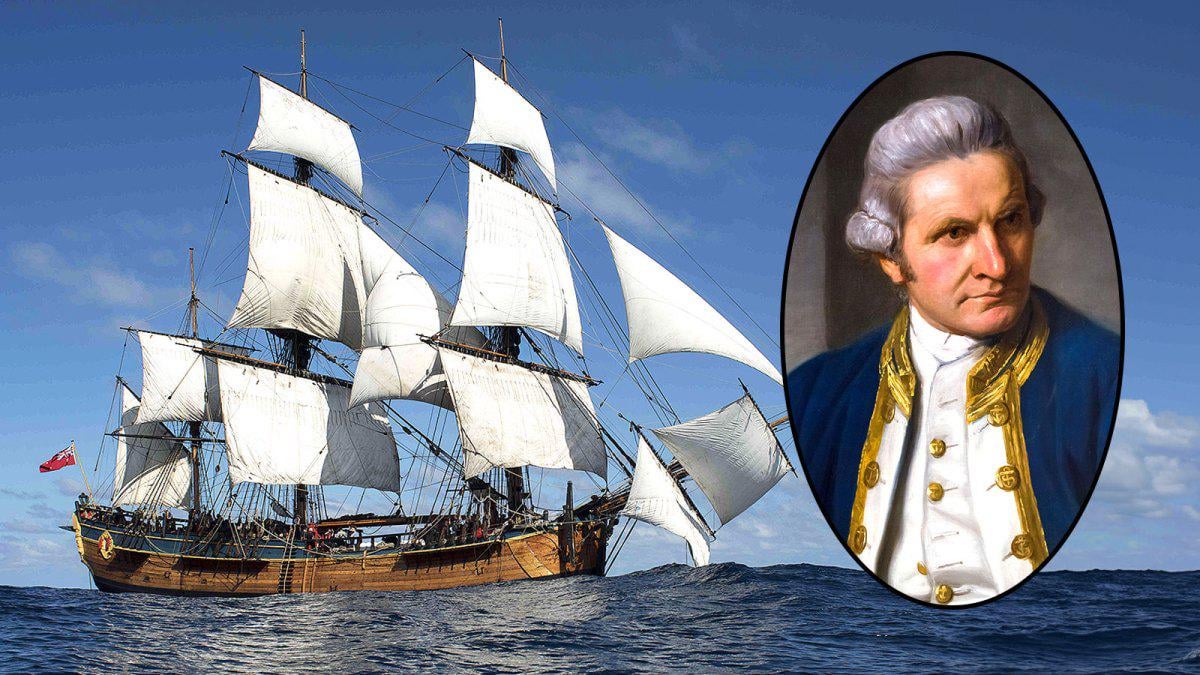
Il luogo di riposo finale dell’HMS Endeavor di Captain Cook
https://www.thetimes.com/uk/history/article/final-resting-place-of-captain-cooks-hms-endeavour-identified-bqwk3xmvl
di BestButtons

Il luogo di riposo finale dell’HMS Endeavor di Captain Cook
https://www.thetimes.com/uk/history/article/final-resting-place-of-captain-cooks-hms-endeavour-identified-bqwk3xmvl
di BestButtons
6 commenti
Article contents:
*Mark Ludlow, June 16 2025, The Times*
The final resting place of the HMS Endeavour, the ship on which Captain James Cook mapped the Pacific Ocean and claimed Australia for the British crown, has been confirmed by researchers as Rhode Island in the United States.
The whereabouts of the Endeavour, which Cook used to reach the Australian continent in 1770 and travel the South Pacific, has been hotly debated for years.
Indeed, a preliminary report in 2022 from the Australian National Maritime Museum, which made the initial claim about the Endeavour, was disputed by Rhode Island investigators.
The Rhode Island Marine Archaeology Project (RIMAP), which had been searching for the wreckage with the Australian authorities since 1999, dismissed the original findings as “premature” or “based on Australian emotions and politics” rather than science.
But after three more years of research, the Australian National Maritime Museum has stood by its original decision — that the shipwreck in Newport Harbour was the Lord Sandwich, previously known as the Endeavour.
The ship, which was sold to private owners, was sunk by the British authorities in 1778 to blockade the French during the American War of Independence. Cook’s voyage on the Endeavour began in 1768, exploring New Zealand in 1769 before reaching the coast of New South Wales in 1770.
Daryl Karp, the director of the Australian National Maritime Museum, said the conclusion was “the culmination of 25 years of detailed and meticulous archaeological study on this important vessel.
“It has involved underwater investigation in the US and extensive research in institutions across the globe,” she said. “This final report marks our definitive statement on the project.”
The museum matched the placement of British timber from the Endeavour’s original plans to those found on the wreck’s main and fore masts. It paid tribute to RIMAP and its “fine historical analysis and detailed artefact recording”, while noting that RIMAP had not ruled out other possible sites for the Endeavour’s final resting place.
The museum recommended more work be done to protect the site at Rhode Island, with the wood slowly deteriorating after 250 years. RIMAP has not yet responded to the final report. But in 2022, it played down claims by the then museum director Kevin Sumption that it had discovered the “ship’s final resting place”. RIMAP’s executive director and principal investigator Kathy Abbass said there was “no indisputable data” to prove it was the iconic vessel.
“There are many unanswered questions that could overturn such an identification,” she said at the time. Adding that “RIMAP recognises the connection between Australian citizens of British descent and the Endeavour, but RIMAP’s conclusions will be driven by proper scientific process.”
In recent decades, Australians have had a mixed relationship with Cook and the Endeavour. While his remarkable journey was the first time the east coast of Australia had been “discovered” by Europeans, it is also bookmarked by indigenous Australians as the start of 200 years of dispossession of their lands.
A monument to Cook in a Melbourne park was removed last month after being repeatedly vandalised.
There has also been a push in recent years to change the date of the Australia Day bank holiday that is celebrated on January 26, the date Captain Arthur Phillip sailed into Sydney Harbour in 1788 and hoisted the British flag.
Just checking, are we allowed to be proud of Captain Cook, or is the narrative that he was an evil, bigoted, coloniser? Asking for a friend.
A ship so cool, a space shuttle was named after it. Capt Cook, despite what you may think of him, in that century, boldly went where no man had gone before.
Tom Hanks stars as Dr. Jack Rourke, a once-renowned naval historian now reduced to adjunct teaching and unpaid museum tours after a scandal tarnished his credibility. Haunted by personal failure and professional ruin, Jack clings to one remaining obsession: his lifelong theory that HMS *Endeavour*, the ship that carried James Cook to the South Pacific, was deliberately scuttled in Newport Harbour during the American Revolution—not wrecked off the coast of Australia as widely believed.
With archaeological whispers and half-buried Royal Navy records as his only leads, Jack assembles a ragtag crew of believers: a sharp-tongued graduate student with a talent for sonar imaging, a retired Navy diver with a secret past, and a tech-savvy archivist who’s been denied tenure one too many times.
Standing in their way is Dr. Adelaide Greaves, a polished, media-savvy Australian historian funded by a billionaire maritime institute. Her team has political muscle, satellite imaging, and a seductive story that bolsters national pride. Australia *wants* the *Endeavour*—and Greaves is willing to rewrite, manipulate, and erase to claim it.
As Jack’s team uncovers submerged wreckage off Rhode Island, sabotage begins. Permits vanish. Drones go missing. Anonymous threats escalate. What started as academic rivalry becomes dangerous. With hurricane season looming and the clock ticking on a legal injunction from Canberra, Jack must defy the U.S. Navy, expose an international cover-up, and dive beneath decades of mud and myth.
In a breathless underwater climax, Jack risks his life to retrieve a barnacle-encrusted ship’s bell engraved with the word no one wants found in Newport: *Endeavour*.
But when truth threatens profits, reputations, and national identity, will the world believe a broken man’s discovery? Or will history be buried once again?
Endeavour Rises: coming this summer to a cinema near you.
Stolen our history! If they want the marbles back they should be forced to return our ship! Its so disrespectful of our empire
They should raise it like The Mary Rose then put it in a dreary visitors centre.