Aleksandar Vucic della Serbia è agitato
https://www.economist.com/europe/2025/06/19/serbias-aleksandar-vucic-is-rattled
di Infosignalsol

Aleksandar Vucic della Serbia è agitato
https://www.economist.com/europe/2025/06/19/serbias-aleksandar-vucic-is-rattled
di Infosignalsol
3 commenti
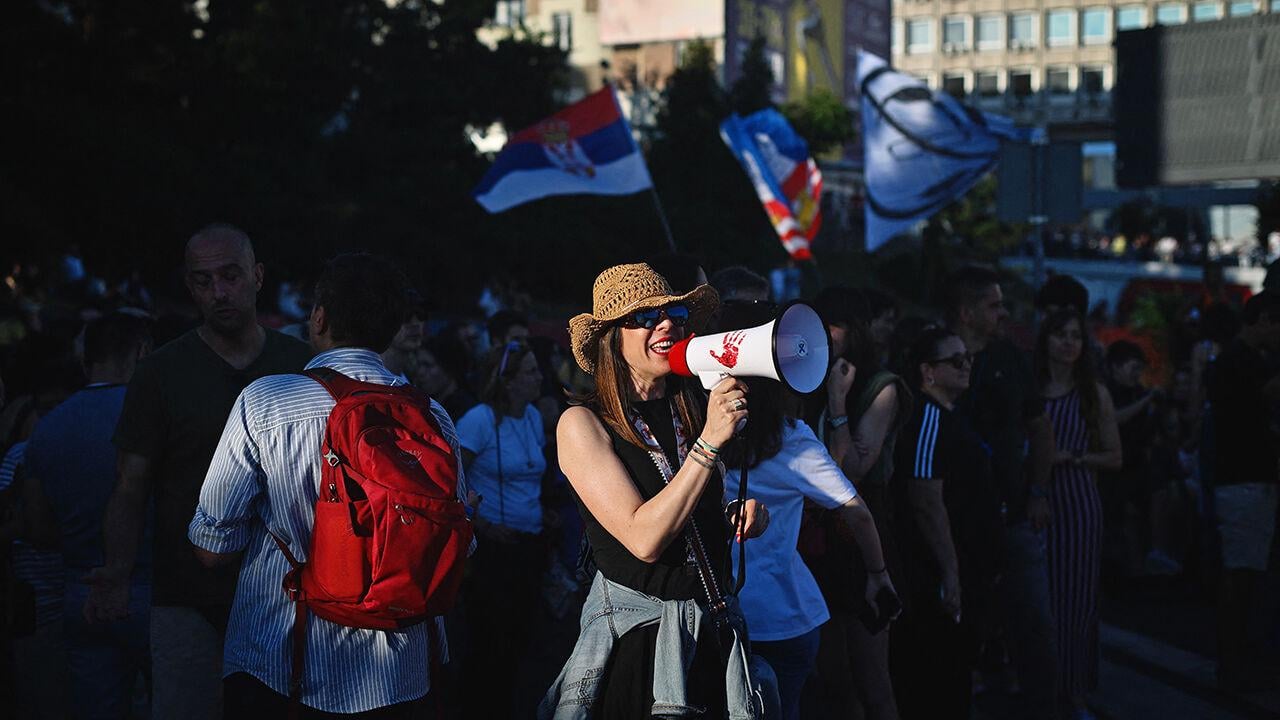
Months of mass demonstrations led by students, which prove to be very resilient, have deeply shaken Serbian President Aleksandar Vucic, who has ruled the country since 2012, according to the British weekly Economist.
In a text published on the website of the British weekly, Vucic was described as a “Balkan bully”, with the assessment that he is “on his knees”.
The British weekly states that students in Serbia must decide “whether to graduate this year or to go all the way in trying to take down Aleksandar Vucic from power.”
“Student demonstrations started during the winter do not fade and have become an instrument for expressing resistance to the president. So far, the demonstrations have failed to overthrow him from power, but he has not been able to stifle them either,” reads the text “Serbian leader Aleksandar Vucic deeply shaken.”
The text, which will be published tomorrow in the print edition of the Economists, reminds that the protests began after 16 people were killed during the fall of a concrete canopy at the railway station in Novi Sad.
“Since the station had just been renovated, many suspected corruption. In an attempt to appease the protesters, Vucic replaced the prime minister, but he failed in his intention,” it said.
The British weekly newspaper adds that students have refused to cooperate with well-known but weak opposition parties, saying initially that they only want justice and better governance of the country, but that they have recently begun seeking early elections.
The economist states that Vucic has ruled Serbia since 2012, that he was an influential figure at the time of Slobodan Milosevic, and that in recent years he has overcome several waves of protests, including demonstrations against the controversial plan for the excavation of lithium – which the European Commission has included on the list of projects of strategic importance for the European Union this month.
“Serbia, a candidate for EU membership, under Vucic’s rule, manages to maintain friendly relations with Russia, although it supplies Ukraine with weapons. His ruling party functions as a clientelistic mechanism — it provides jobs to its supporters in exchange for votes. It also controls all the leading media,” the text reads.
The economist then states that the latest protests have shaken Vucic, and that he accuses the students of being foreign mercenaries and talking about a mysterious coup attempt.
“Liberal NGOs have been targeted by attacks because they are receiving funds from abroad. In the last ten years, the EU has donated 64 million euros for NGOs’ initiatives. But that’s just a fraction of what the EU has given to the government for the modernisation of Serbia as a whole,” it said.
On March 15, “during the most likely the biggest protest in the history of Serbia, a part of the gathered appeared a panic that was apparently caused by the police use of sound weapons of long-range sound weapons.”
Exit, a major music festival in Novi Sad that returned Serbia to the cultural map of the world after the Balkan wars, was left without state funding due to the support of students, and this year’s edition will be the last to be held in Serbia, according to the Economist.
The newspaper also writes that Vucic’s party barely managed to win the June 8 local elections in Zajecar and Kosjerić, where it had previously won almost 80% of the vote, and that Vucic therefore refuses to agree to early elections.
“He is now trying to turn the students against each other. They have been holding universities in lockdown for months. The government has stopped paying salaries to professors – they receive only 12.5 per cent of their earnings, with the rationale not to keep teaching,” it said.
The British weekly also writes that the rector of the University of Belgrade, Vladan Djokic, is negotiating with the government that classes are mostly held online during the summer so that students can finish the school year and enroll in the next one.
“Djokic, who is popular among students, faces mounting criminal charges over the blockade of the university. If the university’s student lockdown resumes, the rector states that the government could begin the persecution of members of the academic community who dislike it, including him. But if he loses his job, he could help in leading Serbia after Vucic,” the Economist adds.
As somebody in Serbia, let’s hope so, but too early to get too hopeful.
I don’t take seriously anything coming from Britain.