
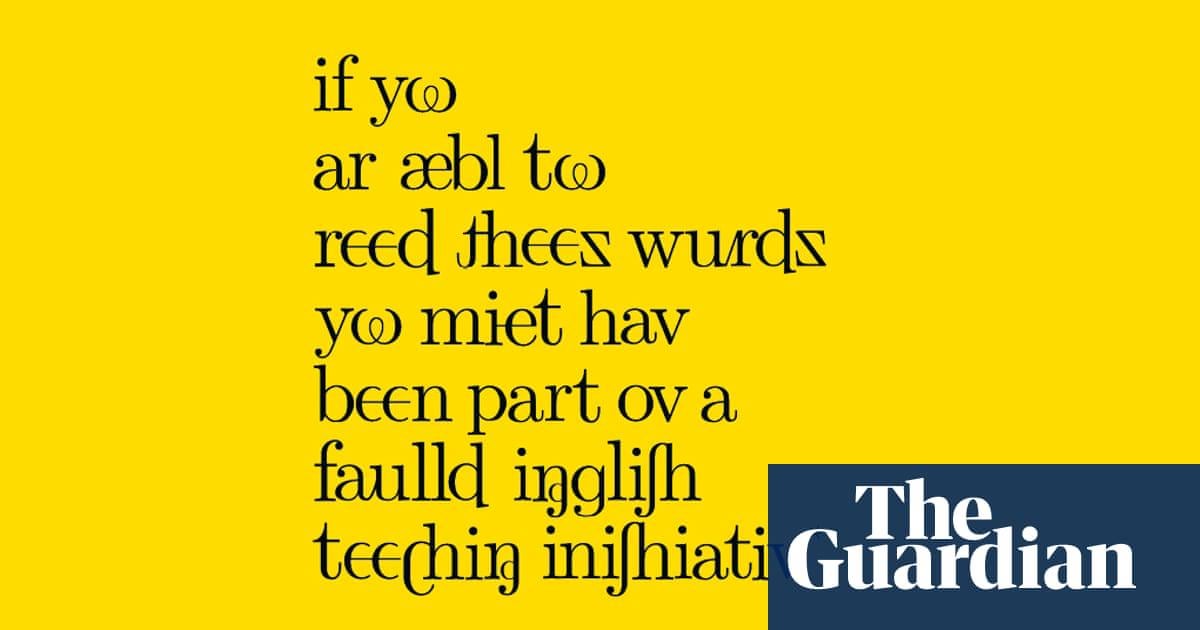
L’esperimento delle scuole radicali degli anni ’60 che ha creato un alfabeto completamente nuovo e ha lasciato migliaia di bambini incapaci di scrivere
https://www.theguardian.com/education/2025/jul/06/1960s-schools-experiment-created-new-alphabet-thousands-children-unable-to-spell
di qwerty_1965
14 commenti
”If you are able to read these words, you might have been part of a failed english teaching initiative”
I was born in 1988, so I suspect it’s simply just not THAT crazy a stretch from our current alphabet.
I left school in 1959 & had no trouble reading this. I think it’s a matter of how your brain is wired , although if I had not learned to spell & read using the standard alphabet . I would definitely have struggled.
I’m 60s child have heard of ITA but I think it missed my school! Having said that I could make out most of the words shown
It had it’s own letter for each sound – maybe 46 and kids learnt to read really quickly with it as it was phonic; spelling had to be taught when children transferred to traditional reading. Swings and roundabouts.
Or you might not have been lol….anyone can figure out what that says
First time I’ve heard about it and maybe it’s just the novelty of having just learnt about it but I think it’s much better and more pratical then our current alphabet and would make an awesome replacement
I learned to read using ITA and my reading and spelling are fine. I do remember some concerned conversations between parents and teachers about making the transition to the “real” alphabet.
I get that English has an absurd number of vowel sounds and diphthongs (although not as many as Danish) – but if we’re adding all those extra letters for vowels, why are we still using digraphs for sh, ch, th? Especially in England where thorn (Þ) and eth (ð) had perfectly good usage until a couple of centuries ago! Why not make X go back to its original Greek sound? Or just use the IPA versions?
Honestly some of the decisions are frustrating. So many lost opportunities – they could halve the number of consonant letters if they just used a diacritical to indicate voiced/unvoiced as well.
I was taught using ITA and seemed to remember it focussing on the sounds of the letters within words .
I moved to a school that used it and felt like a moron. What a stupid invention. It held slow kids back really badly.
Teacher here. It is heartbreaking, enraging and frustrating that we _know_ how to educate children and we don’t do it.
If you want children to be literate, numerate, scientifically knowledgeable in the most basic ways, we can do it.
We know what works.
It’s been shown time and time again what works.
There have been multiple failed attempts to try “child centred learning” or “enquiry based learning” and they all sound lovely, but fail spectacularly.
There are many ways to get it wrong. And they all sound great. Things like “gamify everything!”. Or “make the thing relevant to the kids’ everyday life!”. Or “don’t _teach_ them, let them explore”.
Learning things is hard work. But hard work can be, and is, fun if you feel successful at each step.
All the bullshit “new! Exciting! Innovative!” bollocks is always a direct route to failure for most students.
I started with that. It worked out OK for me but I can see how other kids could have found it all confusing at best.
Fortunately I could read before I went to school, so learning ITA, which I remember very clearly, was an interesting exercise, but not fundamental to my reading. Mind you I am seriously dyslexic. At one time I did wonder if there was a link, but now I am quite sure there is not.
I still have some old exercise books with comments written by my teachers *in ITA*. They must have practised writing it.
A significant reason for its pointlessness is that one learns to read by reinforcement. There is text all around us (road signs, packets of cereal, etc) and practising reading on real life examples is an important part of building strength. Now I live in Japan and am trying to learn Japanese, the same is true.
But the only ITA was at school.
This is just the international phonetic alphabet. They’re trying to write phonetically instead of reaching all the rules and exceptions in English.
However, most people get this wrong. For example, they think “spot” is phonetic, but it’s actually closer to “sbot” and words like handbag become ‘hambag’