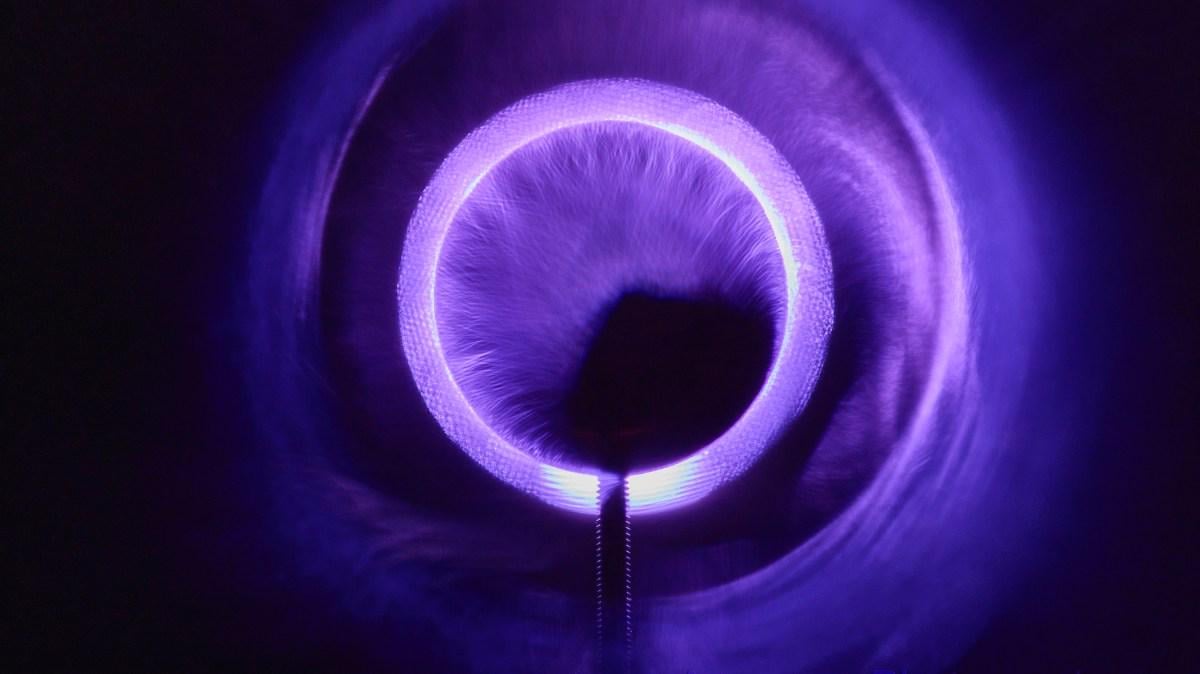
Il mini reattore di fusione nucleare britannica che funziona effettivamente
https://www.thetimes.com/uk/science/article/only-working-nuclear-fusion-reactor-bristol-k85tjk2lx
di BestButtons

Il mini reattore di fusione nucleare britannica che funziona effettivamente
https://www.thetimes.com/uk/science/article/only-working-nuclear-fusion-reactor-bristol-k85tjk2lx
di BestButtons
8 commenti
Some good news for Monday morning:
*Tom Whipple, June 29 2025, The Times*
There are a few things that mark this nuclear fusion reactor out as unusual. For one, it is rather small: it could fit on a table top. For another, this research model currently has a little more gaffer tape than you might expect of the energy technology of the future.
But the biggest difference between it and its competitors is that this nuclear fusion reactor, in a warehouse north of Bristol, is actually working. And it is on the cusp of doing something more unusual still: making money.
For those who think they may have missed the development of a panacea for the world’s energy problems, though, this isn’t that — yet. Rather than being a solution for clean electricity the plan is simply to cure cancer by alleviating a desperate shortage of medical radioisotopes.
“We have got thousands of drugs going through medical trials that use nuclear medicine, and at the same time you have got the supply dwindling,” said Dr Tom Wallace-Smith from Astral Systems.
Radioisotopes are chemicals that can be used to diagnose or treat cancers. Some, such as iodine-131, are crucial in treatment. But many of the most important ones are made by bombarding other chemicals with neutrons. Currently, doing so relies on ageing nuclear reactors, some of which regularly break down, and none of which are in the UK. Doctors are increasingly concerned about shortages.
“There’s this real mismatch, which is constraining the industry,” said Wallace-Smith. This is where he thinks they can help, using nuclear fusion as a new way to provide the necessary neutrons.
Nuclear fusion harnesses the processes found in the sun to join together two hydrogen atoms to become one helium and a neutron. The neutrons can then in theory be used to generate electricity. For clean power advocates, if we could get it to work it would be a solution to climate change, providing unlimited carbon-free energy. But to achieve it requires controlling conditions similar to the sun, while also getting more energy out than you put in. Companies and governments around the world have been working for decades to make a practical reactor.
At Astral Systems, the company co-founded by Wallace-Smith, who did his PhD at Bristol, they have just such a practical reactor. Or, in fact, several. But the difference is that they aren’t looking to get more energy out than in. They are simply looking to make the neutrons, in a device that can sit on a table.
“We don’t have enough neutron sources in the UK to make what we need for medicine,” said Simon Middleburgh from Bangor University, which has one of the devices on order. “The long and the short of it is, this is a compact neutron source.”
He said Astral was one of the “most exciting British nuclear companies to emerge in 20 to 30 years.”
As well as making the radioisotopes currently used in medicine, he said that having a small source that could be used in a hospital would open up new isotopes, that currently degrade too rapidly to be transported.
“It opens up a swathe of new isotopes that could be used to treat people and to diagnose people that we don’t have available to us at the moment.”
But how? Most fusion reactor designs work by containing a plasma in a magnetic field then heating it up to extremely high temperatures.
Astral’s is different. It uses high voltages to fuse hydrogen together in plasma around a cathode, which then as a consequence starts emitting small quantities of neutrons.
“It’s like a neutron light bulb,” said Wallace-Smith. The physics of this has long been well understood.
Wallace-Smith’s metaphorical light bulb moment came when he helped show that hydrogen isotopes were also bumping into the walls of the device, and more reactions could then occur there, raising the efficiency several times over.
“This meant the plasma is less a light bulb than a spark plug,” he said. It also meant they could get more neutrons out.
For now, they are well short of getting more energy out than they put in, although Wallace-Smith doesn’t preclude getting there one day. Simply by making money, though, he has done something that very few have achieved, in the 60 years we have been seeking fusion.
“We have shown you can do fusion now, and there’s real-world immediate applications,” he said. “That’s the surprise.”
Ingenuity will always be the best thing about this country
People who don’t follow the industry might not know that the UK has grown into a major global fusion hub, with both foreign companies moving here and a rich range of domestic British companies.
If anyone felt it was strange that the government increased funding to fusion in the last budget, this is why.
As ever it depends on the meaning of “works.”
The article makes it clear that this is not a power reactor, it’s a neutron source for nuclear medicine. That’s great, but the headline feels a little like clickbait.
I need to emphasise that this is not using it as a power source.
Nuclear fusion as a power source is not fixed in a warehouse, it’s the laws of physics that make it difficult. You cannot have fusion occur at anything but incredibly high temperatures and the resulting radiation has a habit of destroying the container.
This is good however for medical isotopes. There have been shortages across the country and treatment delays as a result.
This company gets a lot of hype considering they’re running something with comparable performance to a commercial DT generator. They are several orders of magnitude below what you need to do useful isotope production.
Only functional model in the world is a stretch too. It’s basically a Farnsworth fusor. I built one as an undergrad. School kids have built them.
Yeah, no. don’t even need to read the article to know it’s bullshit (or at the very least, the reactor is useless for generating power)
Good news Monday.
Has a nice ring to it. We should make this a thing