La Germania sta dando una seconda possibilità prefabbricata
https://www.bloomberg.com/news/features/2025-08-23/germany-is-giving-prefabricated-mass-housing-a-second-chance
di bloomberg

La Germania sta dando una seconda possibilità prefabbricata
https://www.bloomberg.com/news/features/2025-08-23/germany-is-giving-prefabricated-mass-housing-a-second-chance
di bloomberg
21 commenti
*Mass-produced concrete apartment towers once dominated cities in the former East Germany. Can modern Plattenbauten win over new fans with better design and materials?*
*Marilen Martin and Laura Malsch for CityLab at Bloomberg News*
On a bustling construction site in Mannheim, a former industrial hub in Germany’s south, builders are putting the finishing touches on pink and creamy-white timber buildings that look like copied-and-pasted toy blocks laid out around a central square.
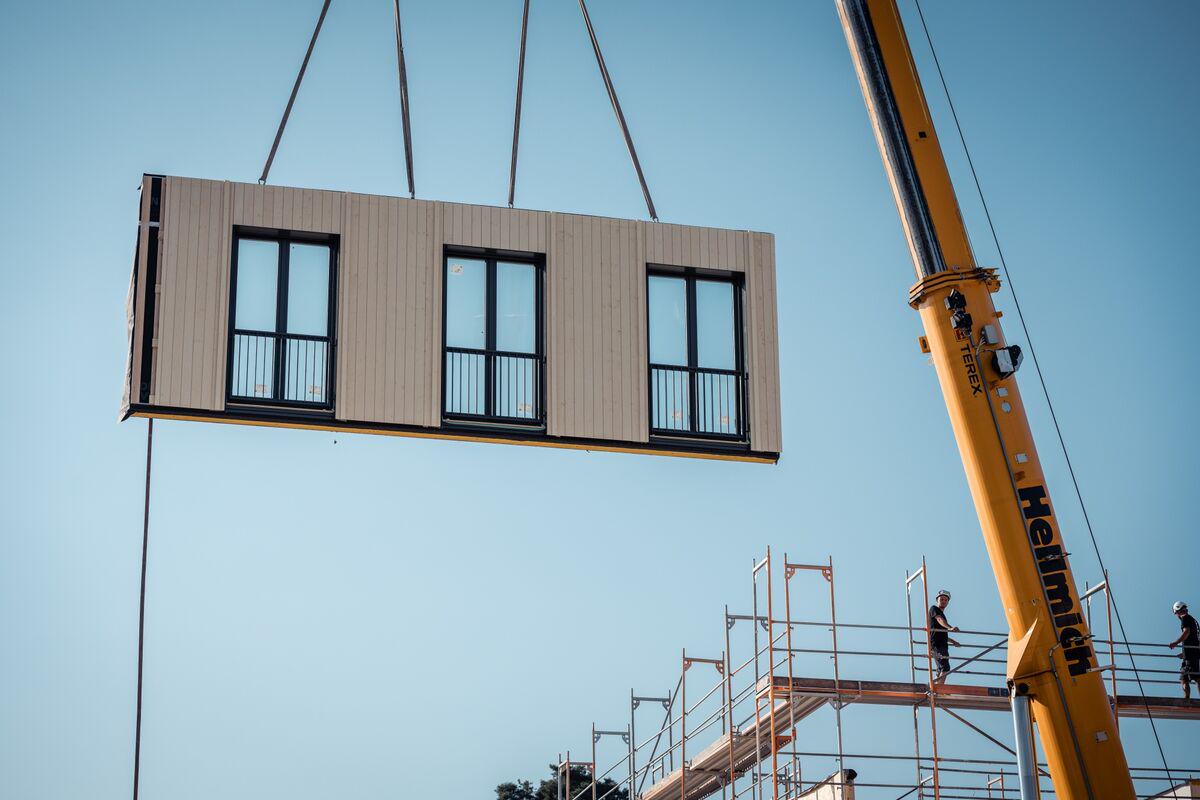
The apartment complex, which will contain 194 units of much-needed affordable housing, is being constructed from prefabricated elements — factory-built walls and other modular elements that are trucked to the worksite, reducing costs and construction times. It’s a technique that Germany’s newly appointed housing minister, Verena Hubertz, says is the key to fixing the housing crisis plaguing Germany’s cities.
Faced with a shortage of an estimated 1.9 million affordable homes, Hubertz has pushed the standardization of construction as essential for meeting her pledge to cut average construction costs for new homes by half. “We will focus on serial and modular construction, because that is the future,” Hubertz said in a statement after taking office in May.
Prefabrication seems like an obvious fix to cut costs and construction times, and modular construction has been used for various kinds of buildings around the globe, from the US to Japan and from Sweden to South Africa. With building elements made in factories then shipped for assembly, standardization can be cheaper and faster than building bespoke homes onsite from scratch.
At least, that’s the ambition. But the industry is still struggling to deliver on a large scale. Only a few German firms are able to manufacture building parts in the proper quantities, and modular construction requires developing a complex network to source materials and manage logistics, according to Jan Hedding of the serial timber building company Nokera, which is developing the Mannheim flats.
[Read the full story here.](https://www.bloomberg.com/news/features/2025-08-23/germany-is-giving-prefabricated-mass-housing-a-second-chance)
The heading can easily be:
Germans, who snobbishly refused to accept an economical solution because they thought they were too special for these houses and were economically stronger than they were, are now forced to adapt the modern solution to housing problem despite their initial upturned attitude.
Excerpts from Article:
>The image of modernity, however, didn’t last. After German reunification in 1989, modular construction quickly fell out of favor… the uniform design fostered a sense of anonymity and social isolation.
>Today, Germany finds itself in another affordable housing crunch. Most recently, rising prices for materials and higher financing costs have added further pressure. The country is turning its attention again to prefabrication — the Platte 2.0.
I only need a small house 1 room, 1 bathroom. give me that prefab, like ca nice cabin 🙂
better than needing >5 years for every house above 3 stories. Not to mention that they already offer prefabricated family homes that cost just as much as a solid house. Like where is the afind compromise?
Honestly just avoid bare concrete and exposed sealants. Thats a lot of the uglyness fixed.
How much of these block’s bad reputation is due to human-incompatible area planning and, later on, lack of upkeep? You would hope they have learned a lesson or two in this regard.
Come over here to Netherlands when you’re done building them in Germany, please…
The real underlying problem here is that young people no longer make “enough” money, in comparison to the costs. The housing crisis is just the most obvious one but this goes to all aspects of life. The social contract has been broken between politicians and voters here.
We’re making homes from used shipping containers these days, and prefabricated can be a seriously premium abode.. it makes total sense to reduce the time spent in building homes, we have the technology to do a far better job than the post war rush of prefab houses.
On a bustling construction site in Mannheim, a former industrial hub in Germany’s south, builders are putting the finishing touches on pink and creamy-white timber buildings that look like copied-and-pasted toy blocks laid out around a central square.
The apartment complex, which will contain 194 units of much-needed affordable housing, is being constructed from prefabricated elements — factory-built walls and other modular elements that are trucked to the worksite, reducing costs and construction times. It’s a technique that Germany’s newly appointed housing minister, Verena Hubertz, says is the key to fixing the housing crisis plaguing Germany’s cities.
Faced with a shortage of an estimated 1.9 million [affordable homes](https://www.boeckler.de/de/pressemitteilungen-2675-in-deutschlands-grossstaedten-fehlen-fast-zwei-millionen-bezahlbare-wohnungen-3172.htm), Hubertz has pushed the standardization of construction as essential for meeting her pledge to cut average construction costs for new homes by half. “We will focus on serial and modular construction, because that is the future,” Hubertz said in a [statement](https://www.bmwsb.bund.de/SharedDocs/pressemitteilungen/DE/2025/05/statement_Fertigstellungszahlen_Wohnungsbau.html) after taking office in May.
Prefabrication seems like an obvious fix to cut costs and construction times, and modular construction has been used for various kinds of buildings around the globe, from [the US](https://www.bloomberg.com/news/articles/2018-06-21/the-modular-home-maker-that-could-make-housing-cheaper) to %5BJapan%5D(https://blinks.bloomberg.com/news/stories/SV43OWDWRGG0) and from [Sweden](https://www.bloomberg.com/news/features/2023-08-15/can-sweden-s-visionary-wood-city-outrun-its-real-estate-crisis) to [South Africa](https://www.kwikspace.co.za/sales/). With building elements made in factories then shipped for assembly, standardization can be cheaper and faster than building bespoke homes onsite from scratch.
At least, that’s the ambition. But the industry is still struggling to deliver on a large scale. Only a few German firms are able to manufacture building parts in the proper quantities, and modular construction requires developing a complex network to source materials and manage logistics, according to Jan Hedding of the serial timber building company Nokera AG, which is developing the Mannheim flats.
Beyond the significant upfront expenses for builders, the idea to standardize homes has also faced backlash from architects and residents concerned about the aesthetics of prefabricated buildings. Factory-built structures have something of an image problem, as the technique is often associated with cheap, utilitarian and temporary buildings.
Germany’s relationship to prefab housing is perhaps deeper and more complex than elsewhere. In the postwar era, the Communist-led German Democratic Republic used prefabricated construction on an enormous scale, leaving behind both many modular buildings and an ambivalent attitude from the public. As the government revives its commitment to this construction type, politicians and construction companies hope that, this time, the new prefabs will leave a happier legacy than their Cold War predecessors.
>Can modern Plattenbauten win over new fans with better design and materials?
In short – yes. Also, the old *Plattenbauten*. And everywhere else that may actually be affordable for a human being without a trust fund or sugardaddy.
If you want better spatial planning, just look at more modern takes on blocks in Poland. The only unexpected thing was the jump to 2+ cars per family but many projects hold very well still.
This is so American
This is much better then house crisis.
If there is a demand for new flats – they must be build.
The problem with housing is that there’s very little that we have automated away.
The reason production lines have become productive af is automation.
Prefab is one way to go, but it also has a ton of challenges. There are many reasons so many multi billion dollar companies that tried to do it failed.
Having prefab floors/cleanings and printing the rest seems like a better bet, but that also has the challenges of fitting wiring/pluming, etc.
Befalling the bathroom and kitchen and floor/ceiling, and 3D print rest could be a good compromise.
Having said that, I’m not very familiar with the space. I’m sure engineers in the space and tell us exactly why neither would work.
Maybe new legislation that will give massive incentives for construction from 20XX on to be automated could be a solution, it that would also mean power would go to a few companies, and a ton of people will lose their jobs.
Building is not the main problem here. Planning and land are the issues.
So while I think prefabricated housing is great, it will not solve our housing crisis.
I live in a prefab brutalist building built for the 1972 Munich Olympics. Nothing wrong with the building except that it has no insulation and that it’s poorly maintained, neither is the fault of prefab concrete.
If I ever decide to build a house I would most likely go for a prefab, the biggest risk of traditional build is the human factor, fickle contractors, or just miltiple different contractors and then aligning everything between them.
While the prefab is mostly made in a controlled workshop, and if you get a turn key the internal work is also done so everything runs much smoother.
Workers and Resources: Soviet Republic intensifies.
EU regulations about energy efficiency still apply. This is actually awesome news, this kind of technique got abandonned because of american propaganda, and people wanting to start living in the suburbs, inspired by those idiotic american tv shows. Efficiency above all, and the more they keep on using this method, the more it will be improved. With a couple hundred thousand new flats per year, a lot will get solved.
Say what you want, but prefabricated housing is better than slums and shantytowns, and definitely better than tent cities full of homeless people.
They may be ugly, but they provide housing with electricity, heating, and indoor plumbing/sanitation.
What’s more is that these pre-fab commie blocks have withstood the test of time. Just go to any former Eastern Bloc country and see for yourself.
Most of newly build apartment blocks are prefab anyway, we just pour concrete for floor/ceiling.