Opinione | Putin si sta muovendo verso la sua prossima tappa. Non aspettare gli spari.
https://www.washingtonpost.com/opinions/2025/11/03/armenia-kazakhstan-russia-putin-information-war/
di dssevag

Opinione | Putin si sta muovendo verso la sua prossima tappa. Non aspettare gli spari.
https://www.washingtonpost.com/opinions/2025/11/03/armenia-kazakhstan-russia-putin-information-war/
di dssevag
1 commento
Fears of escalation beyond Ukraine are back. Warning signs are flashing in Kazakhstan and Armenia.
Russian warplanes buzzing into NATO and European Union airspace — prompting the top diplomat in Brussels to accuse Moscow of “gambling with war” — have reignited fears of escalation beyond Ukraine. Yet while attention is fixed on the Baltic, Moscow has waged an information war in its backyard: Central Asia and the South Caucasus.
After Russia invaded Ukraine in 2022, Finland raced into NATO; Moldova braced for hybrid attacks; Poland fortified its eastern flank. This was all for good reason, but seizing and holding territory is far more costly than Kremlin planners seemed to assume. Unable to replicate Ukraine-style invasions elsewhere, at least while engaged in a full-scale war, Russia is falling back on the tools it knows best — covert influence campaigns, disinformation, destabilization and military and intelligence probing.
Moldova remains Moscow’s prime laboratory, where, according to President Maia Sandu, hundreds of millions of euros have been spent on political meddling. Russia has also interfered in elections in both the Czech Republic and Romania. Now, similar warning signs are flashing farther east — in Kazakhstan and Armenia.
Both sit in Russia’s traditional sphere of influence. Both are edging away, accelerated by the war in Ukraine. And both now rank high on the Kremlin’s worry list.
A confidential 2024 report delivered to senior Russian officials by Prime Minister Mikhail Mishustin warned that Moscow is losing ground in Central Asia and the Caucasus. Meanwhile, these regions have become geopolitically and economically important for U.S. interests.
The United States relies on China for roughly 70 percent of its rare-earth imports — essential for smartphones, electric vehicles and advanced weapons. Beijing suspended exports of rare earths at the peak of the trade war in April and curbed their export again in October, leading to the current trade spat. Central Asia, by contrast, holds vast reserves that could diversify supply chains — Kazakhstan alone might hold the world’s third-largest deposits. Along with the South Caucasus, the region anchors the “Middle Corridor,” a trade route linking Asia and Europe while sidestepping Russia and Iran.
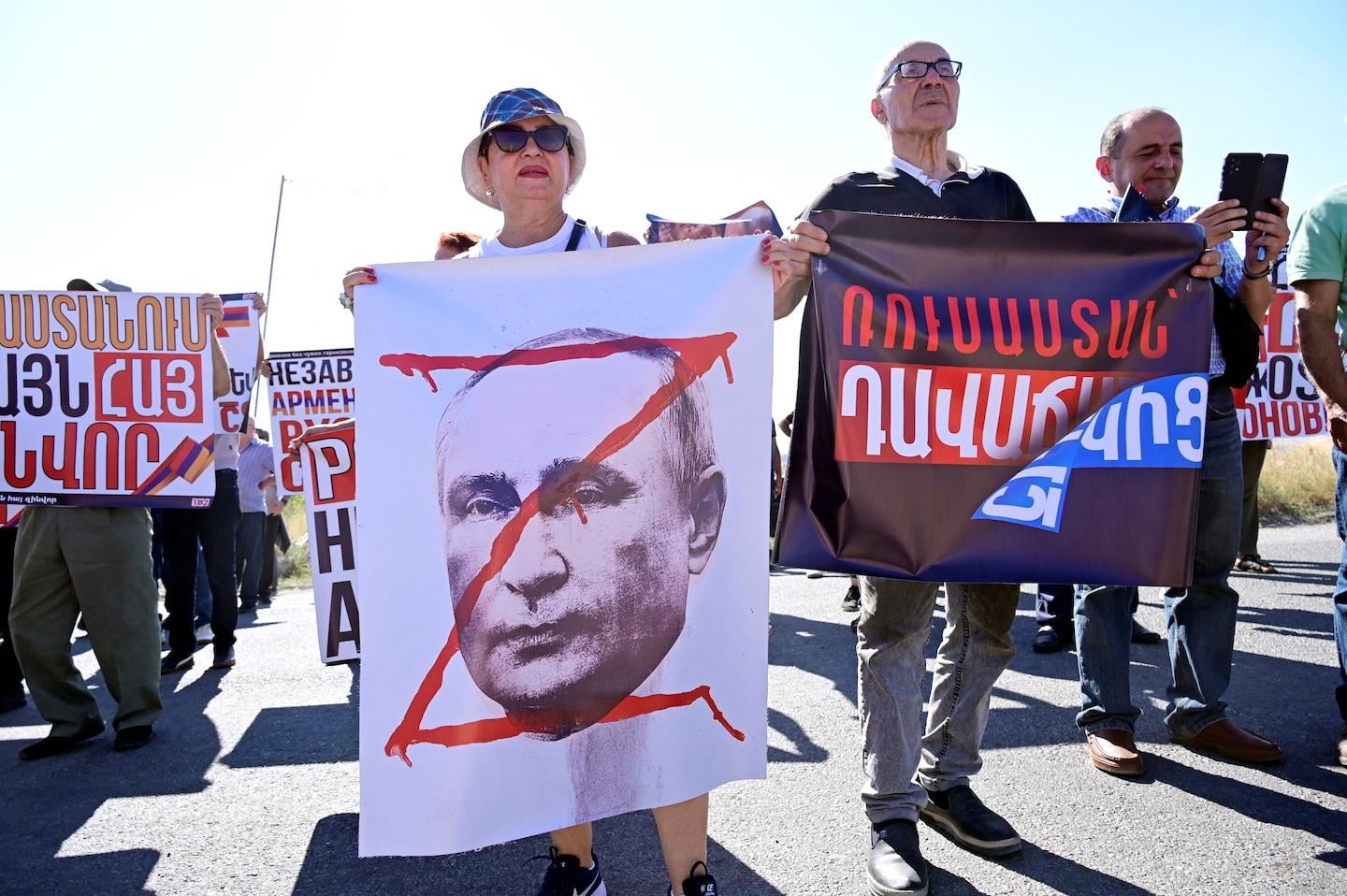
In recent months, Moscow has stepped up its efforts to destabilize the region. In Kazakhstan, Russian operatives have reportedly sought to stir unrest in the country’s Russian-majority north. In Armenia, authorities arrested a pro-Kremlin businessman in an alleged coup plot, while the Armenian Church — accused by church dissidents of having ties to Russian intelligence — has turned against the government.
The playbook echoes Moscow’s strategy in Ukraine: stir grievances in Russian-speaking areas, bankroll friendly oligarchs such as Viktor Medvedchuk, and enlist a branch of the local Orthodox Church, which Ukrainian journalist Oleksii Platonov has dubbed the “Kremlin’s agents in robes.”
Kazakhstan is especially vulnerable. It shares the longest continuous border with Russia and is home to the largest Russian diaspora after Ukraine’s. Russian lawmakers and pundits have questioned its territorial integrity; President Vladimir Putin once claimed the country “never had statehood.” Russian media routinely accuses the Kazakh government of “Russophobia” and calls for defending ethnic Russians — the same pretext used in Crimea and Donbas.
Leaked Russian documents published by Radio Free Europe/Radio Liberty outline plans to weaponize those narratives, co-opt Kazakh elites and seed think tanks with propaganda. Kazakhstan knows its military is weaker than Ukraine’s, and its 4,700-mile border is largely undefended. Putin likely won’t strike while bogged down in Ukraine, but he can prepare the ground. Kazakhstan’s best defense is to raise the political and economic cost of aggression by binding itself to outside powers — China, Turkey, the E.U. and, critically, the U.S.
If U.S. companies and jobs were visibly on the line, Russian meddling would be much riskier. Washington could anchor Western stakes in Kazakhstan with exclusive rare-earth and energy deals, especially in the country’s north.
In Armenia, too, Washington can act. Visible U.S. investment in Armenia’s economy, infrastructure and promising AI sector would show tangible rewards of stability before voters head to the polls next year. The U.S. should also deepen ties with Azerbaijan by urging Congress to lift Section 907 of the Freedom Support Act, which blocks direct assistance to Baku. Building a trilateral framework with Azerbaijan and Israel would further lock in alignment.
Since the 2020 Karabakh war, Russia’s grip on Armenia and Azerbaijan has weakened as both tilt West, culminating in their 2025 peace deal at the White House with President Donald Trump. For Moscow, derailing that process would restore leverage over the Middle Corridor, especially as Georgia tilts back toward Russia.
Prime Minister Nikol Pashinyan is still Armenia’s most popular politician — yet polls show him stuck at 17 percent ahead of next year’s elections. Russia might try to topple him. Moscow is fanning Armenian nationalism and resentment, amplified by outlets such as Russian state-funded Sputnik Armenia and unwittingly echoed by diaspora groups opposed to peace.
Russia’s war in Ukraine has pushed much of the post-Soviet space out of Moscow’s orbit. But that opening won’t last. The Kremlin can destabilize neighbors without firing a shot. Active U.S. engagement — economic, diplomatic and technological — can harden these countries against Russian coercion while protecting vital American interests. Waiting until Moscow moves will be too late.