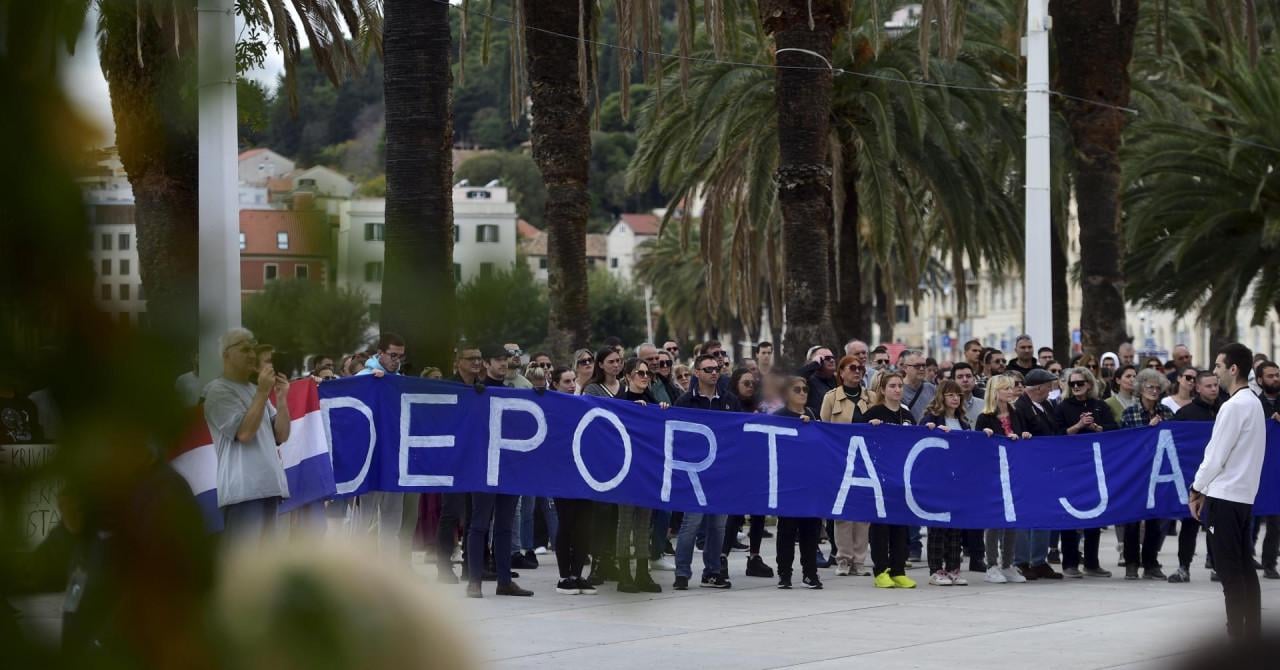
Solo il 3% dei croati si accontenta della presenza di lavoratori stranieri. Nessuno li vuole nelle proprie famiglie.
https://www.jutarnji.hr/vijesti/hrvatska/hrvati-sve-manje-zele-strane-radnike-istrazivanje-15644691#google_vignette
di MLukaCro

Solo il 3% dei croati si accontenta della presenza di lavoratori stranieri. Nessuno li vuole nelle proprie famiglie.
https://www.jutarnji.hr/vijesti/hrvatska/hrvati-sve-manje-zele-strane-radnike-istrazivanje-15644691#google_vignette
di MLukaCro
17 commenti
Full article:
>Only three percent of citizens are completely or partially satisfied with the presence of foreign workers in Croatia, 97 percent are dissatisfied or neutral. No one wants them in their family, and less than 3 percent would accept them as friends, the Institute for Migration Research announced.
>The Institute for Migration Research, in cooperation with the Medianet agency, conducted the second wave of research on the attitudes of Croatian citizens towards foreign workers in early November on a nationally representative sample of 1,000 adult Croatian citizens who were surveyed by telephone.
>The results of this year’s research show an increase in criticism compared to the previous year – 20.63 percent of citizens express complete dissatisfaction with the presence of foreign workers, more than in the first wave of the research when this share was 16.5 percent, 42.16 percent are partially dissatisfied, and 34.13 percent are neutral, the Institute announced.
>Satisfaction is expressed by a minority of respondents – 2.78 percent are partially satisfied, and 0.30 percent are completely satisfied.
>Compared to last year’s results, there is a change in the structure of reasons for dissatisfaction. Fear of crime was also present last year, when, in addition to the security aspect, one of the most prominent reasons for dissatisfaction was the view that there is too much cultural diversity in Croatia.
>Fear of crime, economic and work reasons
This year, the most common reason for dissatisfaction remains the fear of an increase in crime, cited by 69.8 percent of dissatisfied respondents, but economic and work reasons are followed by emphasis.
>51.7 percent of citizens state that they are concerned about the reduction of employment opportunities for domestic workers, and 47.7 percent state that the cost of labor and work standards are being lowered.
>Cultural differences and disagreements are cited by 48.8 percent of respondents, but with a lower intensity than in the previous wave, which shows that the reasons for dissatisfaction have shifted towards safety and labor-economic explanations.
>Among citizens who are satisfied with the presence of foreign workers, the main reason stands out as cultural diversity, cited by 87.1 percent of satisfied respondents, which, according to respondents, contributes to intercultural exchange and the enrichment of social life.
>Other reasons include reduced unemployment (58.1 percent), increased economic productivity (48.4 percent), and greater availability of certain services (19.4 percent).
>High level of social distance towards foreign workers
This year, social distance towards foreign workers was measured for the first time, and the results indicate a high level of social reservation towards foreign workers.
>The results of the measurement showed that almost none of the respondents want a foreign worker to become a member of their family, only 2.4 percent of citizens want them as friends, 5.7 percent would accept them as neighbors, and about 10 percent want them as colleagues at work.
>The results show that acceptance of foreign workers is most pronounced in the work environment, while closer forms of social relations are rarely acceptable.
>An analysis of socio-demographic characteristics shows that attitudes towards foreign workers are largely uniform according to gender, age and level of education, with minor deviations. Younger respondents are somewhat more likely to express neutral or slightly positive attitudes, while older respondents are more likely to cite security reasons for dissatisfaction.
>Differences by gender and education are minimal, however, differences by employment status are more pronounced – unemployed respondents are more likely to express negative attitudes and particularly emphasize concerns about jobs and economic insecurity.
>Working people cite similar reasons, but to a lesser extent, while retirees highlight security aspects somewhat more often.
>The findings show that integration will be a significant challenge
“While last year the main reasons for dissatisfaction were fear of crime and the perception of too much cultural diversity, this year citizens are significantly more likely to highlight concerns related to the impact of the arrival of foreign workers on safety, job availability and salary levels, and to a lesser extent they express concerns about their own culture and values,” says Ivan Balabanić, head of the research.
>”The research also shows that Croatian citizens do not want to have almost any personal relationships with foreign workers, which suggests,” Balabanić adds, “that they perceive them primarily as temporary workers, rather than as potential fellow citizens.”
>”Since integration is a two-way process in which foreign workers need to accept Croatian culture and values, but the local population also needs to show openness to the cultural diversity of foreign workers, these findings indicate that the integration of foreign workers into Croatian society will be a significant challenge,” concludes Balabanić.
>The director of the Institute, Marina Perić Kaselj, emphasizes that such research is extremely important because it allows us to base discussions about foreign workers in Croatia on verified, empirical insights, rather than assumptions or individual impressions.
>”Systematic data collection and analysis enables informed political decisions and the development of strategies based on real trends and problems. This is precisely why we believe that continuous monitoring of this phenomenon is necessary for effective migration management and the development of sustainable public policies,” concludes Perić Kaselj.
The situation in Croatia is very much a case of foreign workers being imported to keep the cost of labor down, and to funnel money to a select few in the country.
Most of the workers are there after being recruited by intermediary agencies from Croatia (which make bank on this, and are owned by the “right” people), shipped over, and put to work for less than a local worker would ask for. They are usually housed in horrible conditions, which sucks for them AND for the locals, as a popular landlord “lifehack” is, instead of renting an apartment to, say, a family, they instead put up a bunch of bunk beds and rent it out to a dozen or more foreign workers.
This isn’t a case of hating immigrants, these people aren’t immigrants. They are either in Croatia to work for a while and go home, or to use Croatia as a springboard to move on to more prosperous EU contries. They are being exploited by their employers and landlords while also milked for money by the intermediaries who get them here.
At the same time, the locals get to “enjoy” artificially depressed wages, an ever worsening housing situation, and a large number of foreigners with no intention of assimilating in the slightest. All so a few rich assholes could get richer, and all of it under the protection of the government who enable the framework for this scam.
> “Since integration is a two-way process in which foreign workers need to accept Croatian culture and values, but the local population also needs to show openness to the cultural diversity of foreign workers, these findings indicate that the integration of foreign workers into Croatian society will be a significant challenge,” concludes Balabanić.
Amen. For a truly harmonious and productive society, all sides need to know the rules and be nice to each other, and not just as an obligation, but sincerely. Considering this is a new development for Croatia (especially just a few decades after the Balkan Wars and shittons of others before that), hopefully this improves over time as Croatia’s economic boom continues, and it becomes ever more prosperous.
Hopefully the proud, based Croats will never become foreign workers themselves in… I don’t know… the DACH countries…
It’ll be a very interesting situation going forward because record numbers of young Croatians have moved to Western European countries since the country joined the EU.
Someone’s got to wash the old and clean the toilets – And while the average Croatians would rather have Croatians do it, too many young Croatians don’t even want to stay in Croatia.
It’s a funny phenomena.
Croats adore to be foreign workers in other countries. They adored it for decades and decades before economy here reached the level that anyone foreign wants to come and work here.
What do you mean want them in their families? You mean they don’t want family members to marry immigrants?
I mean Croatia had the biggest concentration camp outside nazi Germany and occupied Poland and they committed war crimes in BiH just like Serbia, so should not really be a surprise 🤷
Makes me sad because Tito was a fucking badass leader and his partisans brave af. Maybe the 3% are their descendants 🤣🤣
Can anyone answer which demographic is mostly imported in Croatia?
I worked with a croat once. He said he hated everyone from the 3rd world, Asia, Africa and the Latin Americas. So, I guess the racist trait was not just him.
Funny how Croats are very content with tourists that make up 26% of their country’s economy. Maybe Croats should be less content with the Croat companies that take advantage and exploit foreign workers on Croat land.
Right stance, current in PL the same situation.
Uber/Just Eat/Amazon wants cheap labour but ordinary Poles are rather against mass imigration from exotic countries. We have a lot of Ukrainian refugees – which are “perfect” migrants(almost 1000 years we live in one country), but paid by Russia politicians make everything to disparage them. Moreover, they earn by selling Schengen visas to people in Asia and Africa.
So corporations, Russian, politicians are content – but not citizens.
I don’t think Croatians would care if it was farm workers. But opening up fake souvenir shops and restaurants in cities that are used as money laundering outlets and immigration scams is something else.
The majority of people are probably seeing the latter and not the former.
Google TL: “The survey results showed that **almost none** of the respondents wanted a foreign worker to **become a member of their family**, only **2.4 percent** of citizens wanted them as **friends**, **5.7 percent** would accept them as **neighbors**, and around **10 percent** wanted them as **work colleagues**.”
[n1info](https://n1info.ba/english/news/bosnia-leads-in-number-of-foreign-workers-in-croatia-amid-growing-issues-with-wage-complaints): **Bosnia** leads in number of foreign workers in Croatia amid growing issues with wage complaints
[schengenvisainfo](https://schengenvisainfo.com/news/croatia-issues-record-number-of-work-permits-to-nepali-citizens): Croatia Issues Record Number of Work Permits to **Nepali Citizens**
[moving2europe](https://www.moving2europe.eu/news/only-19-of-foreign-workers-plan-long-term-stay-in-croatia-survey-reveals): Only **19% of Foreign Workers Plan Long-Term Stay in Croatia**, Survey Reveals
I’m sorry for guys that wanted to stay in Croatia to just get despised by Croatian society like Bosnians.
And they are right! Croatia is great and their people, food and culture too! 🇭🇷
Who immigrates to Croatia ? Balkan countries are kinda third world outside of big cities
Good thing we got many Germans in this thread lecturing us on how to treat immigrants. We would have never known otherwise.
Now please stop voting for the AFD. Thank you.
What about foreign travelers?