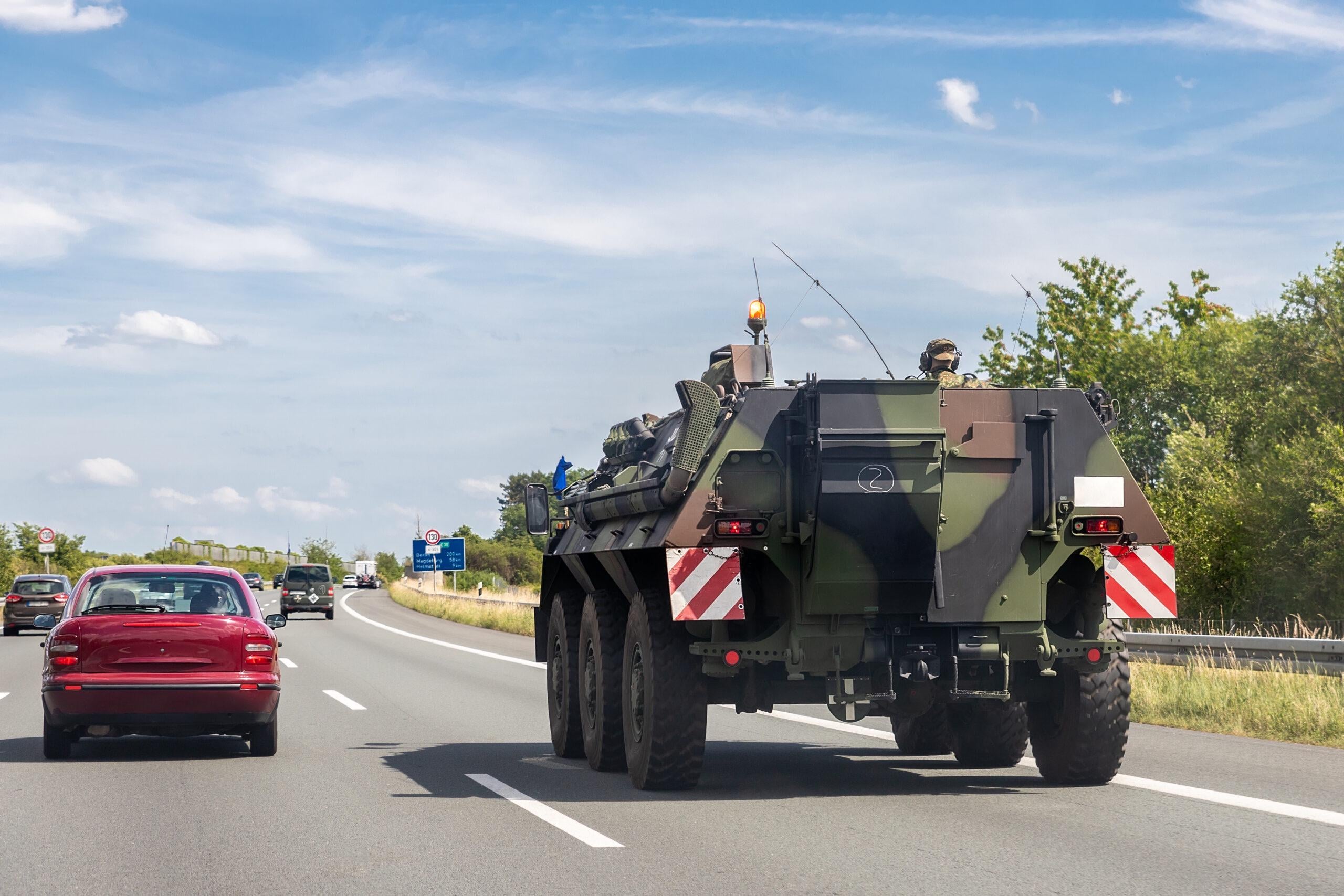
Perché spostare un carro armato in tutta Europa richiede ancora settimane e cosa vuole risolvere l’UE
With the war next door, Europe warns its military mobility is still too weak
di PoleHawk

Perché spostare un carro armato in tutta Europa richiede ancora settimane e cosa vuole risolvere l’UE
With the war next door, Europe warns its military mobility is still too weak
di PoleHawk
7 commenti
Europe slow-moving bureacruacy will kill Europe and Ukraine. Europe should not have slow-moving bureacruacy in this case.
Because Romania has no interconnected highway system.
The Netherlands, Germany, and Poland already have well-tested systems in place to quickly move large amounts of NATO forces from west to east.
The ‘random’ example of moving stuff from Rotterdam to the Bulgarian coast is not exactly an obvious one. Take a ship.
Time to rebuild the “Mriya” plane
Hungary is a problem here too.
It’s uneven in different parts of Europe rather than all.
As this DW report ([YouTube link](https://www.youtube.com/watch?v=KnnV-_mppq0)) says, for example, the Netherlands-Germany-Poland corridor is “a model for the rest of the continent”. This is an important part because that’s the corridor for reinforcing Poland and the Baltic States.
Moving from France to Romania, on the other hand, “takes 60 days”. The DW graphics people erroneously made them pass through Switzerland and Austria but even, if it were more accurate, or the NATO central European route through southern Germany and then Czechia, Slovakia, and Hungary, to Romania and NATO’s southeastern flank, there’s a sure hint where border access and probably infrastructure for NATO forces need to be improved.
I addition to the improvement of European infrastructure, Germany is currently completely rebuilding its military with this problem in mind.
In the Cold War the potential frontline was going right through Germany itself. Because of that no side had to worry about the problem of quickly bringing their forces to the front when needed. This was one of the reasons why the entire Cold War Bundeswehr consisted exclusively of heavy units. No Infantry on foot or wheels, no towed artillery. Every unit was completely mechanized and armored to maximize resilience and mobility on the battlefield. (The other reason was, that the use of nuclear, chemical and biological weapons in WW3 was expected and every soldier that wasn’t protected inside an armored vehicle wouldn’t have lasted long enough to do their job.)
This scenario has changed. Todays Bundeswehr must be able to defend its allies in the east. The potential frontline will be in the Baltics and Eastern Poland.
The heavy units with tracked vehicles have to be stationed near these borders to be useful in the first weeks of a war. This is the reason why the new heavy 45th Panzer Brigade with its Leopard 2, Puma and PzH2000 will be permanently stationed in Lithuania.
The second part of the restructuring is establishing new medium units. These units will have lighter, wheeled armored vehicles instead of heavy tracked ones. Mostly based on the Boxer platform. This includes, for example, brand new IFVs (Schakal) and SPCs (RCH155). These units will be able to be deployed from their home bases in Germany to the eastern NATO borders in a few days instead of weeks.