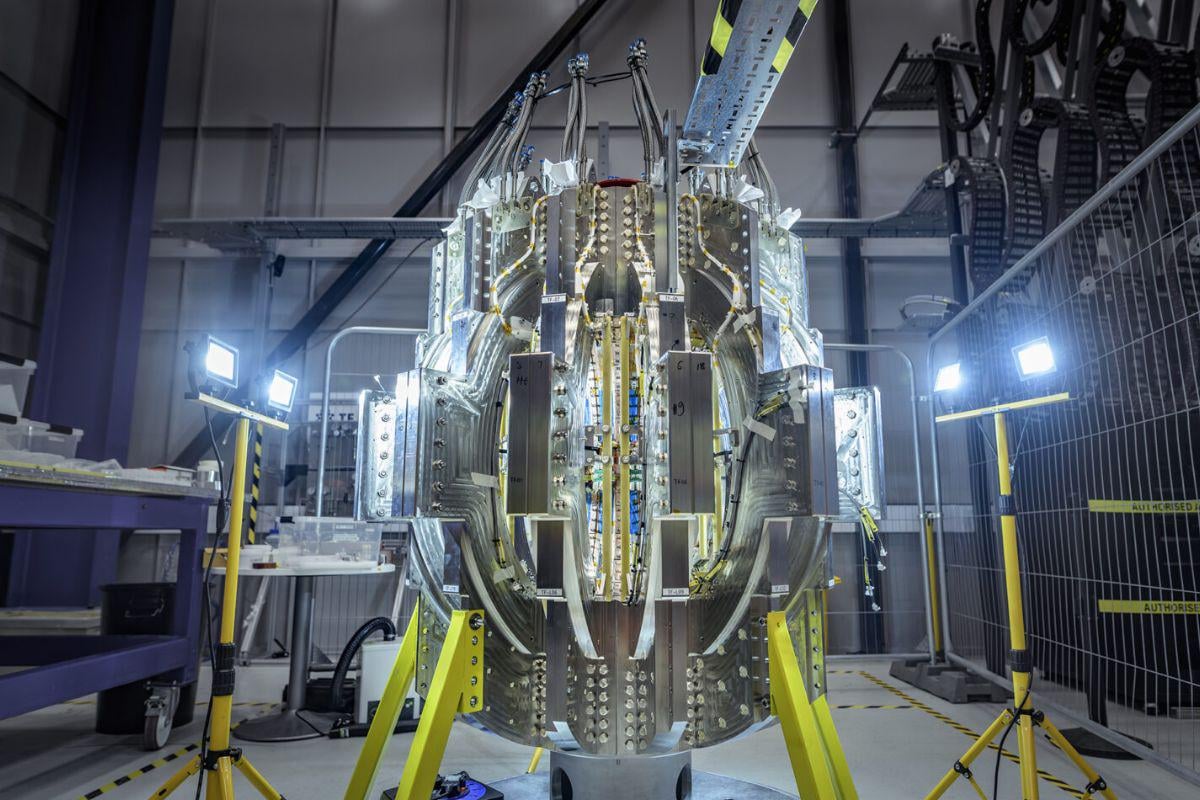
Un importante passo avanti nella fusione nucleare grazie al successo del Regno Unito nella creazione di un sistema magnetico HTS completo in una configurazione reale.
di UpgradedSiera6666

Un importante passo avanti nella fusione nucleare grazie al successo del Regno Unito nella creazione di un sistema magnetico HTS completo in una configurazione reale.
di UpgradedSiera6666
6 commenti
The British super magnet that wants to tame the Sun.
In a suburb near Oxford, engineers from the start-up Tokamak Energy have just reproduced the magnetic conditions needed to operate a fusion power plant, without plasma or radiation, but with a magnet.
This technological feat, dubbed Demo4, is a unique system of high-temperature superconducting (HTS) magnets capable of producing 11.8 teslas at -243°C, with seven million ampere-turns injected into its central column. That’s more than enough to contain plasma heated to temperatures higher than the core of the Sun.
The heart of Demo4: a loop of electricity and cold
Demo4 is therefore a complete system of high-temperature superconducting (HTS) magnets. Finally, “high temperature” is a figure of speech, as these magnets operate at -243°C, just 30 degrees above absolute zero!
Under these polar conditions, Demo4 has managed to produce a magnetic field of 11.8 teslas, placing it in the very exclusive club of ultra-intense field generators. By way of comparison, a medical MRI machine operates at around 1.5 to 3 teslas.
The Demo4 system also enabled the equivalent of seven million ampere-turns to circulate in its central column (an ampere-turn is a measurement that combines electrical current and the number of turns in a coil).
The key to containing plasma
The recipe for nuclear fusion is fairly simple: heat hydrogen until it turns into plasma, a gas in which electrons and nuclei move independently of each other. Then, prevent it from touching the reactor walls, otherwise everything will melt, including your project.
This is where magnets come into play, as they create a toroidal magnetic field that traps the plasma like a wasp in an invisible bottle.
To achieve this, a complex network must be created: 14 toroidal magnets, 2 poloidal magnets, auxiliary coils, and compensators.
Until now, no one had ever succeeded in testing a complete HTS magnet system in a real tokamak configuration. Demo4 is the first to achieve this feat.
“Super magnets” made from superconducting materials”
These new “super magnets” are made of superconducting materials based on yttrium, barium, and copper, and have incredible properties. They can carry 200 times more current than copper, without any Joule heating losses.
They are also lighter, more compact, and cheaper to cool than their niobium-titanium counterparts.
This opens the door not only to smaller, more efficient tokamaks, but also to unexpected civilian applications.
A technology that extends beyond the nuclear field.
These magnets could have applications beyond nuclear fusion. They could be useful, for example, in data centers, to distribute electricity with zero loss, in electric aircraft engines, where every pound saved counts, and even in magnetic levitation trains, where their ability to generate powerful fields without unnecessary weight would be a blessing.
What’s more, these magnets could be manufactured on a large scale. This is not a one-off prototype that costs an arm and a leg to reproduce. It is a replicable, industrializable, and scalable technology.
Seeing plasma as never before.
Another technological highlight: the British company also recently achieved another major first by filming the interior of the Tokmak and its plasma in color and at high speed.
These images allow us to observe live interactions between plasma and materials such as lithium, which is being tested to cool the plasma’s periphery. The goal is to reduce wear on the reactor walls, one of the Achilles’ heels of conventional tokamaks. This approach is called the X-point radiator mode, and it could well become the future operational standard for fusion power plants.
The idea is to make the plasma sweat in the right place, like a Formula 1 engine that dissipates heat where it is most strategic. This results in cleaner, more sustainable fusion that is less aggressive on components, and therefore more realistic from an industrial standpoint.
Next steps for the project
The next step will be to increase the magnetic field even further, test the limits of these magnets, and above all, integrate them into a tokamak that produces more energy than it consumes.
On that day, we will no longer talk about the “promise of fusion.” We will talk about electricity on demand, clean, uranium-free, CO₂-free, powered by the sun… in a box.
So are we still 20 years away from a successful reactor and 50 away from commercial adoption then?
20 years away boys
That’s a huge step!
Won’t be able to sell it to the US, they’re still trying to figure out what magnets are.
I hear the government are looking at how to tax unlimited free energy.