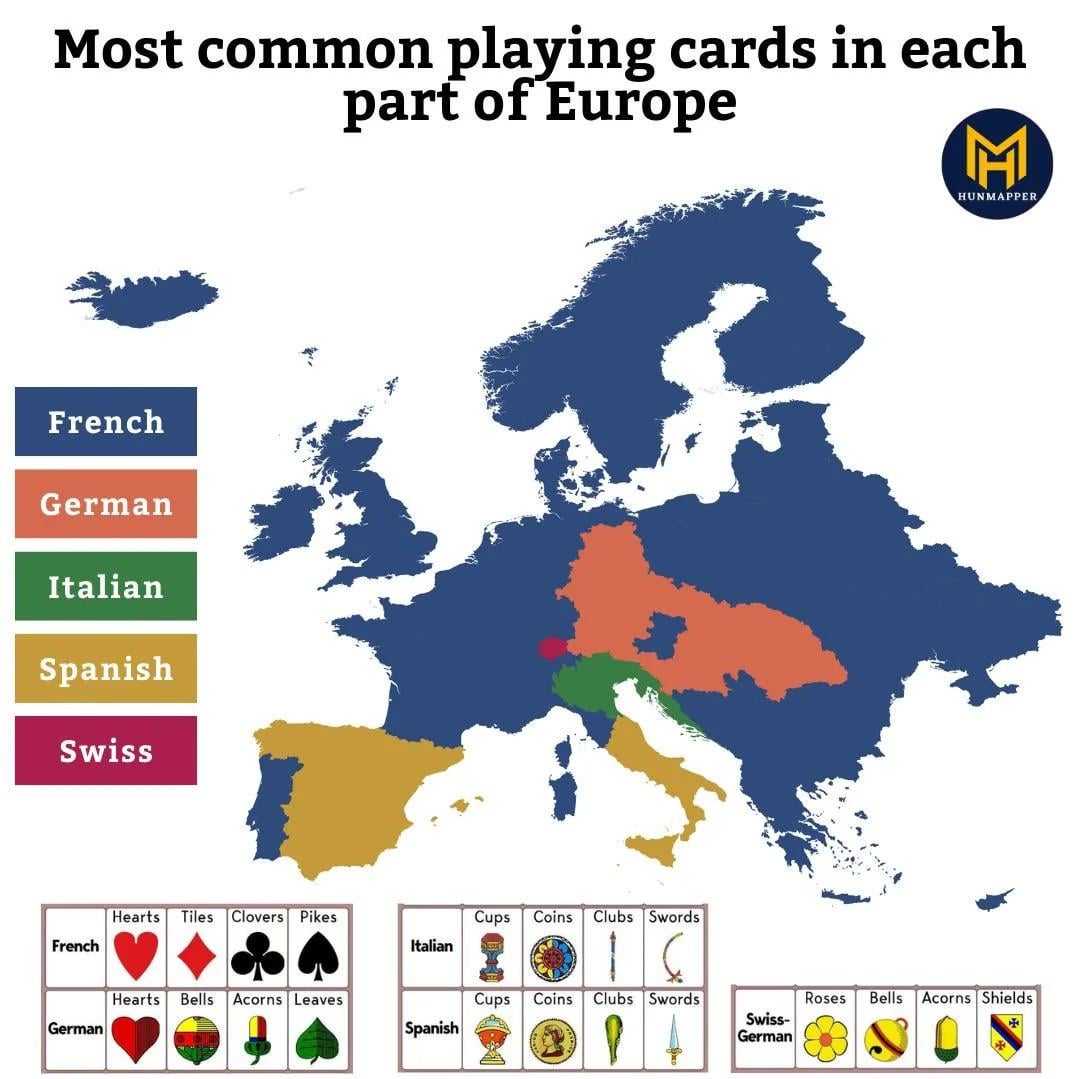
Le carte da gioco più diffuse in ogni parte d’Europa
https://i.redd.it/a8svoe2c7llg1.jpeg
di superdouradas

Le carte da gioco più diffuse in ogni parte d’Europa
https://i.redd.it/a8svoe2c7llg1.jpeg
di superdouradas
49 commenti
German style used to be popular in Poland and there are many people that still use German names for French symbols.
In the Spanish one the Coins are called Golds (oros). I thought in the French one was Hearts, diamonds, clubs and spades?
Wait what. How did I never realise these aren’t universal 😀
Wait what ?
How do people play with complicated symbols and no clear colors ?
I can’t believe this is the way I learn there are so many cars types.
In Croatia we call the german cards “mađarice” which means hungarian cards. I guess we got them from Hungary, and Hungary got them from Germany.
TIL
I just assumed everybody used the same
Im German and I’ve never see the German ones (same with literally any other than the French ones)
Yeah I don’t think anyone in Hungary is talking about German suited ones (which we call Hungarian, lol) when we say ‘cards’, it’s always French.
We basically have ‘cards’ and ‘Hungarian cards’.
I never figured that out until today but in portugal we use the French styled card type “naipes” but we call the spanish names. Hearts “Copas”(cups), Tiles “Ouros”(coins), Clovers “paus”(Clubs), Pikes “espadas”(swords)
In greece we use the Italian names not the french
What’s you guys favourite Spanish deck figure? I’m a rey de bastos enjoyer 😎
The peculiar thing about the Swiss cards is that they’re not used based on language, even-tho it says “Swiss-German” here. There’s a line going through the Swiss-German speaking part of Switzerland, the so called Brünig-Napf-Reuss line, which interestingly resembles the border between Alemannia and Burgundy 1000 years ago, and East of it people use the “Swiss-German” cards and West of it people use the French style cards.
Mostly for a game called “Jass” which plays a big role in Swiss tradition. Even these days Jass games are being broadcasted on main national TV. When one town plays a game of Jass against another town the type of cards used depends on which town is the host.
I know as Hearts, Diamonds, Clubs, Spades – UK
I live in the green area of Italy. We use both green and blue versions for different games
In Milan and NW Italy the French suites are more common than the Italian ones, which start becoming more common from Bergamo going eastwards. It’s a heritage from the Venice days.
[https://it.wikipedia.org/wiki/Carte_da_gioco#/media/File:Italia_semi_delle_carte_da_gioco.png](https://it.wikipedia.org/wiki/Carte_da_gioco#/media/File:Italia_semi_delle_carte_da_gioco.png)
From Finland here, confirmed, French playing cards are most common here. Our words for the card “nations” are following, hertta, ruutu, risti ja pata. Word, hertta, I don’t know how to exactly translate, but, it is a previous times, woman’s name, and some women here in Finland probably still has that as a name. Ruutu, tile, or screen, should speak for itself. Risti, cross, if you look at it, I think you can see it. Pata, pot is the most direct translation. Not sure why it is used as a word for that card, but, that is what we are using.
not entirely correct… most common cards in southtyrol are german cards 100%
I believe in Schnapsen supremacy and the Double German/Hungarian card is its messenger.
I’ve only seen the Italian/Spanish in Divination tarot cards
ah….
herz, caro, kreuz und schüppe
That’s not “Bells” in German one, it’s “pumpkin”! 😅 That’s how we call it in Hungary.
This doesn’t appear accurate. I’m Slovenian and I’ve only seen French here. I only saw Italian and German ones when I was abroad (in Italy or Austria).
One of the things that impresses me is that almost everyone knows a card game or two with just a standard deck of cards. it’s one of those universal things, but I never realized that there are variatons. I only know the French deck.
We say ‘cups/pentacles/wands/swords’ or ‘chalices/disks/batons/spades’.
interesting, in Poland we use the french one, but a lot of people call the ♢ “bells”
Kinda wrong. In Italy we use the “french” ones for some games and the “italian” ones for some other games.
Also the italian ones change between regions. Most used ones in my case are the Trevigiane, but also the Napoletane are very widespread.
Until recently I didnt know there were other than the French style.
Guys I think the most serene republic of venice has returned!
/s
Pikes?!
Can’t call a spade a spade these days
Portugal: French symbols, Spanish/Italian names. Except we call “gold(s)” to “coins”.
The long shadow cast by the Kingdom of the Two Sicilies.
Hungarian cards use the German suits, but feature the heroes of the Swiss liberation war
To be fair in Greece by now the most common playing cards deck is the of Tichu.
Spain has 40 in a deck. Museum of Naipes (playing cards) is in Vitoria-Gastreiz.
Wake up, a new map of Central Europe just dropped
I didn’t even know there were other cards than what are apparently French playing cards.
TIL the old local card game from my homeregion is based on Spanish card style.
https://en.wikipedia.org/wiki/Aluette
If you differentiate Spanish and Italian cards, you should differentiate Spanish and Catalan too. Catalan cups are like Italian ones and Catalan coins do not have faces, like Italian ones, but are golden, like Spanish ones. Cubs and swords are different from both Italian and Spanish ones.
Also, French suits start on 1, not A, and end on V, D and R, not J, Q and K, as English ones, and the images of the suits are slightly different, thinner. Also, V D and R have each a character name, unlike English cards, which have no name.
So, Italian and Spanish do not seem differentiated enough here.
Also considering that the graphics of the Italian cards vary by region and sometimes province.
So, according to this criteria the map should mention every italian subtype. And otherwise aggregate Spanish and Italian in the same category.
Today is the day when I learned there are different types of cards. We use the French one aplparently though no one calls it otherwise than just cards in Poland. Also media seem to publish only that standard
I live in a region where we use both, French and German, depending on the game
Slovakia should be striped for “french”/“german”… We use both for different games, we literally call the French ones “Žolíkové karty” cause they’re primarily used to play “Žolík” (the local variant of Rummy), and the German ones “Sedmové karty” named after the game of “Sedma”…
(there are multiple games for both decks, these two are just name-bearing here…)
I think Czechia is similar in this but not entirely sure…
notice that the ones in Tuscany are not french cards: they use the french suites, but the deck is 40 cards like the italian deck.
In czechia we use both french and german ones. Depends on the set.
funny how in Italy there is north, south and then Tuscany lmao
Hearts, diamonds, clubs and spades
Finally figured out why the clover symbol is usually called “clubs” in English.
It’s funny that even during the Soviet times one of the (very few) pictures designs (I mean pictures of kings/dames/valets) used on the cards produced in the USSR was actually a tsarist Russian design based on the fake “old Russian” costumes developed for nobles who took part in one famous ball-masquerade in tsar’s Winter Palace not long before the WWI. If party bosses realized this, someone would have to go to Siberia for anti-Soviet activity or something. 🙂