Because you normalized it to be a function of hours worked
ZeitgeistWurst on
The “germans work fewer hours” isn’t really the full story – its more that overall more people work, but often part time.
So instead of a traditional single earner family you got way more households where both partners work, but part time.
EU-National on
Do they work fewer hours, or is it another employment fraud scheme like in Belgium where employees work 38hours on paper but 40+ in reality?
-Against-All-Gods- on
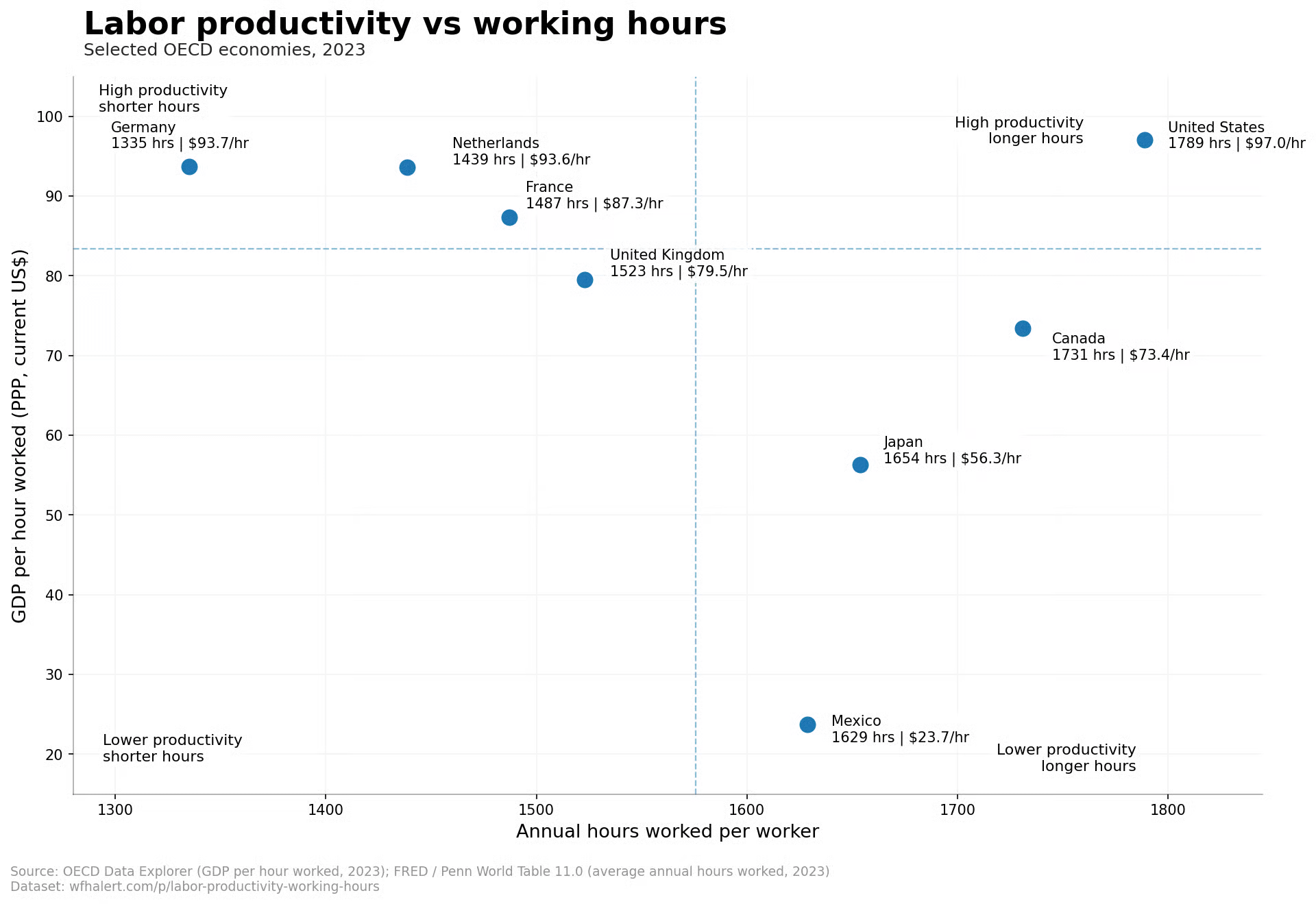
Total productivity (time x value, according to the chart):
USA 173533,0
Netherlands 134690,4
France 129815,1
Canada 127955,4
Germany 125089,5
UK 121078,5
Japan 93120,2
Mexico 38607,3
Loki-L on
GDP per capita is not really a good way to measure productivity. If it was an Irish person could work half as many hours as a German and still have the same productivity per hour worked.
The truth is that at some point if you start working longer hours, your productivity doesn’t go up along with it and you reach a point of diminishing returns.
However that point depends on a lot of things ranging from the exact job to work culture and company.
A job working on an assembly line will stay productive longer than an office job, before longer hours stop giving you extra results.
The more freedom you have and the more mentally and physicslly taxing your job is the less your employer benefits from making you work overtime. At some point the mistakes you end up making cost them more than the extra work you do brings them.
Nebuladiver on
Thus doesn’t show “why”.
Sure-Current-3267 on
Total Labour productivity paints a different picture https://ilostat.ilo.org/topics/labour-productivity/ and if you add total factor productivity, the underdeveloped German capital markets worsen the rank of Germany.
Paeris_Kiran on
It’s because they siphon money out of their eastern labor colonies.
TaxNervous on
What kind of productive sectors a country has a lot more weight, more than how many hours workers toil, Germany and Netherlands have high productive with a lot of added value industrial/information/financial sector, on the other hand you have Spain, for example, whose economy depend a lot more on services like tourism or hospitality, which are by definition low productive, low added value but labor intensive sectors, the Spanish worker might work more hours but they produce way less per hour, mostly because the way services industries are.

9 commenti
Because you normalized it to be a function of hours worked
The “germans work fewer hours” isn’t really the full story – its more that overall more people work, but often part time.
So instead of a traditional single earner family you got way more households where both partners work, but part time.
Do they work fewer hours, or is it another employment fraud scheme like in Belgium where employees work 38hours on paper but 40+ in reality?
Total productivity (time x value, according to the chart):
USA 173533,0
Netherlands 134690,4
France 129815,1
Canada 127955,4
Germany 125089,5
UK 121078,5
Japan 93120,2
Mexico 38607,3
GDP per capita is not really a good way to measure productivity. If it was an Irish person could work half as many hours as a German and still have the same productivity per hour worked.
The truth is that at some point if you start working longer hours, your productivity doesn’t go up along with it and you reach a point of diminishing returns.
However that point depends on a lot of things ranging from the exact job to work culture and company.
A job working on an assembly line will stay productive longer than an office job, before longer hours stop giving you extra results.
The more freedom you have and the more mentally and physicslly taxing your job is the less your employer benefits from making you work overtime. At some point the mistakes you end up making cost them more than the extra work you do brings them.
Thus doesn’t show “why”.
Total Labour productivity paints a different picture https://ilostat.ilo.org/topics/labour-productivity/ and if you add total factor productivity, the underdeveloped German capital markets worsen the rank of Germany.
It’s because they siphon money out of their eastern labor colonies.
What kind of productive sectors a country has a lot more weight, more than how many hours workers toil, Germany and Netherlands have high productive with a lot of added value industrial/information/financial sector, on the other hand you have Spain, for example, whose economy depend a lot more on services like tourism or hospitality, which are by definition low productive, low added value but labor intensive sectors, the Spanish worker might work more hours but they produce way less per hour, mostly because the way services industries are.