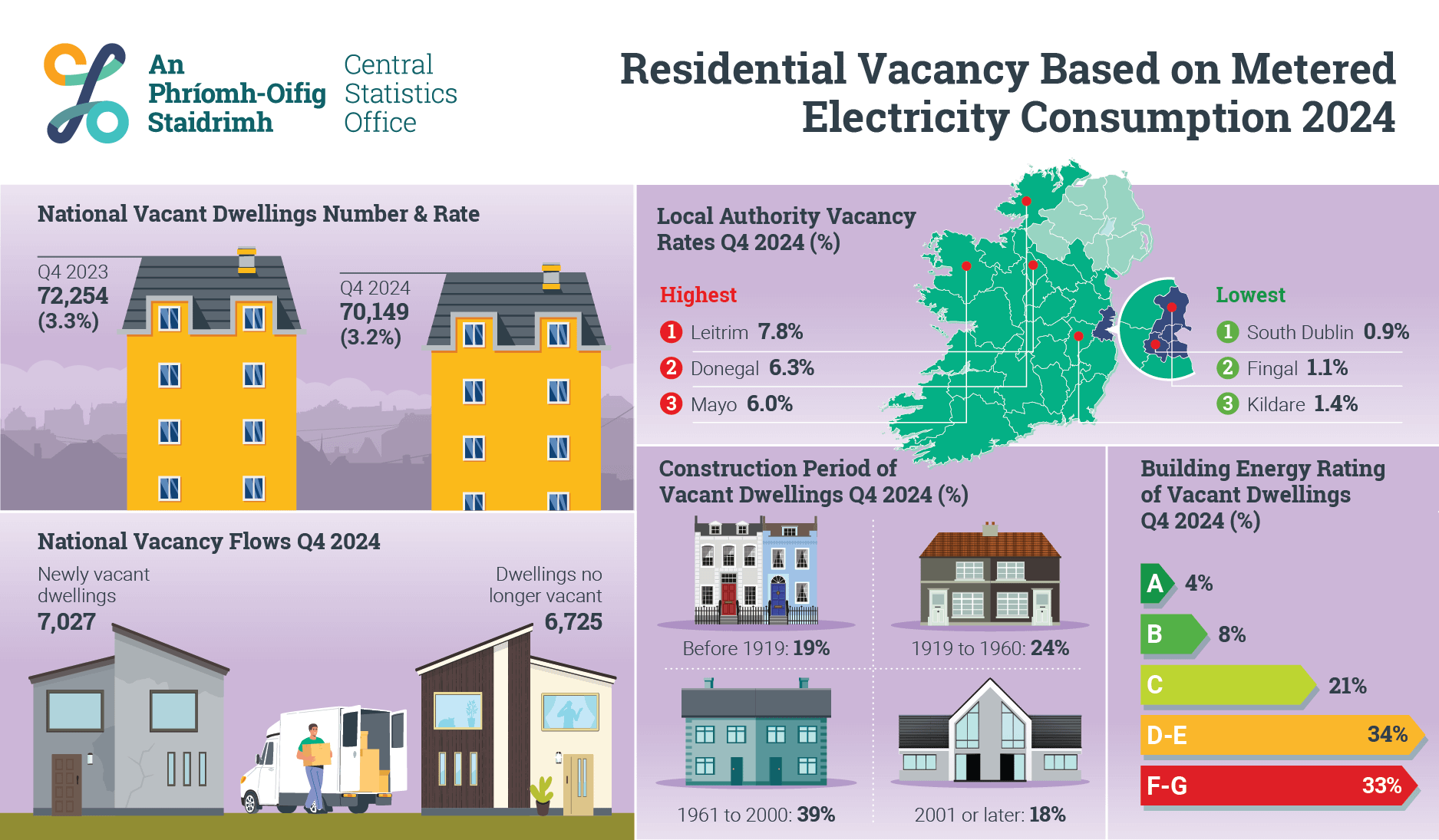
Nel quarto trimestre del 2024 vi erano oltre 70.000 abitazioni sfitte a livello nazionale sulla base dei bassi livelli di consumo di elettricità misurato
https://i.redd.it/r4cdosk27zqg1.png
di NanorH

Nel quarto trimestre del 2024 vi erano oltre 70.000 abitazioni sfitte a livello nazionale sulla base dei bassi livelli di consumo di elettricità misurato
https://i.redd.it/r4cdosk27zqg1.png
di NanorH
9 commenti
**Key Findings**
* There were 70,149 dwellings in Ireland which consumed very low levels of electricity over the 12-month period to the end of Quarter 4 (Q4) 2024. This gave an estimated national vacancy rate of 3.2% based on low electricity consumption.
* Using low levels of metered electricity consumption as a measure for vacancy, the number of vacant dwellings fell from 72,254 (3.3%) in Q4 2023 to 70,149 (3.2%) in Q4 2024.
* Over 2,100 more dwellings moved out of vacancy than became vacant in 2024.
* Using Electricity Supply Board (ESB) designations, the rural vacancy rate was 5.4% and the urban vacancy rate was 2.2% in Q4 2024.
* The Local Authorities with the highest vacancy rates in Q4 2024 were Leitrim (7.8%), Donegal (6.3%), and Mayo (6.0%).
* In contrast, much lower vacancy rates were found in South Dublin (0.9%), Fingal (1.1%), and Kildare (1.4%).
* Glenties in Donegal was the Local Electoral Area (LEA) with the highest number of vacant dwellings in Q4 2024 (1,615), while the lowest number was in Leixlip, Kildare (71).
* In Q4 2024, 33% of vacant dwellings had a Building Energy Rating (BER) rating of F or G where a match could be made to a BER assessment.
https://www.cso.ie/en/releasesandpublications/fp/fp-rvmec/residentialvacancybasedonmeteredelectricityconsumption2024/keyfindings/
Donegal and Mayo are holiday homes, most likely. That’s why they’re higher.
Places with very high density of population and employment have low vacancy rates while places with very low density, and tourism dependence have somewhat higher rates.
This is groundbreaking research!
Shows that empty homes is not really as big an issue as some populists tell you.
Not really correct numbers, I am on a solar group and some people are in the negatives etc as they are more or less totally running off solar. Selling back to the grid and in credit. So that might have an affect on numbers
You will also have houses for sale which has little to no usage of electricity
Looks like vacant properties in high-demand areas are a smaller issue than they’re made out to be. Obviously there are visibly vacant properties in areas where they should be inhabited, but a small factor in the context of the housing crisis.
Compare it to other EU and developed countries and we are a good bit above average. More can always be done and less vacant homes is better but its not going to mive the needle much on the ecisting problems.
2nd homes should be taxed t kingdom come
I’ve said it before, i’ll say it again. The housing crisis is only a housing crisis because of the consistent over focus & over investment in Dublin by successive governments.
Cant build housing fast enough in Dublin, stop investing in dublin, stop pushing companies to move operations there. You have lots of vacant housing, bring the jobs & you dont need to build the houses.
If you can take a 2000 house hunters out of wood shallets in their parents back gardens in Finglas & side step building 1000 houses for them at 400k a pop you dont have the supplies or workers to build by getting a few companies to set up in & around Leitrim instead of Tallagh. Why arent they doing that.
Surely the 400 million saved in my scenario would be a lot better saved for the sake of giving people a couple million in grants to do up vacant houses in the country & the cost of fixing a few roads, bribing a few companies with a slightly softer investment package & buying an extra train or laying a bit of track ro service the area