
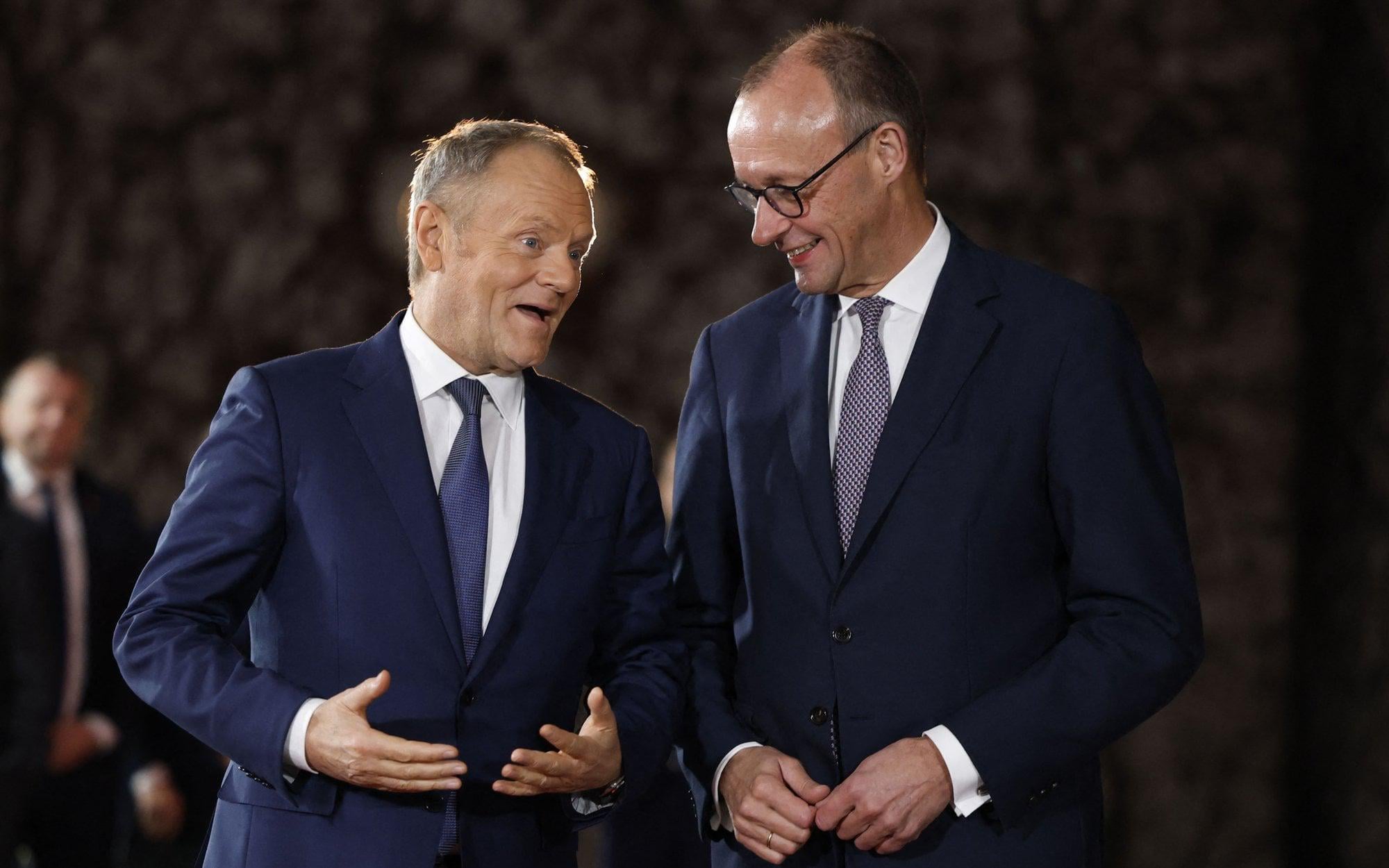
Un sondaggio del Western Institute. È più probabile che i polacchi vedano le relazioni con la Germania in modo positivo piuttosto che negativo
https://www.rp.pl/spoleczenstwo/art44065341-badanie-instytutu-zachodniego-polacy-czesciej-oceniaja-relacje-z-niemcami-dobrze-niz-zle
di eloyend
4 commenti
Deepl:
**A survey by the Western Institute. Poles are more likely to view relations with Germany positively than negatively**
Are Poles obsessed with Germans? In a survey by the Western Institute, the results of which were reported by “Rzeczpospolita,” there is more gray than red. This is not necessarily a cause for concern. Because that is the color of pragmatism in international relations.
In December, the Western Institute surveyed what Poles think about Germans and Germany. Respondents rated current Polish-German relations as somewhat (32%) or very (4%) good. Those who view them as very or somewhat bad are 13 percentage points fewer. The rest consider them neutral. And the majority believe that they will not change in the future (67%).
**Moderate pragmatism among Poles in assessing relations with Germany**
A decidedly or somewhat negative attitude toward Germans is expressed by 29% of respondents, a positive one by 25%, and a neutral one by 46%. By comparison: a positive attitude toward Czechs is expressed by 45% of respondents, and toward Ukrainians by 22%. A negative attitude is expressed by 8% and 39%, respectively.
What attitude toward Poland do the survey participants believe Germans might have? According to 38% of respondents, it is neutral. Twenty-eight percent of those surveyed view it as positive, while 33% view it as negative.
– I believe the results paint a positive picture—in the sense that they are balanced. Based on them, we can conclude that Poles are characterized by moderate pragmatism. It is often assumed that a neutral attitude is synonymous with negatively tinged indifference, or even has a negative character. However, strong emotional charge is not necessarily beneficial for thinking about foreign policy – comments Dr. Ryszarda Formuszewicz, coordinator of the “Polish-German Dialogue” project at the Western Institute. “The results can be interpreted as a sign that the social foundation for Polish-German cooperation is strong. If there are signs of distrust, they need not be interpreted as resentment. Not everyone who approaches the matter with reserve is automatically negative,” adds the expert.
**Poles are not indifferent toward Germans. But they do not obsess over them**
And how has the war in Ukraine influenced perceptions of our western neighbors? One can only surmise that this is reflected in the responses to the question “In matters of security, Poland can trust Germany”: 28 percent of respondents agree somewhat or strongly with this statement. Thirty-six percent of Poles surveyed hold the opposite view. As many as 44% of respondents believe that “Poland sees Russia as a threat, while Germany still hopes to restore cooperation with Russia.” 18% of survey participants strongly agree with this statement, and 26% somewhat agree. A total of 19% of those surveyed disagree.
Can “Poland count on Germany in a crisis”? 34% of Poles surveyed believe it cannot—either “definitely not” (14%) or “rather not” (20%). 26% count on their western neighbor. In contrast, survey participants are more likely to express the belief that “in a crisis, Germany can count on Poland”: a total of 41% hold this view (a combination of “definitely” – 36% and “somewhat” – 5%), while 14% of respondents do not share this confidence.
“Germans do not occupy the attention of the vast majority of Poles on a daily basis, while following the public debate—especially on social media—one might get a different impression. It is not so much indifference, but rather that Germans evoke fewer emotions among Poles than Ukrainians do. And scaring people with Germany may only work on the most mobilized minority,” says Dr. Piotr Cichocki of the Department of Sociology at Adam Mickiewicz University in Poznań.
**This is no longer the 1990s. The myth of the Reich has fallen. Poles view Germany pragmatically**
Or perhaps the poll also reveals what we think of ourselves? The statement “Poland is more developed than Germany in certain areas” is accepted by 43% of survey participants. The group of respondents who reject it is 24 percentage points smaller. Thirty-eight percent of people have no opinion. The statement “Germans consider themselves a model, but they no longer have grounds for that” is endorsed by 45 percent of Poles surveyed. Fifteen percent of respondents disagree with it.
– Germany is no longer the model of modernization it was 20 or 30 years ago. We know this from other studies as well. Poles are convinced that, in many respects, Poland is more developed today. The myth of the Reich has been debunked. The image of Germany is more nuanced today. Over the past three decades, Poland has narrowed the social and economic gap with Germany. Poles also note that Germans are more conservative, for example, in the areas of digital and financial services—they don’t even have a digital ID system like mObywatel. And they aren’t convinced that large German cities are safe today. All of this proves that Poles have a pragmatic view of Germany, according to Dr. Cichocki.
Nearly half of respondents (49%) believe that Poland and Germany share common interests. This is 27 percentage points more than those who would rather (15%) or definitely (7%) disagree with this statement. More than half of respondents (51%) agree with the statement that “cooperation between Poland and Germany promotes stability in Europe.” 18% disagree. Meanwhile, 31% have not formed an opinion on this matter. According to 47% of survey participants, “Polish-German reconciliation is a key achievement of post-war Europe.” The number of respondents who strongly (6%) or somewhat (12%) disagree with this statement is 29 percentage points lower.
Are we dependent on each other? The percentage of respondents who believe that “Poland’s economic situation depends on the situation in Germany” (34%) is 12 percentage points higher than those who are convinced that no such link exists.
Do “Germans expect Poland to submit”? 29% of Poles surveyed disagree somewhat or strongly with this statement. Forty percent of respondents would agree with this statement. Thirty percent have no opinion on the matter. Forty-eight percent of respondents believe that “Germany has a different vision of the EU than Poland,” while 14 percent disagree.
Do “Poland and Germany benefit equally from EU membership”? In the opinion of 40% of Poles surveyed—no. The group of respondents who somewhat (21%) or strongly (4%) agree with this statement is 15 percentage points smaller.
**Reparations are important even to those respondents who have a positive attitude toward Germany**
Should Poland demand reparations from Germany for World War II? According to 55.7% of survey participants—yes. 15.8% of respondents disagree. Meanwhile, 28.4% of those surveyed find it difficult to take a position.
As many as 37 percent of respondents believe that “Polish-German disputes over the past are a matter for historians.” And 40 percent would agree with the statement “The issue of reparations unnecessarily divides Poles and Germans.” Meanwhile, 30 percent and 26 percent of respondents, respectively, expressed disagreement. The group of respondents who agree with the statement that “the issue of reparations is part of a political game between parties” is also larger—by 37 percentage points—(a total of 52 percent).
At the same time, when asked for their opinion, Poles believe that “Germans lecture Poles on how to view history,” “do not acknowledge the scale of the victims of World War II,” and “have not accounted for their wartime losses.” “Issues related to redress—and this isn’t just reparations—are the ones with the greatest potential. They resonate even among those respondents who generally have a positive attitude toward Germany,” notes Dr. Cichocki.
Going into detail: 49% of respondents (this is the sum of “definitely” – 24% and “somewhat” – 25%) believe that Germany lectures us on history. According to 19% (this is the sum of “definitely” – 5% and “somewhat” – 14%), the opposite is true. 33% have not formed an opinion on this matter.
54% of Poles are convinced that “Germans do not acknowledge the scale of World War II casualties” (this is the sum of “definitely” – 25% and “somewhat” – 29%). Only 13% of respondents disagree with this statement. This time, 32% of respondents have no opinion on the matter.
According to 58 percent of respondents, “Germany has not made amends for the war damages.” Twelve percent of Poles surveyed would disagree or strongly disagree with this statement. Thirty percent did not take a position.
– I am very pleased with the results of the Western Institute’s survey. And with the fact that there are more and more such surveys. Another one—for example, following the CBOS survey—shows that we are not Germanophobes. We have a broad neutral—but not indifferent—middle ground and passionate extremes that drive the debate. There is considerable consensus regarding reparations—regardless of their views, respondents believe this is an unresolved issue and, in their opinion, must change. There is mistrust regarding the sustainability of Germany’s policy shift toward Russia—we do not necessarily believe that a major change has occurred in this regard. It is true that this mistrust grows alongside respondents’ right-wing views, but at the same time, it is widespread. However, the survey shows that there are many options for Polish-German cooperation—sums up Dr. Anna Kwiatkowska, head of the German Team at the Center for Eastern Studies and co-author with Prof. Marek Cichocki of the podcast “Germany in Ruins?”, in an interview with “Rzeczpospolita.”
i’d believe same for germany. poland is aiight or i’ve never heard the contrary. I used to in my childhood, but I havent heard a pole-joke for decades now
Grass is green, sky is blue, other neighbouring countries will likely band together against an agressor.
This is to be expected, no? Why would we need a survey for it?
I mean, I am sad that poles do feel mostly ambivalent about us, but at the same time I don’t really blame them.
I take that it’s not overwhelmingly negative, which is the impression reddit can sometimes give.
Hope we grow better together