
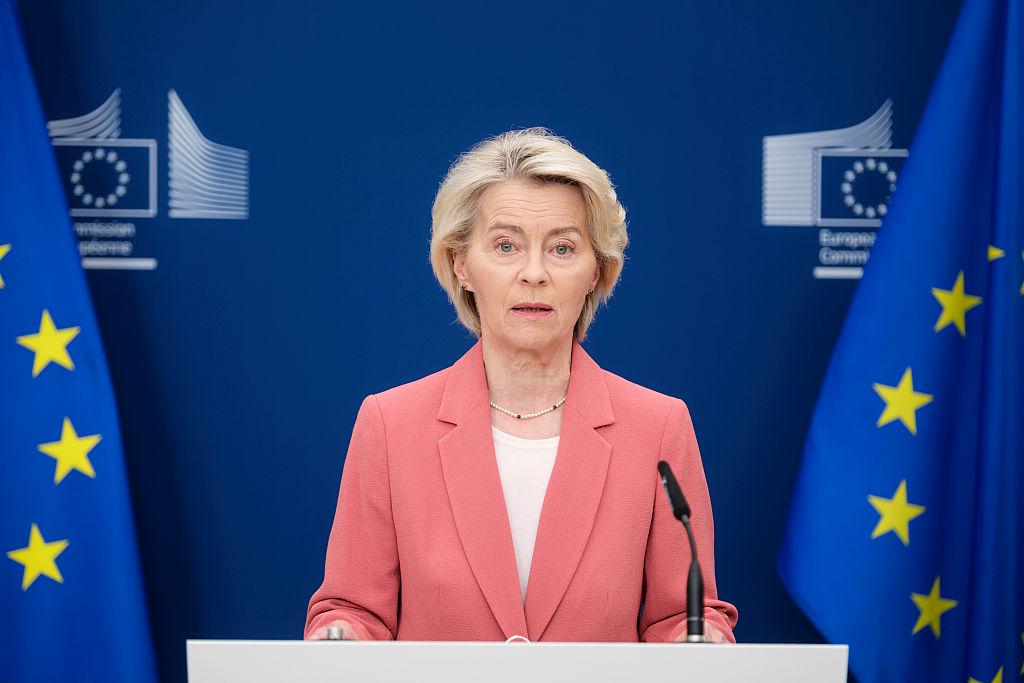
“Non sono qui per adulare”: ecco l’uomo dietro la candid camera dell’UE | Per 40 anni, Thierry Monasse ha catturato i leader dei principali vertici e incontri dell’UE a Bruxelles
https://www.euractiv.com/news/im-not-here-to-flatter-meet-the-man-behind-the-eus-candid-political-photographs/
di GirasoleDE
1 commento
**For 40 years, Thierry Monasse has captured leaders at major EU summits and meetings in Brussels**
[Martina Monti](https://www.euractiv.com/authors/martina-monti/)
In Brussels, where nothing is left to chance, Thierry Monasse has built a photography career on the moments that are.
Monasse’s mornings are predictable in a way that the city’s life, and its public transport, are probably not. Tea first. Camera second. In that order, non-negotiable.
By mid-morning, he is already moving through Brussels, from European Commission briefings to the rooms inside the Justus Lipsius complex and through security checks that feel longer when you are carrying lenses. Only then comes the real work – the split second before Brussels remembers it is being watched.
Monasse was born in Brussels to French civil servants – though his life feels less rooted than that suggests. He sits down in a Scottish jumper, a Canadian hat, and switches into Romanian with a Moldovan waiter before ordering a sharp Italian espresso and landing on a story about his Bialetti coffee machine.
It’s a fitting scene. A bit Brussels, a bit nowhere, and somehow all held together by caffeine.
The route to becoming one of the most well-known photographers of EU politics was anything but glamorous. He started by selling cameras in a cramped, forgettable corner shop, and spent hours developing film in a dim lab, often relying on family support to get by.
Only later did he become, in his words, “a real photographer”.
Today, he has more than 71,000 images on Getty and nearly four decades of experience photographing presidents, heads of state, ministers, and ambassadors, as well as key moments of EU politics, such as [Brexit](https://www.gettyimages.nl/detail/nieuwsfoto%27s/british-secretary-of-state-for-exiting-the-european-union-nieuwsfotos/934346888) or the [start of the war in Ukraine](https://www.gettyimages.nl/detail/nieuwsfoto%27s/president-of-the-european-council-charles-michel-speaks-nieuwsfotos/1238740769?adppopup=true).
He still tries to work every day. Even on holidays, he rarely leaves his camera behind, people who know him say. When we meet on a Saturday, he has just come back from a shoot.
“It’s hard to survive,” he says, as a fact you learn slowly. “When you want to become someone, you’ve got the idea of it. But the idea is not the reality.”
That reality, in Brussels especially, comes with trade-offs. Precarity. Arrogance. Competition. Yet, what sets Monasse apart is a stubborn refusal to play along. He does not discard what others might call a “bad” picture.
As a freelance photographer, “I’m not here to flatter,” he says. Once, he recalls, an MEP asked him to take down a picture months after it had been uploaded. He refused.
But the reason is that for Monasse, the best image is one that is alive, when something is happening. “Positive or negative – but alive.”
In EU circles, however, power has become too self-aware. Leaders arrive, deliver their lines, and leave. Everything is dull, rehearsed, and safe. “It is correct,” he says. “But the photo is dead.”
And that is why he spends most of his time looking for what escapes the script.
He remembers a meeting the EU foreign policy chief Kaja Kallas held with an Icelandic delegation, or the kind of encounter that was never meant to look messy. At one point, someone from her cabinet pulled him aside. “Is it okay?” they asked. “It’s a little bit chaotic.”
Monasse didn’t hold back, captured it and sent it to Getty, which either accepts or rejects the pictures.
Yet for all his years in Brussels, the moment he felt closest to history did not happen there. It was in Berlin, when he took a [photograph](https://www.gettyimages.nl/detail/nieuwsfoto%27s/disabled-man-in-a-wheelchair-is-lloking-at-man-who-are-nieuwsfotos/1294890556) of a wheelchair standing alone in front of the Berlin Wall in 1989.
People who know him say he remains human in a capital that often is not, and even subconsciously, that is what he looks for in his pictures. It is that humanity that ultimately helps justify the personal cost of being a photojournalist living by the political agenda.
Monasse asked himself long ago if long hours and the unpredictability of capturing a big moment of history are a price worth paying.
His answer is plain: “No. I don’t want to pay that price.” Because for all the images he has taken and circulated around the world and media, Monasse seems uninterested in becoming visible himself.
He describes it as a dual existence. There is the EU life: summits, long nights, and bad Wi-Fi connection. And then there is the private life: slower, full of friends he has anecdotes of, and generally better fed. In that second life, there is also Laura, his Venezuelan wife, and a world where no one cares about the perfect frame or who stood next to whom.
Monasse has spent decades photographing a city often dismissed as grey and technocratic, and he does not entirely disagree with that assessment.
But he also knows that Brussels can, in fact, be seen. You just need to know where to stand.
(bw, jp)
Apr 3, 2026 – 06:00; Last updated: Apr 3, 2026 – 10:57