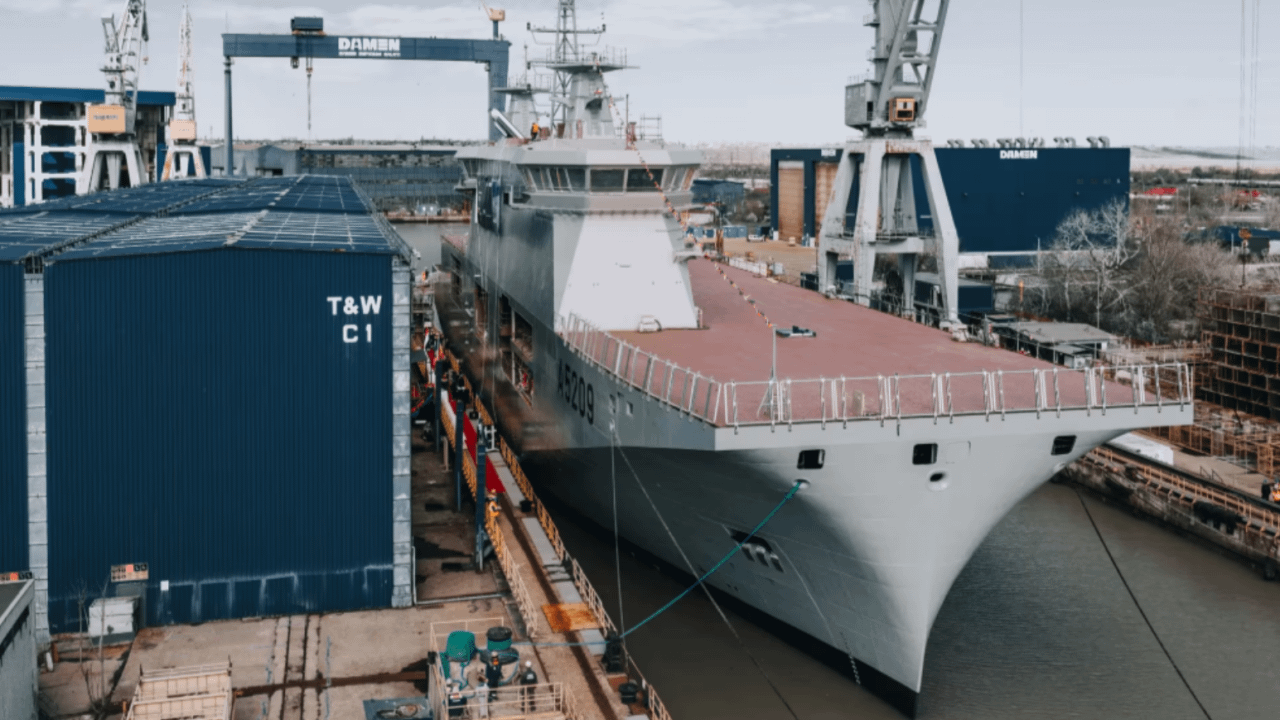
La prima porta droni europea costruita appositamente per la Marina portoghese, lanciata in Romania
https://tvpworld.com/92516786/portugal-europes-first-drone-carrier-launched-in-romania-by-damen-shipyards
di MorrisM

La prima porta droni europea costruita appositamente per la Marina portoghese, lanciata in Romania
https://tvpworld.com/92516786/portugal-europes-first-drone-carrier-launched-in-romania-by-damen-shipyards
di MorrisM
3 commenti
A Romanian shipyard has launched Europe’s first purpose-built drone carrier for the Portuguese Navy, marking a “point of no return” for naval warfare’s move towards unmanned solutions.
The 107-metre NRP “D. João II,” named after Portugal’s XV century monarch, entered the water on April 7 at a shipyard in the Black Sea port city of Galați, where the Dutch company Damen chose to build the vessel.
It had been designed primarily to deploy aerial, surface and underwater drones rather than traditional crewed aircraft.
“Given Portugal’s extensive coastline, this ship represents a valuable addition both for the Portuguese Navy and for European maritime operations,” said Bram Langeveld, Damen’s Chief Commercial Officer.
“It will support maritime security, scientific research, and disaster response.”
The vessel reflects lessons from modern conflicts, including the war in Ukraine and heightened Russian naval activity, where unmanned systems are increasingly used for surveillance, strike and reconnaissance at lower costs and risks.
Built for about €132 million with European Union recovery funds, the ship is intended as a flexible drone hub able to switch mission profiles within days by swapping modular payloads.
“MPV 10720 is the result of an innovative, forward-looking approach by the Portuguese Navy in adapting to modern naval requirements,” Langeveld said.
Modern warfare
The concept was conceived by former navy chief Henrique Gouveia e Melo, who described it during a contract signing in 2024 as “a point of no return for modernity”.
Its 94-metre flight deck supports drones and helicopters, while onboard systems enable the launch and recovery of unmanned surface and underwater vehicles.
Hangars, a stern ramp and mission bays allow multiple autonomous systems to operate simultaneously.
The ship can carry containers, vehicles or boats and accommodate specialists such as drone operators and scientists.
It can also be reconfigured to host a field hospital, laboratories or humanitarian aid modules.
Designed for deployments of up to 45 days, it will support maritime surveillance, protection of critical undersea infrastructure and real-time data collection.
Sea trials are scheduled later this year before the vessel enters service with the Portuguese fleet.
Super tare. Doar imi pot imagina ce ar fi putut fi in porturile de la Galati si Mangalia daca nu le capusa statul pana nu se mai putea…
Industria asta trebuie pretuita si ocrotita ca o floare rara.