Europa: Perché investire nell’energia eolica e solare per evitare shock legati al gas non ha funzionato per alcuni
https://www.nytimes.com/2026/04/10/climate/europe-energy-crisis-iran-war.html?smid=url-share
di ulfOptimism

Europa: Perché investire nell’energia eolica e solare per evitare shock legati al gas non ha funzionato per alcuni
https://www.nytimes.com/2026/04/10/climate/europe-energy-crisis-iran-war.html?smid=url-share
di ulfOptimism
9 commenti
Renewables help long term, but they don’t solve short term volatility without storage and grid upgrades. Feels like the infrastructure side didn’t keep up with the transition
Above a certain threshold you have to run a 1-to-1 parallel system for when the wind doesn’t blow and the sun doesn’t shine.
Most of Europe except for the Med has some of the worst conditions for solar on the planet, and even here in Scandinavia where we have wind galore, you find upwards of 10 days at a time when the wind doesn’t blow.
In the absence of wind and sun you can only build nuclear if you don’t have hydro and geo (they are geographically dependent). Beyond that the only other solutions require burning stuff. Which means more emissions. It’s that simple.
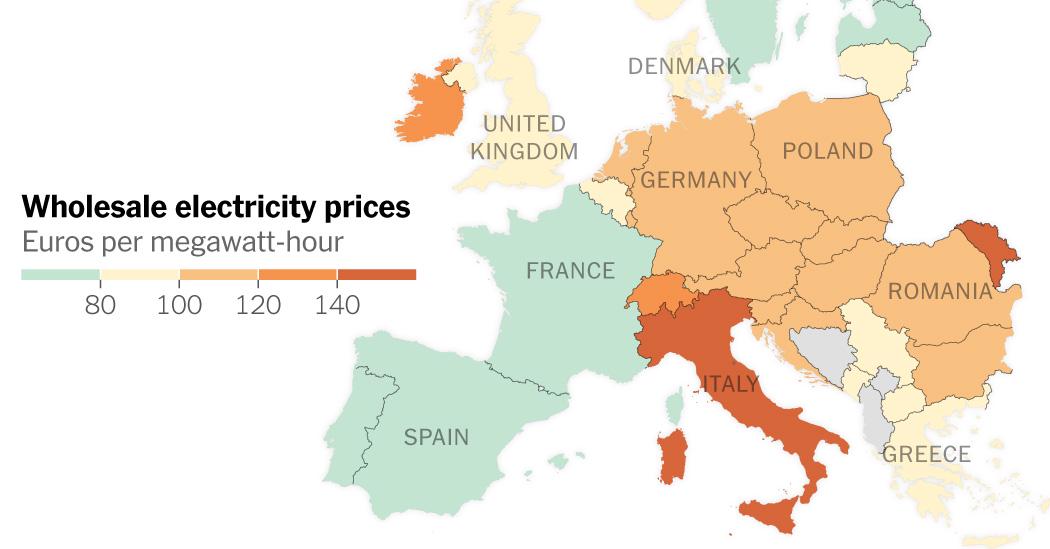
This NYT article nicely explains why the **very low price for renewable energy generation** is not resulting in low energy bills for the consumers. It’s an **energy market issue**:
*”Because of the way Europe sets wholesale electricity prices, even a small amount of fossil fuel in a country’s energy mix can have an outsize effect, anchoring prices higher and canceling out potential savings from renewables.”*
And meanwhile Spain has managed to overcome this to a good extent – because they have more renewable capacity installed.
Without Paywall: [http://archive.today/gSEwp](http://archive.today/gSEwp)
TL;DR:
> European countries’ wholesale electricity prices are determined by the last, most expensive form of fuel that’s added to the mix.
Which means that for the low cost of renewables to have an effect, a market needs to be fully powered by renewables (or at least non-fossil fuel) for at least some of the time. I think that’s important to remember, we don’t need 100% renewable energy production all of the time to lower prices, even having a single hour every day where gas/coal/etc doesn’t dictate the price will lead to cheaper energy prices on average.
> These pricing dynamics help explain why Spain’s renewables have been so transformative. In 2021, gas prices determined Spanish wholesale electricity prices 52 percent of the time. By 2025, the country had installed so much renewable energy that the number had fallen to 26 percent.
Wow, I thought UK electricity was a ripoff. If that map is accurate, Germany and most of Central Europe is economically fucked.
The problem is renewable transition isn’t happening fast enough to save Europe’s economies. We haven’t even managed to get a renewable grid, let alone replace oil in transportation and agriculture.
I remember the days before the market ideologues took over and we had a company whose job was to generate and sell electricity efficiently and reliably. Our electricity was relatively cheap in those days.
The NYT is way too simplistic.
First of all, even the wholesale spot market is not as simple as “highest bid sets the price ” – the market clearing price is a result of a more complex algorithm where both demand and supply curves (price vs volume) are compared.
But the biggest blunder to this simplified article is that spot markets in Europe cover a *minor* part of the total electricity traded volumes, as the larger part goes through long term “over-the-counter” bilateral agreements.
In fact, if you look at the avg price map, you can see that Greece is doing better than Germany, despite having larger volume covered by gas generation.
And Italy’s problem is mostly the *lack* of generation in the 2 bidding zones with the highest demand (north and central), thus relying on imports. Which then drags the prices up in the adjacent bidding zones with much smaller volumes.
It’s almost as if large parts of Europe barely gets any sun and other parts barely any wind.