
Dissuadere la Russia dall’aggressione. La Polonia sta formando una divisione in grado di catturare l’Oblast di Królewiec
https://radar.rp.pl/modernizacja-sil-zbrojnych/art44213991-zniechecanie-rosji-do-agresji-polska-tworzy-dywizje-zdolna-zajac-obwod-krolewiecki
di eloyend
11 commenti
Deepl translation, with minor corrections and notes:
——–
**Deterring Russia from aggression. Poland is forming a division capable of capturing the Królewiec Oblast**
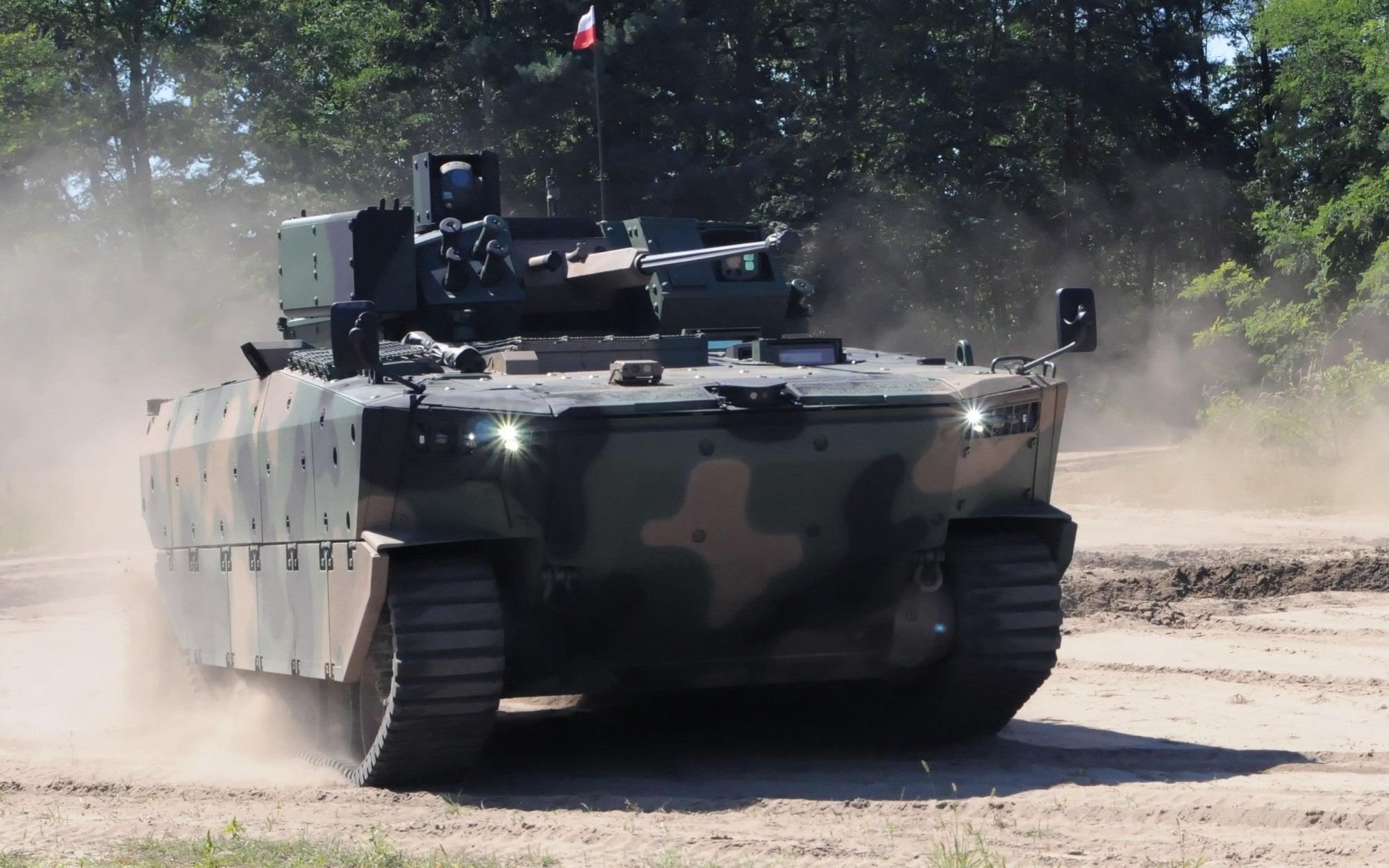
Opposite the Królewiec Oblast, Poland is building a division designed to neutralize a Russian bridgehead within hours. A key element of this plan is nearly 300 Borsuk armored personnel carriers. A second contract for their delivery could be signed as early as May.
Currently, the sole recipient of the Borsuk Infantry Fighting Vehicles (BWP) manufactured in Poland by Huta Stalowa Wola S.A. (HSW) is the 16th King Casimir Jagiellon Pomeranian Mechanized Division (known as the “Amber Division”), deployed in the Królewiec direction. All indications suggest that it will be the recipient of deliveries not only under the first contract but also under the next one, which is about to be signed.
The division’s three main brigades are armored and mechanized units. These are the 9th Armored Cavalry Brigade and the 15th and 20th Mechanized Brigades, which together have seven tank battalions (including three currently being formed) and five mechanized battalions.
The division’s fourth brigade (the 16th Brigade) is a newly forming motorized brigade equipped with wheeled armored personnel carriers (KTO Rosomak), which, in the case of versions equipped with 30mm gun turrets, can also be considered “wheeled APCs.”
**Poland’s “Amber Division” needs nearly 300 Borsuk vehicles**
The 16th Division comprises a total of five mechanized battalions, which are to be equipped with new BWP vehicles. Depending on whether the current structure of 58 vehicles per battalion is maintained or whether smaller battalions with one fewer company—i.e., consisting of 44 vehicles—are introduced, the division’s requirement for Borsuk armored personnel carriers is 290 or 220 vehicles in the standard APC version, excluding the announced specialized variants.
Both statements from military representatives and the division’s intended mission suggest that the “58” model will be maintained (and thus the requirement for a minimum of 290 Borsuks). It should be noted, however, that when discussing the division’s mission, we are not relying on official information, but solely on conclusions drawn from our own analyses.
A total of 116 vehicles have been ordered so far, which will allow for the re-equipping of two mechanized battalions. However, a second contract for the Borsuk may be signed as early as May, as confirmed by PGZ President Adam Leszkiewicz in an interview with “Rzeczpospolita.” Under the new implementation agreement, vehicles will most likely be ordered for two additional battalions, and perhaps a few extra units intended for training purposes. The latter would most likely go to the Land Forces Training Center in Poznań, which also trains personnel for the Armored and Mechanized Forces.
**How many Borsuk vehicles are ultimately intended for the Polish Army?**
Under the framework agreement signed in 2023, the Polish Army plans to ultimately acquire a total of 1,400 Borsuk vehicles. The contract provides for the delivery of over 1,000 combat vehicles and over 300 specialized variants, which are to include, among others, command, reconnaissance, engineer, medical, and technical support vehicles.
The first implementation agreement under the framework contract, signed in 2025, covers the delivery of 111 BWP Borsuk vehicles. Deliveries will be carried out in several phases. The first 15 units were delivered at the end of 2025. The next three were scheduled to be delivered to the military in 2026 (though there will likely be more), and subsequent batches (33 and 55 units) are planned for 2027–2029.
Earlier, between 2020 and 2023, the Polish Army received a series of pre-production vehicles (five in total), intended primarily for qualification testing and personnel training. These vehicles made it possible to test a full mechanized platoon and diagnose any significant technical issues, as well as assess the Borsuk’s tactical capabilities before launching production of the production vehicles.
*The 16th Division is the first unit of the Polish Army to undergo the rearmament process with Borsuk vehicles, as well as the first to fully transition to the new K-2 tanks*
Negotiations are currently underway regarding a second implementation agreement, which is expected to significantly increase the number of vehicles ordered and produced. Production is handled by Huta Stalowa Wola (HSW), whose production capacity is gradually increasing.
In addition to the infantry fighting vehicles themselves, plans also call for the acquisition of “support vehicles” for the Borsuk, which will perform specialized roles within mechanized brigades. In this part of the program, dialogue between HSW and the Military Automotive Works (WZM) in Poznań will be crucial, as there is a real possibility that the newly established Wielkopolska Armored Center will take over production of this portion of the order.
The Polish Armaments Group also sees significant export potential in the Borsuk program. Currently, in the Polish variants, the vehicles are integrated with the highly advanced—but consequently also expensive—Polish ZSSW-30 turret. Therefore, to increase competitiveness in foreign markets, configurations with cheaper turret systems are being considered, such as the Slovak TURRA turret, which would allow the offer to be better tailored to the financial capabilities and requirements of foreign customers.
**The 16th Division will be the first fully modernized division of the Polish Army**
The 16th Division is the first unit of the Polish Army to undergo the rearmament process with Borsuk vehicles, as well as the first to fully transition to the new K-2 tanks from the first two implementation contracts (a total of 360 units). Considering that it is simultaneously undergoing rearmament with new artillery and missile systems, it can be concluded that in the near future it will be the first fully modernized and reorganized division of the Polish Army.
In the case of the second unit undergoing extensive modernization—the 18th Mechanized Division—this process will likely take longer. While the process of equipping it with new American Abrams tanks is slowly coming to an end, as is the modernization of its artillery, the mechanized battalions’ vehicle fleet will have to wait longer for new vehicles due to plans to equip the division with new heavy IFVs. It is to be hoped that these will be Polish Ratel IFVs, whose prototype (or, at worst, a 1:1 scale model) we should see as early as this fall at the trade fair in Kielce.
**Polish IFVs will be a pillar of the mechanized forces**
The Borsuk is today one of the pillars of the mechanized forces’ restructuring. In practice, it allows for the replacement of the worn-out BWP-1s with light, amphibious vehicles featuring STANAG 4-level armor at the front (protection against anti-tank ammunition from large-caliber machine guns and artillery shrapnel), STANAG 3 (enhanced ballistic protection, shielding the crew from anti-tank rounds and artillery fragments) on the sides, and resistance to mine blasts and improvised explosive devices, which significantly improves the survivability of the crew and the troop load.
In its base version, the Borsuk has a combat weight of approximately 28 tons, and in a configuration with additional armor, it reaches about 30 tons. The vehicle is 7.6 m long and 3.4 m wide. The standard crew consists of three soldiers plus six infantrymen, and armament is provided by the ZSSW-30 turret with a 30 mm Bushmaster cannon, a 7.62 mm machine gun, and Spike LR launchers.
In contrast, the heavy infantry fighting vehicle (CBWP Ratel) currently under development is expected to weigh approximately 42–48 tons, which is significantly more than the Borsuk, automatically ruling out amphibious capability. In this case, the focus is on heavier armor, better protective capabilities (including the ability to integrate active protection systems such as Trophy), and full interoperability with Abrams tanks within the 18th Mechanized Division.
The Ratel is to retain a three-person crew and carry 6–8 troops. As its main armament, it will receive the same ZSSW-30 turret as the Borsuk, though possibly in a version with a 40mm cannon, which would give it significantly greater firepower when engaging armored targets. We will likely find out what the configuration of this vehicle will be this fall during the MSPO trade show in Kielce.
**The 16th Division is to be capable, if necessary, of occupying the Królewiec Oblast**
Poland is not building the 16th Division to attack Królewiec. It is building it so that an attack on Poland or the Baltic states ceases to be a rational option for Russia. The Borsuks (IFVs), K2 (tanks), Homars (MLRSs), and the new air defense system are all pieces of the same puzzle. A puzzle in which the cost of Russian aggression is to clearly outweigh any potential benefits. In practice, this means creating a division capable not only of defending its own territory but also of rapidly neutralizing Russian forces in the Królewiec Oblast and seizing it, if necessary, to prevent this bridgehead from being used against NATO.
As long as Królewiec remains a forward bastion for Moscow, capable of striking NATO targets and blocking the supply lines of the Baltic states, the risk calculation on the Russian side looks different. A division that can turn this bastion into a costly liability within a matter of days reverses that calculation. If the second implementation agreement for the Borsuks is signed in May as announced, the 16th Division will become fully operational in its new configuration by the turn of this decade at the latest (and not, as was assumed until recently, by the late 2030s).
Another unit is needed to be formed to retake occupied slavic Berlin
now imagine if from the other side lithuania would do the same + a naval blockade it would be encircled..
https://preview.redd.it/l8orcxnqsqxg1.jpeg?width=600&format=pjpg&auto=webp&s=5e304c15f73798e06f37216d8ff8e675942ed037
# Královec!
In collaboration with with Greater Czechia, right, RIGHT???
What a bs… they have nukes there.
Jeżeli rocznie budujemy 30-50 Borsuków a potrzebujemy 1400 to zanim zbudujemy ostatni to pierwsze będą już wymagały gruntownej modernizacji.
What about drones and cyberwarfare?
Well, sound and looks like ruZZian fake news / propaganda site.
It is Russian propaganda. Otherwise it would be very stupid of Poland to do it.