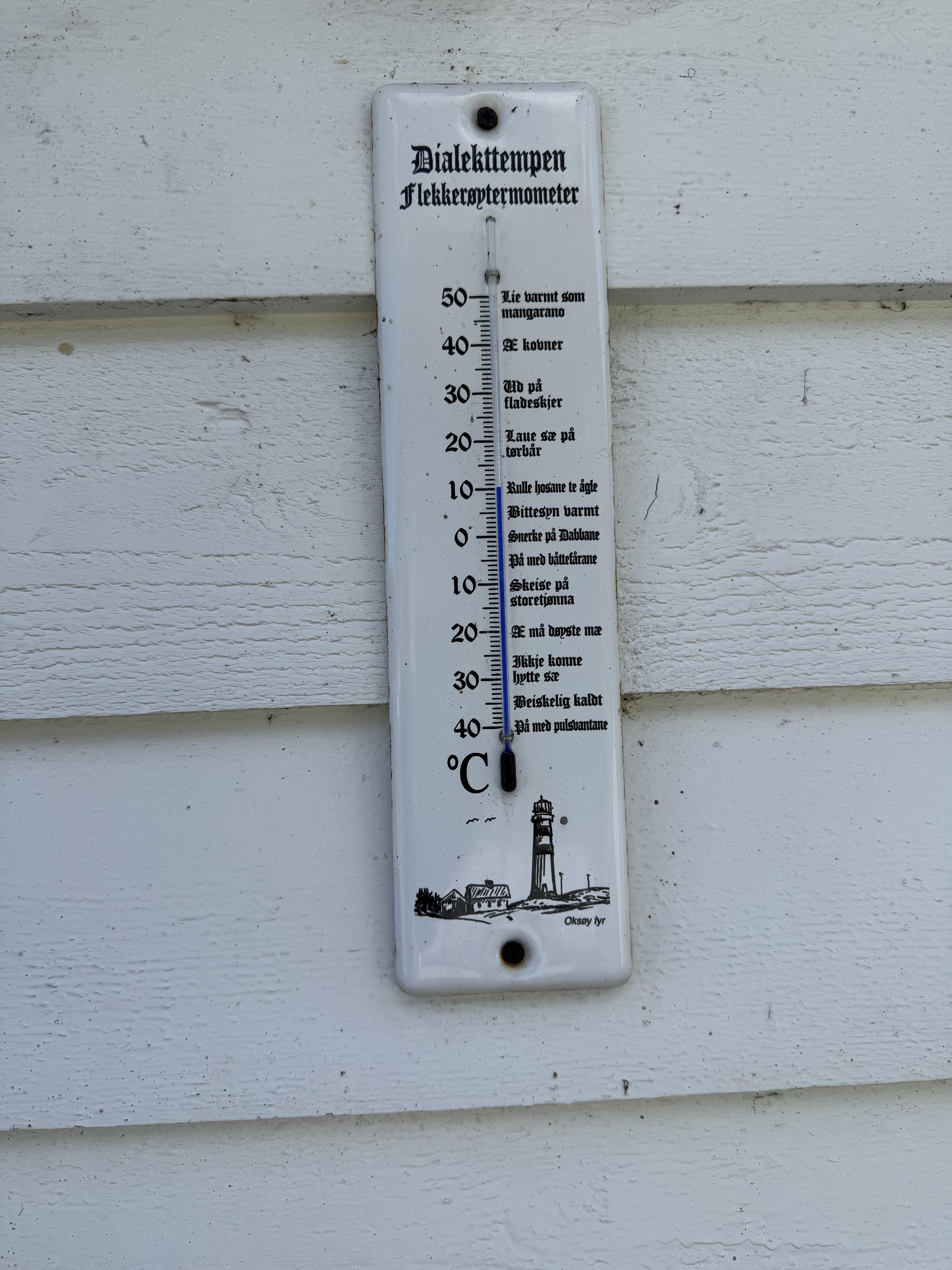
Ho visto questo termometro a Olden e sento che deve essere davvero divertente. Forse, forse no. Hai idea di cosa dica?
https://i.redd.it/ex9l3utzuj3h1.jpeg
di Xfire2024

Ho visto questo termometro a Olden e sento che deve essere davvero divertente. Forse, forse no. Hai idea di cosa dica?
https://i.redd.it/ex9l3utzuj3h1.jpeg
di Xfire2024
8 commenti
I’m from Oslo and have no idea what I’m Reading here
Wow, thats southern Norwegian dialect, more precisely Flekkerøy.
All I can say is that its thermostat you can buy called “Flekkerøy thermostat”, or “dialect thermostat”
How to translate, no idea, but knew right away since you can see many of these around the southern coastal areas of Norway where my mothers side of family is from.
EDIT:
Found a rough translatation after a quick search.
Another Edit: My mistake, wrong transaltion for what is actually writen on your image. Sorry. Need to ask someone from there then.
I think I have a solution, thanks to A.I. Can’t guarantee the quality of the translation though.
Hope it helps.
Teksten ved temperaturene/Text by the tempretures.
* **“Lie varmt som mangarano”** → “As hot as hell” / “Extremely hot” (“mangarano” virker som lokal dialekt/slang; betydningen er omtrent veldig varmt)
* **“Æ kovner”** → “I’m overheating”
* **“Ud på fladeskjær”** → “Out onto the bare rocks/skerries” (typisk sørlandsreferanse til soling/bading)
* **“Lave se på torbår”** → Usikker. Trolig noe som betyr “slappe av og se på torvågen/torvet/båtene”. Denne klarer jeg ikke sikkert.
* **“Kulle josane te åge”** → Veldig usikker lesning. Kan være en lokal frase jeg ikke klarer å tolke korrekt.
* **“Bittesyn varmt”** → “A tiny bit warm”
* **“Snare på Dølarane”** → Usikker. Kan vise til et lokalt sted eller uttrykk.
* **“Då må båtførane”** → “Then the boat people must…” / ufullstendig uten kontekst.
* **“Skeise på storetjønna”** → “Skate on the big pond/lake”
* **“Æ må døgste mæ”** → “I’m freezing” / “I’m chilled to the bone”
* **“Ikkje komme hytte te”** → “Can’t get to the cabin”
* **“Beiskjeligt kaldt”** → “Terribly cold”
* **“På med pulsvarmane”** → “Put on the wrist warmers”
Nederst står også/Bottom text.
* **“Oksøy fyr”** → “Oksøy Lighthouse”
– «Lie Varmt som Mangarano» – just as warm in Mangarano (a town in Madagascar).
– «Æ kovne» basically what we say for «I’m so fucking warm I wanna puke». It means losing your breath iirc.
– «ud på fladskjer»- «out to flatskjer», I guess a place on Flekkerøya. The dialect thermos has different place names depending on the places.
– Laue se på tørbår- iirc Laue means swimming, so «swimming at tørbår» but I has always said it more as to lay on the beach/ svalberg and just chill…
– rulle hosanna te ågla- i don’t know man. I guess rolling the pants? ** edit: I found it! It’s dialect for rolling the socks to the ankles.
– bittesyn varmt – a small little bit warmth
– snerke på dabbane – when there’s beginning to come a thin ice on water. Think «snerk» on the water
– skeise på storetjønna – skate on stortjønna
– æ må røyste mæ – idk
– ikkje konne hytte sæ – idk I read it as to not be able to be angry? ( å ikke kunne hytte seg- han hyttet med neven????)
– beskelig kaldt – *really* freaking cold
– på med pulsbantane – «on with the pulsbantane» pulsbantane are «pulswarmers» knitted hand and arm warmers iirc.
It’s not really funny as its just old dialect sayings for the weather and temperatures
The thermometer may have been in Olden, but is a humorous «dialect thermometer for Flekkerøy», a community in Agder (or Sørlandet), the southern coast of Norway.
The highest temperature on the scale, +50 C, translates to «as hot as Mangarano», a former location for Norwegian missionaries at Madagascar, specifically a hospital and refuge for people at Madagascar with leprosy.
https://www.kirken.no/nn-NO/fellesrad/drobak-frogn/om-oss/misjon/misjon%20mental%20helse/
https://nms.no/nyhet/mangarano-skal-gjenreises
Flekkerøy (and the southern coast of Norway) is a part of the Norwegian «Bible Belt». Starting in the 1860s, Norwegian Christian missionaries had a presence at Madagascar. This was a visible activity also in various Norwegian churches and Christian organisations. They collected money to fund the missionaries and their work, and the missionaries returned to their local churches with presentations and stories. Norway was not really a wealthy country in 1866, but the returning missionaries presented a different perspective to people in various small Norwegian communities.
https://en.wikipedia.org/wiki/Madagascar–Norway_relations
https://madagascarmission.org/remembering-former-missionaries-to-madagascar/
The temperature at +30 degrees Celsius is described as «out to Fladeskjær», a rock in the sea outside Flekkerøy, and a popular spot for fishing.
That’s a ‘dialect thermometer’, which describes various temperatures in colorful phrases from a specific Norwegian dialect. Norway has hundreds of dialects, and the dialect thermometer therefore comes in hundreds of variations. This one applies to Flekkerøya, a small island on the Southern coast.
50 – as warm as mangaramo (assuming thats a place?)
40 – I’m boiling
30 – out to Fladeskjær (flat rock, «skjær» is used avout rocks in the sea) this is an island around Arendal city
20 – this I’m really unsure about
10 – curling toes or pulling toes back
0 – «snerk» is the layer that forms on top of soup so I’n assuming this means ice on a specific lake
-5 – on with the slippers
-10 – I think this is ice skating on Storetjønna, a lake
-35 – really cold
This was hard, and I’m just an hour drive from Arendal where I assume this is from
I grew up on Flekkerøy and can add the missing lines:
20 Laue sæ på tørbår:
Go swimming at Tørbår
Tørbår is the name of place kids liked to go swimming (= laue sæ)
10 Rulle hosane te ågle
Roll the socks down to the ancles
0 Snerke på dabbane
Thin layer of ice on puddles
-15 På med båttefårane
Time to put on “botfor”, a waterproof and warm cover over the shoes
– 20 Æ må døyste mæ
I have to hit my arms to keep warm (slå floke in Norwegian.)
– 30 Ikkje konne hytte sæ
Can’t manage this cold
– 35 Beiskelig kaldt
Extremely cold. Beiskelig sounds like one of the many invented words used instead of swearing.
Seing the dialect in writing make me realise how many weird expressions we use there.