https://old.reddit.com/r/armenia/comments/1dcrba0/interesting_article_in_an_arf_publication/
di mikek1968

https://old.reddit.com/r/armenia/comments/1dcrba0/interesting_article_in_an_arf_publication/
di mikek1968
5 commenti
That’s Stepan, who is among the only ones among them with genuine real common sense. I’ve never met him but have heard good things. Most of his posts are well-reasoned. From his style you can tell he is a scholar and not a signaling doofus.
ARF members in his chapter listen to him, but ARF leadership and their firebrands do not pay much attention to the guy. It’s a big shame.
Wow, what a normal take in an ARF publication.
I’m shocked an ARF site published this. I’ll paste it here just in case they change their minds:
_______
**What is the end point? A call for pragmatism…**
June 5, 2024 Stepan Piligian
This has proven to be one of the more difficult columns to write. The current events in our global Armenian nation are intersecting with my core values, creating moral dilemmas and difficult choices. Similar to most American-Armenians, we were raised to love our heritage and encouraged to contribute to its prosperity. When Armenia became an independent nation in 1991, it was the fulfillment of a dream for the diaspora and our brethren in the homeland. The early years of the Republic were anything but ideal from an economic and quality of life perspective, as Armenia made the painful transition from an oppressed state to a democracy with a market economy. As domestic policies have matured, national security has dominated the political landscape. I find it painfully ironic that while much of the diaspora advocated for Armenia to align itself with the West, it has also become the most ardent critic of the current government in the homeland. We seem to cling to our independence in the diaspora. The duplicity of the diaspora in the United States, as it advocates for the homeland while publicly attacking its government, raises an interesting question: what is the role of the diaspora as it relates to advocacy? Is it an independent, parallel entity that can add significant value to the homeland while resisting the temptation to act as a remote critic?
The current environment gives us a clear view of this challenge. Most of the advocacy work in this country is viewed as foreign policy content by the United States government and the Republic of Armenia. If we in the diaspora are working on behalf of the homeland, how do we manage disagreements? It is clear that some members of the advocacy community have been harsh critics of Armenia’s policies, and their views have been quite public. My question is: does the U.S. government respect the Armenian community when we lobby for U.S. taxpayer funding for Armenia yet advocate for regime change? I am certain that we are tolerated by the U.S. but perhaps not respected. We are all entitled to our opinions, but activist criticism of the Armenian government from outside of Armenia is troubling. Do we really have a vested interest in the impact of this activism, or are we confusing impact with an attempt to protect our “investment”? It is an important question, because the messaging is mixed. It suggests that we in the diaspora expect some level of influence in the policies of the sovereign Republic of Armenia. We would be wise to separate our emotional bonds as Armenians with the rights of a sovereign republic. One of the most significant obstacles to a stronger relationship between the diaspora and the homeland is the perception that the diaspora seeks to influence Armenia in return for its advocacy. Even if this is merely a perception, public criticism of Armenian politics feeds that perception. How can we in the United States profess our commitment to Armenia when large segments of our advocacy community have an estranged relationship with Armenia’s embassy in Washington? One would think it would be a major area of interface, but the lack of visible interaction tells a different story.
The vast majority of us do not live in Armenia and are not citizens. We have strong and passionate ties, but we must understand the definition of sovereignty. The examples of the Aurora Initiatives and The Future Armenian offer us a different approach. Certainly there are concerns about the state of Armenian society, but these organizations practice a refreshing, forward-thinking approach that avoids the perception of public meddling. What we do for Armenia, we must do for love, which includes disagreeing on policy. Protesters in Armenia are within their rights as citizens, according to Armenia’s laws in a functioning democracy, but legally we are foreigners. The citizens of Armenia have the responsibility to determine the future of their country. This is a very difficult concept for us to embrace, given our compassion for Armenia and our willingness to wantonly express criticism. Supporting Armenia and expecting nothing in return is a noble concept, but our willingness to do so is tested in times of disagreement. It is not our responsibility to be remote critics who contribute to instability. We need to pause when we contribute to disunity. Our enemies are skilled at taking advantage of our weaknesses. The Turks have often targeted the diaspora in an effort to create or exploit discord. We need to have a more strategic mindset and move beyond opinions outside the realm of our responsibility.
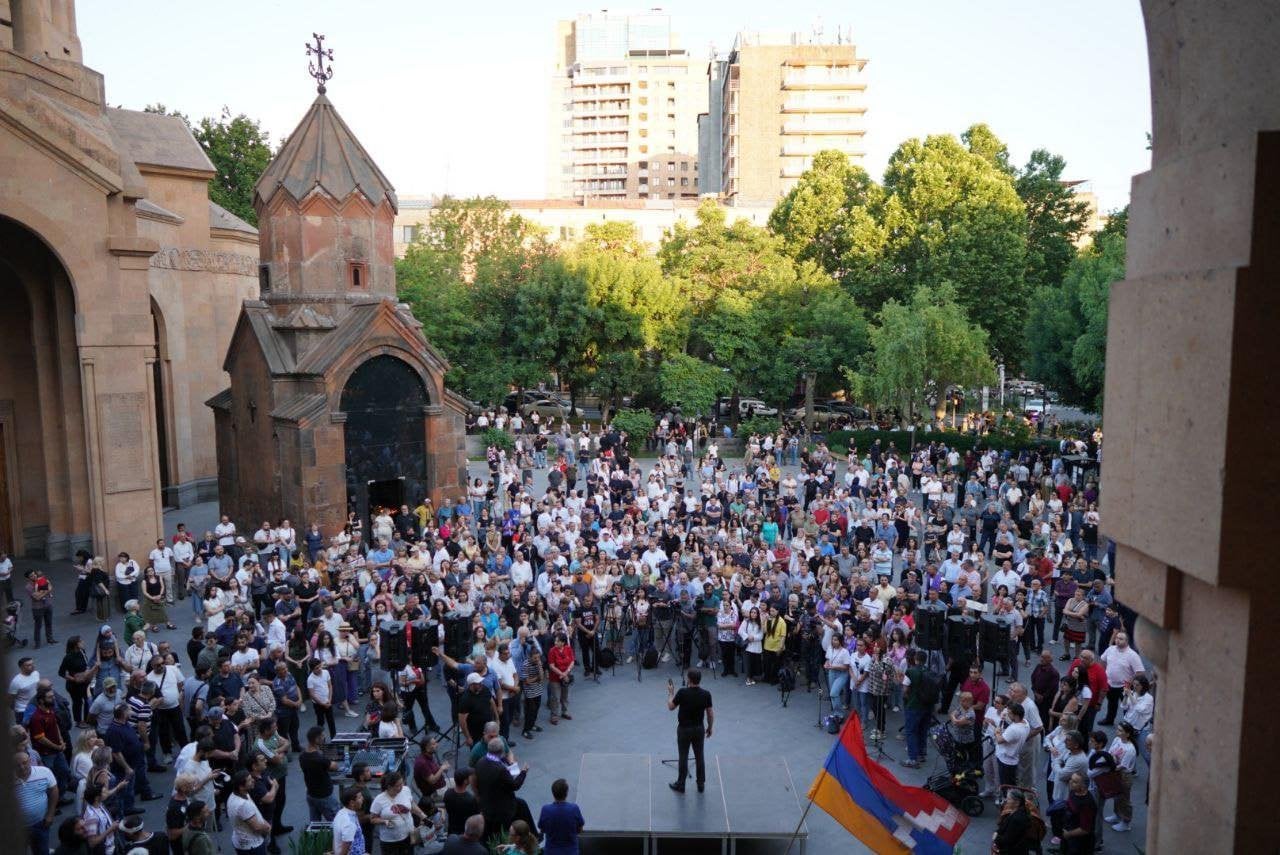
Another area in our global domain in dire need of a dose of pragmatism is the “Tavush for the Homeland” movement. What started as, I believe, a sincere response to a very emotional issue along the border of Tavush has evolved into a magnet for every “opposition” group. These groups have little in common with each other, except their opposition to Prime Minister Nikol Pashinyan. While I believe in the right to free expression in a democracy, we must ask ourselves…what is the end point for this campaign? We have a primate of the Armenian Church who launched local protests that transitioned into a march to Yerevan. He has preached nonviolence but has advocated for acts of civil disobedience. The latter can be peaceful but challenge authority and openly push the limits of tolerance. This can lead to troubling circumstances. Anyone leading such public activity grounded in peaceful values has a responsibility to outline a path forward. All we know is that Bagrat Surpazan has stated that he is the opposition candidate for Prime Minister. Why? How? What are his qualifications? As tensions rise, with the opposition forces challenging authority and lines becoming blurred, the protesting leadership should be responsible and tone it down. Armenia does not need internal instability while trying to maintain its sovereignty and national security. It is very easy to criticize, but it would be wise to offer solutions. I have not heard any.
*continued below*
Yes, the article makes sense, and Stepan is making a level headed assessment here.
With that in mind, I think before we look at the macro level, we have to solve some micro level issues.
Stepan is talking about disunity within the political sphere – dude, what about the disunity within the ARF itself? How many of you guys are misaligned on things? How many of you just straight up LIE to one another? Clean up your room before you tell others to clean up the house.
Dashnaks are split in three, the cohort that holds onto the old vein of the Dasnaktsutsyun, and the other that consciously holds onto the HHK axis, and the other that consciously holds onto Robik & Co.
When the Dashnaks clean up their own party, then they can ask for less internal conflict. Half the internal conflict stems from them, and their idiocy/corruption/infighting over the years is how we ended up with the incompetent QP.
I grew up in Glendale attending AYF events, etc. – that’s the perception I had as a KID because it was so blatantly obvious, and nothing has changed until today.
In Armenia, I’ve yet to see the Dashnaks do anything but lead to disaster. The only people who have any authority/representation/ability to do anything are, for lack of a better term, compromised.
That party (particularly the Armenian branch) was infested with KGB, and today, still has people “reporting” to the FSB, and the brainwashed ARF members from the diaspora STILL donate to these morons.
Stepan is a symbol of what it COULD be – but they need to realize that all hope is lost (unless they go full scorched earth). Point out EXACTLY who’s a problem in your party – watch the others follow suit.
Stepan, and the rest of the earnest Dashnaks – they need to detach themselves from their romanticized idea of the party and from a new one, like the Hnchaks and Ramgavars of old. So many of them are so concerned with the image and the “pativ” of the party, they lose sight of the fact that not ousting these people is a bigger net detriment to Armenia AND the diaspora’s ability to be an effective tool.
Just skimmed through, it’s probably an OK article but it’s late by exactly a month now.