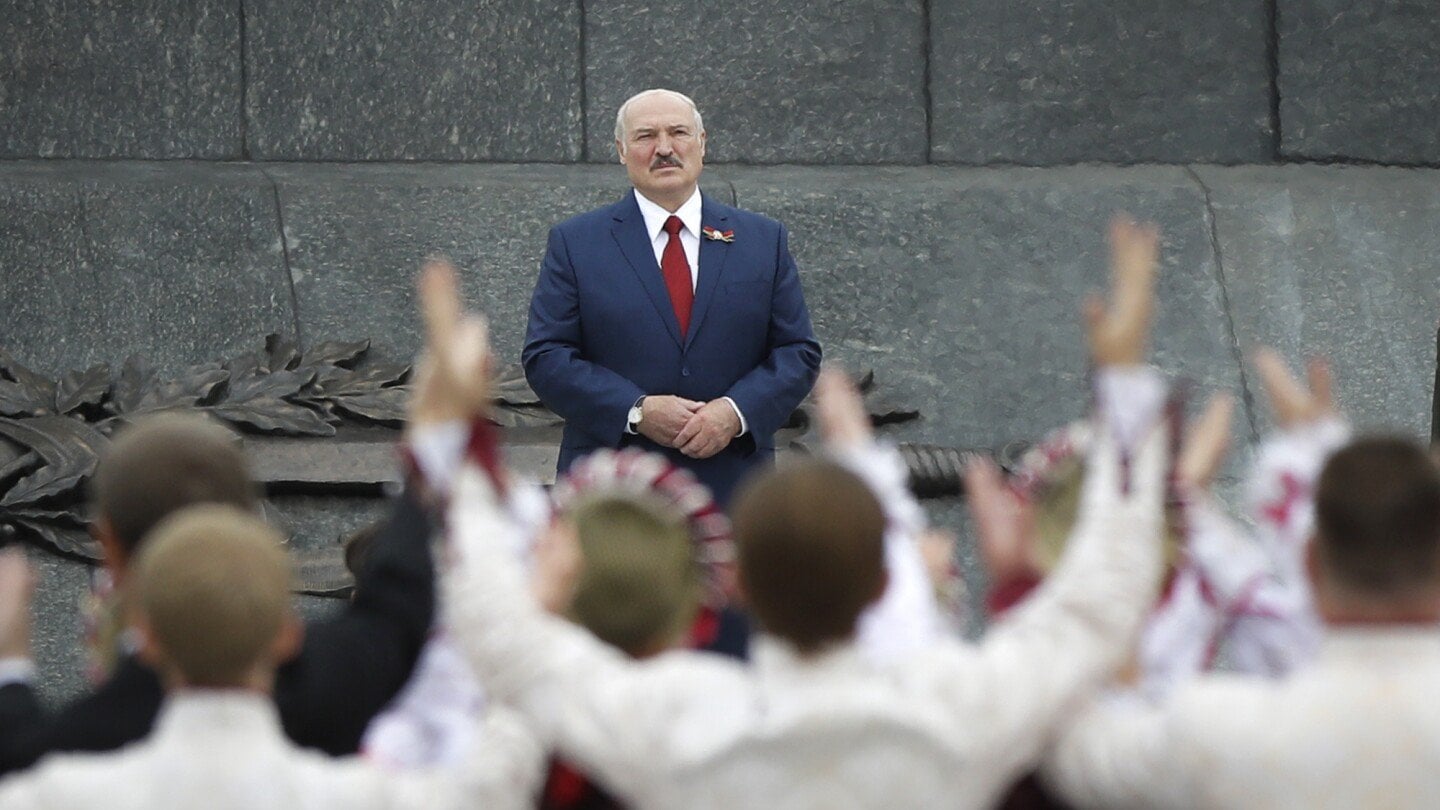
In Bielorussia la lingua madre sta scomparendo mentre il russo assume un ruolo di primo piano
https://apnews.com/article/belarus-language-russia-lukashenko-russification-bcc4eb1881ca6c93f98ef9951068dde7
di paniniconqueso

In Bielorussia la lingua madre sta scomparendo mentre il russo assume un ruolo di primo piano
https://apnews.com/article/belarus-language-russia-lukashenko-russification-bcc4eb1881ca6c93f98ef9951068dde7
di paniniconqueso
8 commenti
If this seems bad to you in Belarus, then it should seem bad to you in your own country, because unless you’re living in a country like Iceland, there’s a good chance there’s one or more minoritised (=treated as lesser than another) language n your country as well.
Belarussian is supposedly an “official” language in Belarus. Many European languages don’t even benefit from any kind of legal recognition or protection in their own home.
>TALLINN, Estonia (AP) — When school started this year for Mikalay in Belarus, the 15-year-old discovered that his teachers and administrators no longer called him by that name. Instead, they referred to him as Nikolai, its Russian equivalent.
>What’s more, classes at his school — one of the country’s best — are now taught in Russian, not Belarusian, which he has spoken for most of his life.
>Belarusians like Mikalay are experiencing a new wave of Russification as Moscow expands its economic, political and cultural dominance to overtake the identity of its neighbor.
>It’s not the first time. Russia under the czars and in the era of the Soviet Union imposed its language, symbols and cultural institutions on Belarus. But with the demise of the USSR in 1991, the country began to assert its identity, and Belarusian briefly became the official language, with the white-red-white national flag replacing a version of the red hammer and sickle.
>But all that changed in 1994, after Alexander Lukashenko, a former Soviet collective farm official, came to power. The authoritarian leader made Russian an official language, alongside Belarusian, and did away with the nationalist symbols.
>Now, with Lukashenko in control of the country for over three decades, he has allowed Russia to dominate all aspects of life in Belarus, a country of 9.5 million people. Belarusian, which like Russian uses the Cyrillic alphabet, is hardly heard on the streets of Minsk and other large cities anymore.
>Official business is conducted in Russian, which dominates the majority of the media. Lukashenko speaks only Russian, and government officials often don’t use their native tongue.
>The country depends on Russian loans and cheap energy and has created a political and military alliance with Moscow, allowing President Vladimir Putin to deploy troops and missiles on its soil, which was used as a staging area for the war in Ukraine.
>“I understand that our Belarus is occupied. … And who is the president there? Not Lukashenko. The president is Putin,” said Svetlana Alexievich, who won the 2015 Nobel Prize for literature and lives in Germany in effective exile. “The nation has been humiliated and it will be very difficult for Belarusians to recover from this.”
>Belarusian cultural figures have been persecuted and hundreds of its nationalist organizations have been closed. Experts say Moscow is seeking to implement in Belarus what the Kremlin intended to do in neighboring Ukraine when the war there began in 2022.
>“It is obvious that our children are being deliberately deprived of their native language, history and Belarusian identity, but parents have been strongly advised not to ask questions about Russification,” said Mikalay’s father, Anatoly, who spoke to The Associated Press on condition his last name not be used, for fear of retribution.
>“We were informed about the synchronization of the curriculum with Russia this year and were shown a propaganda film about how the Ukrainian special services are allegedly recruiting our teenagers and forcing them to commit sabotage in Belarus,” he said.
>Mikalay’s school was one of the few where paperwork and some courses were conducted in Belarusian. In recent years, however, dozens of teachers were fired and the Belarusian-language section of its website vanished.
>Human rights advocate Ales Bialiatski, convicted in 2023 on charges stemming from his Nobel Peace Prize-winning work, demanded his trial be conducted in Belarusian. The court rejected it and sentenced him to 10 years.
Saying that belarus was part of the Russian empire for *centuries* is a bit of an exaggeration.
Most of belarus was part of the Russian empire from the second partition of Poland in 1793 till the end of the empire in 1917. So around 125 years.
It’s spreading like cancer
Was working with a Belarussian guy some 10 years ago. He told me Belarussian language is only used by elderly people in the villages.
A sad case of late stage ethnicity wipe.
could that be said about every small European language, just replace Russian with the English language 🙂
Of course, it’s for different reasons
How pro-Russia is the average Belarusian?
This is just a consequence of being locked out of every market except for the giant neighbour with a relatively large economy that also has a mutually intelligible language that isn’t too hard to learn
From the perspective of a young Belarusian, why would they learn their countries language when they could probably go places learning fluent Russian, it’s not like they’re gonna be locked out of communicating in their homeland