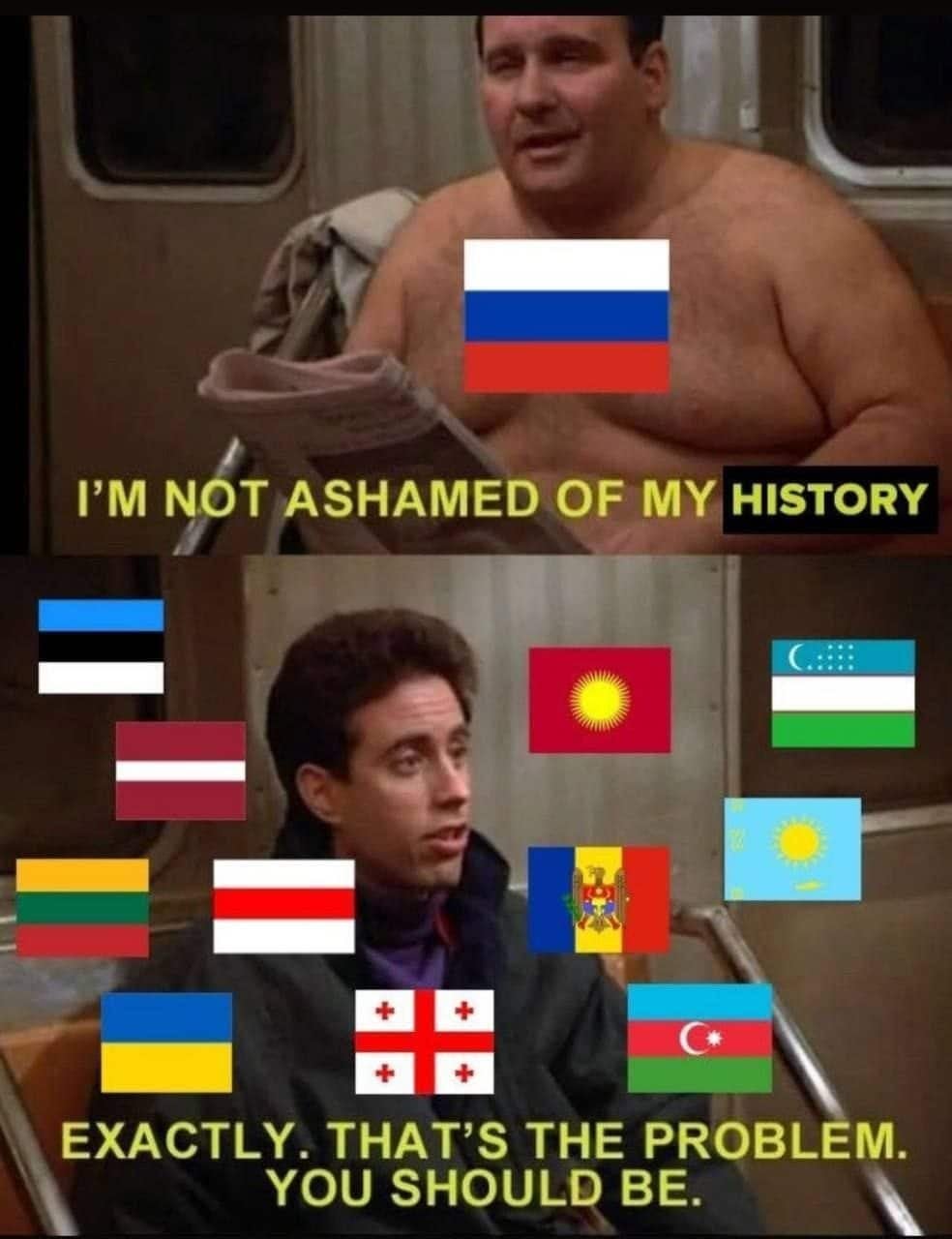
Ogni russo è responsabile della creazione della “palude puzzolente di una società basata sulla forza e sulla frode”, – A. Solzhenitsyn
di HydrolicKrane

Ogni russo è responsabile della creazione della “palude puzzolente di una società basata sulla forza e sulla frode”, – A. Solzhenitsyn
di HydrolicKrane
5 commenti
Remember back during World War 2, how everyone always made sure to remind themselves of the great irreconcilable gulf between the National Socialist regime and the German citizen.
No, I don’t either. Nobody in their right mind was doing this. And there is a very good reason why today, Germany has an allergy to all things Nazi. Nobody expects a reincarnation of Hitler to suddenly appear in the Reichstag and to continue his reign. It is understood – much like it is understood that the sky is blue and ice is cold – that the Nazi regime can only develop anew if it gains traction in the people first.
When it comes to discussing Russia, this conventional wisdom is swept under the rug. Not because it ever stopped ringing true, but because it’s an inconvenient truth. Nobody wants to look at this huge country with thousands of nuclear warheads and to acknowledge they are well and truly the enemy. It’s easier to pin it all on the regime – almost wishing it away in the process. Imagining it temporary. As something that will disappear in time. Some way, somehow. Putting the alarm on snooze and pretending you don’t have to go to work, if only for five more minutes. And then five more and five more and before you know it, you’re fired.
Well if we present this quote of Solzhenitsyn, let’s read on what his opinion on Ukraine is:
_______
I am well-nigh half Ukrainian by birth, and I grew up to the sound of Ukrainian speech. And I spent the greater part of my front-line service in sorrowful Belorussia, where I became poignantly attached to its melancholy, sparse landscape and its gentle people.
Thus, I am addressing both nations not as an outsider but as one of their own.
And, in any case, our people came to be divided into three branches by the terrible calamity of the Mongol invasion, and by Polish colonization.⁹ All the talk of a separate Ukrainian people existing since something like the ninth century and possessing its own non-Russian language is a recently invented falsehood. We all sprang from precious Kiev, from which “the Russian land took its beginning” (as Nestor puts it in his chronicle),¹⁰ and from which we received the light of Christianity. The same princes ruled over all of us: Yaroslav the Wise apportioned Kiev, Novgorod, and the entire expanse stretching from Chemigov to Ryazan, Murom, and Beloozero among his sons; Vladimir Monomakh was simultaneously Prince of Kiev and Prince of Rostov and Suzdal;¹¹ the administration of the Church exhibited the same kind of unity. The Muscovite state was of course created by the same people who made up Kievan Rus. And the Ukrainians and Belorussians in Poland and Lithuania considered themselves Russian and resisted Polonization and conversion to Catholicism. The return of these lands to Russia was at the time universally perceived as an act of reunification.
It is indeed painful and humiliating to recall the directives issued during the reign of Alexander II (in 1863 and 1876), when the use of the Ukrainian language was banned, first in journalism and then in belles-lettres as well. But this prohibition did not remain in force for long, and it was an example of the unenlightened rigidity in questions of administrative and Church policy that prepared the ground for the collapse of the Russian state structure.
However, it is also true that the fussily socialistic Ukrainian Rada of 1917 was created by an agreement among politicians and was not elected by popular vote.¹² And when the Rada broke with the federation, declaring the Ukraine’s secession from Russia, it did so without soliciting the opinion of the population at large.
I have had occasion to respond to emigre Ukrainian nationalists who keep trying to convince America that “communism is a myth; it is really the Russians who are seeking world domination, not the communists” (and, indeed, it is “the Russians” who are supposed to have seized China and Tibet, as is stated in a law passed by the U. S. Senate three decades ago, and still on the books).¹³ Communism is the kind of myth of which both Russians and Ukrainians got a firsthand taste in the torture chambers of the Cheka from 1918 onward. The kind of myth that confiscated even seed grain in the Volga region and brought twenty-nine drought-ridden Russian provinces to the murderous famine of 1921–22. The same myth that later thrust the Ukraine into the similarly pitiless famine of 1932–33. As common victims of the communist-imposed collectivization forced upon us all by whip and bullet, have we not been bonded by this common bloody suffering?
As late as 1848, Galicians in Austria-Hungary referred to their national council as the “Chief Russian Rada.” But then in a severed Galicia, and with active Austrian encouragement, a distorted Ukrainian language was produced, unrelated to popular usage and chock-full of German and Polish words. This was followed by the attempt to force Carpatho-Russians away from their habit of using the Russian language, and by the temptations of radical Pan-Ukrainian separatism, which manifests itself among the leaders of today’s emigration in bursts of farcical ignorance (such as the assertion that St. Vladimir “was a Ukrainian”)¹⁴ or reaches lunatic vehemence in statements such as: “Let communism live so long as the Muscovites perish.”
How can we fail to share the pain and anguish over the mortal torments that befell the Ukraine in the Soviet period? But does that justify the ambition to lop the Ukraine off from a living organism (including those regions which have never been part of the traditional Ukraine: the “wild steppe” of the nomads—the later “New Russia”—as well as the Crimea, the Donbas area,¹⁵ and the lands stretching east almost to the Caspian Sea)? If we are to take the “self-determination of peoples” seriously, then it follows that a nation must determine its fate for itself It is a question that cannot be decided without a national plebiscite.
To separate off the Ukraine today would mean to cut across the lives of millions of individuals and families: the two populations are thoroughly intermingled; there are entire regions where Russians predominate; many individuals would be hard put to choose between the two nationalities; many others are of mixed origin, and there are plenty of mixed marriages (marriages which have indeed never been viewed as “mixed”). There is not even a hint of intolerance between Russians and Ukrainians on the level of the ordinary people.
Brothers! We have no need of this cruel partition. The very idea comes from the darkening of minds brought on by the communist years. Together we have borne the suffering of the Soviet period, together we have tumbled into this pit, and together, too, we shall find our way out.
Why should they be, a countries history defines thw people of it? If russia should be ashamed of its history why shoulnt Britian France the the Usa and basically any country in the western world be ashamed of it thier people seem to be quite proud of it
That’s true, Russians running from the responsibility of their doings like from a fire. And in doing so repeating their genocidal attempts again and again.
There are lots of Russian that fought against the evil in their nation, I won’t blame them for not succeeding.