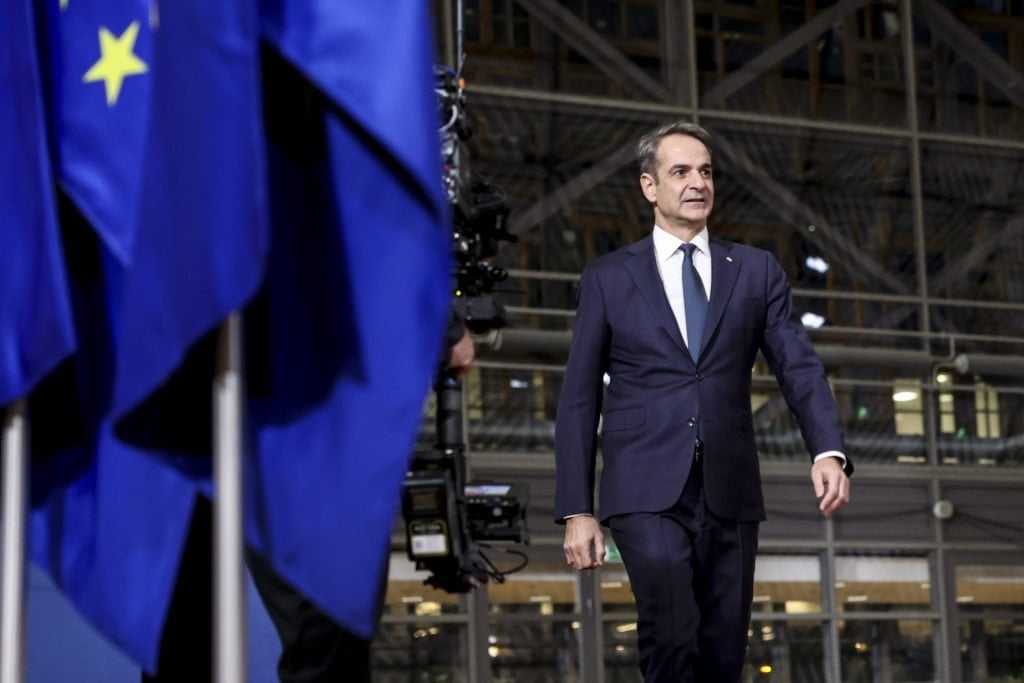
Il primo ministro greco Mitsotakis: “La Germania deve agire insieme”
https://table.media/en/china/interview-en/greek-prime-minister-mitsotakis-germany-must-pull-itself-together/
di Greekball

Il primo ministro greco Mitsotakis: “La Germania deve agire insieme”
https://table.media/en/china/interview-en/greek-prime-minister-mitsotakis-germany-must-pull-itself-together/
di Greekball
11 commenti
#full text:
**In an interview with Table.Briefings, Greek Prime Minister Kyriakos Mitsotakis argued for economic reforms – in Europe and in Germany. He also calls for a European defense fund, financed through common borrowing.**
*European competitiveness needs to be improved. What are the main reforms the European Commission and the European Heads of State should put in place?*
I think it is very clear that we are burdened with excessive regulations in Europe, which is hampering the competitiveness of all companies, but in particular small and medium-sized enterprises. We’re looking forward to the proposal by the Commission President for an omnibus legislation that will simplify regulation across the board. It is also very, very clear that we need to do something about energy.
*What should be done about energy?*
Energy prices in Europe are much higher than those in the United States, but also within Europe we see great discrepancies in energy prices and if we want to make the green transition happen, we need to invest in our grids. The electricity grid should be treated as projects of European common interest. They could require European financing. However, we need to not only bring down electricity prices in Europe in general, but to also make the European electricity market function in order to avoid the great disparities of the electricity price within the European Union.
*The EU also promised to cut bureaucratic obligations by up to 35 percent. Is that realistic?*
That’s a target the Commission has set, but it is very clear that we’re adding regulations without really thinking about the consequences of those regulations on the cost structure of our businesses. We cannot implement the green transition at the expense of our competitiveness.
*How are you doing this in Greece?*
We’ve cut taxes without jeopardizing our fiscal position, we have deregulated, we have digitized the state, and this has resulted in growth, that is significantly higher than the eurozone average, while at the same time we’re able to produce primary surpluses and bring down our debt. So, you can actually cut taxes and create fiscal space through growth. This is exactly what Friedrich Merz is proposing, and I can tell you that in the case of Greece it worked.
*We have to talk about Greek economy. It has been outpacing the euro area since 2021, I think. Public debt declined. It sounds like a miracle. Are you suggesting a new kind of economic policy or is it supply-side only?*
No, it’s not supply-side only. Of course, we have been successful in reasonably cutting taxes, but we also went after tax evasion. We were ruthless in going after tax evasion using digital tools, and this is giving us additional fiscal space to invest and to support our welfare state. Of course, we also need structural reforms, labor market reforms, skills reforms, justice reforms, digitization, which has been a tremendous success in Greece since we took over. All this together has created an environment that fosters and attracts investment. And if you add to that the RRF, which has been a great success in Greece. I think it gives us an opportunity to bridge the investment gap that has always separated Greece from the eurozone average.
*Greece was Europe’s problem child years ago and now it’s like a comeback story, and everybody looks up to your country. How does it make you feel?*
First of all, it makes me feel good on behalf of my people, on behalf of the country. I think the Greek people have proven incredibly resilient. But the job is not done. There are still significant issues in Greece. We still need to catch up with the rest of Europe, especially when it comes to our GDP per capita. But I think we’re moving in the right direction.
*The Draghi report is a sharp warning to the European Union, especially for its lack of economic dynamism. The US and China are funneling billions of dollars to their industry. Don’t we also need more money for European companies, and where should it come from?*
Absolutely, and this is going to be the next discussion that we will have at the level of the MFF. We cannot hope to achieve all the goals we have set without the financial means to do so. Part of the money will come from private capital, but part of it will also be public money. The RRF has been a great success. We need to look at what we’ve done and think about the next day.
*What do you mean, more specifically?*
Defence, which is a great priority for all of us. There is no way we can fund our increased defence expenditures simply from national budgets. We may need a small – compared to the RRF – focused European defence fund funded by joint European borrowing.
*How big should that be?*
I don’t know. Even if it were 100 billion, it would send a clear signal that we mean business. I have submitted this proposal together with Donald Tusk. We need to spend more at the national level, Greece is already spending more than 3 percent of its GDP on defence, and we need to spend more on the European level. At the end of the day, it’s our security that is threatened.
*Polish Foreign Minister Sikorski once said that he fears Germany’s power less than its weakness. Do you agree?*
We cannot envision significant progress in the European Union and strengthening the European economy without a competitive Germany. So, Germany needs to get its act together. There are structural issues related to the German economy, they’ve been well discussed in the German public debate. So, I think this is a time for bold action and more radical reforms.
Turn the tables on Germany by giving Germany turn-tables.
Any concrete ideas about “bold action and more radical reforms”?
How tables have turned…
“Going after tax cheats with digital tools” okay, but dodging taxes, usually happens alot by getting paid in money.
Perhaps Greece could start paying of their debt of 400 bn. $ before targeting other european countrys.
I do agree with a better system for energy pricing, what is the incentive to drop coal plants, if you earn the same as green energy.
To summarize: He wants more European funding, which ultimately means mainly German funding.
Somehow that is always the solution for everything, for certain countries in Europe. Germany is in a recession and Europe has to understand that the German money pipeline is now closed and other countries have to do their part.
As a Greek, it’s really frustrating having to constantly read, pay your taxes, and pay your debts by certain people in here. What exactly do you think Greece has been doing all these years while at the same time defending the border, dealing with the migration crisis that started with the Iraq war AND investing in military defense for decades cause we had an external threat before Putin’s war started?
then bail us out.
If you want to impose your economic ideals, this is what you need to do.
Now the boot is on the other Schumacher…
He’s right about deregulation. The EU is both overregulated and poorly regulated imo.
I love how no one that posted in this thread so far (with the exception of a single user) didn’t even bothered to read the article and yet they are entitled to having an opinion on the piece