
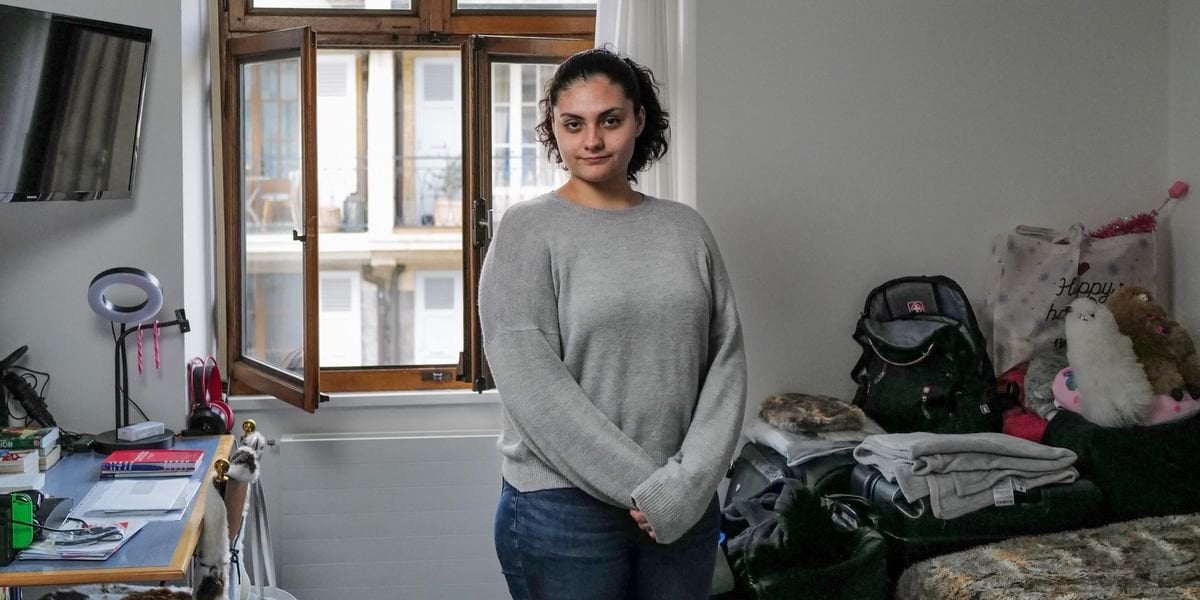
Rifugi di emergenza al limite | Sofia (19) vive in un rifugio per senzatetto. Ci sono sempre più donne come lei in Svizzera
https://www.tagesanzeiger.ch/obdachlosigkeit-schweiz-angebote-der-heilsarmee-ausgelastet-947207962287
di BezugssystemCH1903
2 commenti
Translation:
**Tagi frequently switches to a paid article:**
**Part 1:**
>__Emergency shelters at capacity__
>Sofia (19) lives in a homeless shelter. There are more and more women like her in Switzerland. In many cities, shelters are overwhelmed. This is shown by a survey. Since the pandemic, new layers of society have become homeless.
>-Sofia Trost, a 19-year-old Swiss woman, lives in the Bel’Espérance homeless shelter in Geneva.
>-The pandemic has significantly exacerbated homelessness in Switzerland.
>-Emergency sleeping places are overcapacity nationwide and include waiting lists.
>-New socio-political approaches aim to alleviate homelessness in the long term.
>“What, you’re from Aargau? Me too!” exclaims Sofia Trost. Where someone comes from is the first thing she wants to know. The 19-year-old Swiss woman is sitting in a meeting room at the Bel’Espérance shelter in Geneva’s old town. Until the pandemic, tourists stayed here. Outside, a plaque with three stars still adorns the facade. Sofia calls it “the hotel.”
>She speaks the typical Swiss German of an expatriate, a bit rusty but without shame. Otherwise, she’s a completely normal teenager. She likes Japanese rice cakes, Mochi, has a dream job (“I want to work in development aid”), and laughs a lot. But without “the hotel,” she would be on the streets. Sofia Trost is at risk of homelessness.
>Sofia’s story may seem atypical. But it shows how homelessness in Switzerland is changing.
>Her father is Swiss, her mother is Peruvian, and Sofia grew up in financially difficult circumstances. Her parents are separated. Mother and daughter moved around frequently, living for a while in Florida, sometimes in a car. From ages 10 to 16, they lived in Oberrohrdorf in Aargau. A happy time, says Sofia. Then her father passed away, and the family spiraled into financial hardship. Money became increasingly scarce, and Sofia and her mother moved to Lima, Peru. Sofia felt uncomfortable and unsafe there. She graduated from the Swiss school with a scholarship—and then wanted to return to Switzerland as quickly as possible: “This is my country; here I have a future.”
>With a few bags of luggage, she flew to Geneva in May 2024, where she stayed with a Peruvian acquaintance. But the arrangement was temporary, and eventually, she had to leave. And the only option left was “the hotel.” Sofia’s past sounds like a life without a future. Sofia says: “I will make it.”
>__The system in Switzerland is overwhelmed.__
>Her new home is the Bel’Espérance shelter run by the Salvation Army. It offers 51 places for women without homes. Khady Sow is the lead social worker at the facility. She says: “Our goal is to help the women get back on their feet.” There is no standard solution for this. Behind every case lies an individual story. Sow has a lot to do. “When a room becomes available, it’s full again by the evening,” she says.
>This is the case across Switzerland. Figures show that the system is increasingly overwhelmed.
>The Salvation Army is the largest provider of homeless shelters in the country. It operates 700 beds nationwide in emergency shelters, hostels, and residential homes. Spokesperson Simon Bucher says: “All Salvation Army facilities in all cities and regions are heavily utilized or overcapacity, including waiting lists.”
>A survey in Swiss cities confirms this picture.
>__Bern: “Demand is not met.”__
>Claudia Hänzi, head of the city’s social services, says: “Since 2023, emergency sleeping places in Bern have been permanently and fully occupied or overcapacity.” There are repeated “overloads of the support system.” In November, the canton approved 38 additional emergency sleeping places. Additionally, up to 20 places for women are to be created. In total, the city offers 117 emergency sleeping places. Hänzi says: “The demand is not met.”
>__Geneva: Over 500 free places.__
>515 places have been available year-round for two years, free and accessible to all, regardless of whether the person has a residence permit or not. “This is unusual in Switzerland,” says Christina Kitsos, mayor of Geneva, responsible for the department of social cohesion and solidarity. The offer is co-financed by all Geneva municipalities. Annual budget: 20 million francs. A new study will soon reassess the number of affected individuals in Geneva.
>__Lausanne: 100 new places.__
>Authorities have been working under high pressure to expand capacity in the last two years: 100 new sleeping places, bringing the total in Lausanne to 239. At least the number of rejections has been reduced.
>In other cities, the situation is similar: In Basel, according to authorities, emergency housing is “heavily utilized.” In Winterthur, the administration has noticed that more and more low-income people are relying on transitional housing after losing their homes. The city of Zurich created 30 additional places last year for supervised housing integration.
>Even in smaller cities, the situation is tense: Neuchâtel will soon have to open a shelter with ten beds to respond to the “dramatic situation” in the city, as a spokesperson told the Neuchâtel newspaper “Arcinfo.” In St. Gallen, the number of overnight stays in the city’s shelter has increased by 10 percent in three years.
>The Salvation Army says it is currently in contact with several cantons and larger municipalities outside major cities because they are struggling with problems.
I suspect that immigration has something to do with this. Priorities should be rethink, the native population should be number one and then (presumably) asylum seekers and other similar categories should be at the bottom and only considered if the N1 priority is fully taken care of. Additionally, the workforce needs should be rethink. We don’t have lack of skilled workers to the extend that it is advertised.