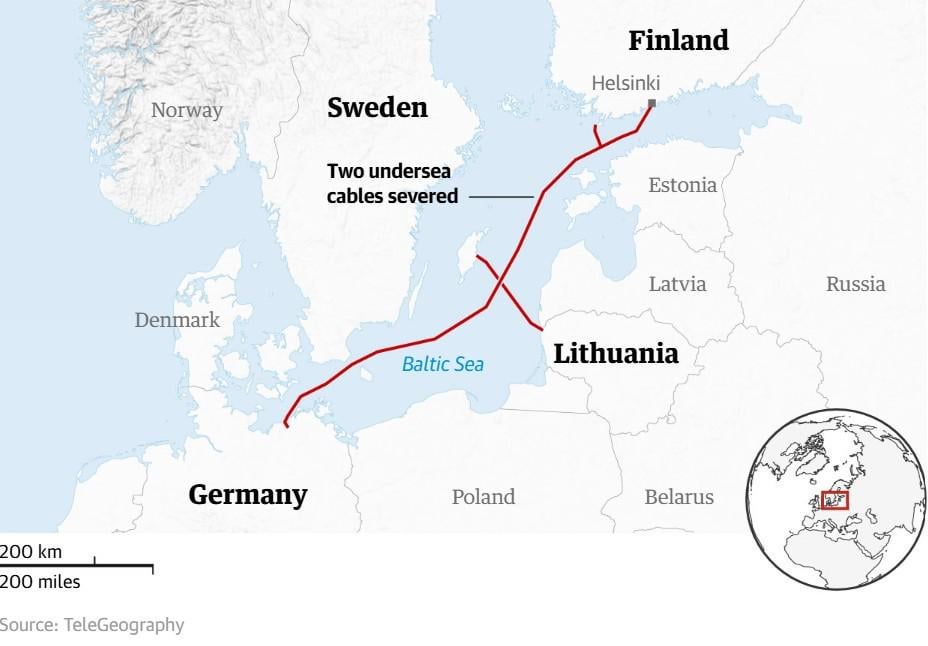
Numero di cavi del mare sottomarino danneggiati nel Mar Baltico dall’ottobre 2023: almeno 11
https://i.redd.it/8d8er8wxv2ge1.jpeg
di nimicdoareu

Numero di cavi del mare sottomarino danneggiati nel Mar Baltico dall’ottobre 2023: almeno 11
https://i.redd.it/8d8er8wxv2ge1.jpeg
di nimicdoareu
4 commenti
[Source](https://apnews.com/article/nato-france-russia-baltic-cables-ships-damage-764964a275530915c2cc5af1125ec125)
**What’s under the Baltic?**
Power and communications cables and gas pipelines stitch together the nine countries with shores on the Baltic, a relatively shallow and nearly landlocked sea. A few examples are the 152-kilometer Balticconnector pipeline that carries gas between Finland and Estonia, the high-voltage Baltic Cable connecting the power grids of Sweden and Germany, and the 1,173-kilometer C-Lion1 telecommunications cable between Finland and Germany.
**Why are cables important?**
Undersea pipes and cables help power economies, keep houses warm and connect billions of people. More than 1.3 million kilometers of fiber optic cables — more than enough to stretch to the moon and back — span the world’s oceans and seas, according to TeleGeography, which tracks and maps the vital communication networks. The cables are typically the width of a garden hose. But 97% of the world’s communications, including trillions of dollars of financial transactions, pass through them each day.
“In the last two months alone, we have seen damage to a cable connecting Lithuania and Sweden, another connecting Germany and Finland, and most recently, a number of cables linking Estonia and Finland. Investigations of all of these cases are still ongoing. But there is reason for grave concern,” Rutte said on Jan. 14.
**What’s causing alarm?**
At least 11 Baltic cables have been damaged since October 2023 — the most recent being a fiber optic cable connecting Latvia and the Swedish island of Gotland, reported to have ruptured on Sunday.
Although cable operators note that subsea cable damage is commonplace, the frequency and concentration of incidents in the Baltic heightened suspicions that damage might have been deliberate.
Is Russia trying to sabotage the Nordics defense or Europe overall by doing this?
Maybe another slightly disgruntled letter will stop them..