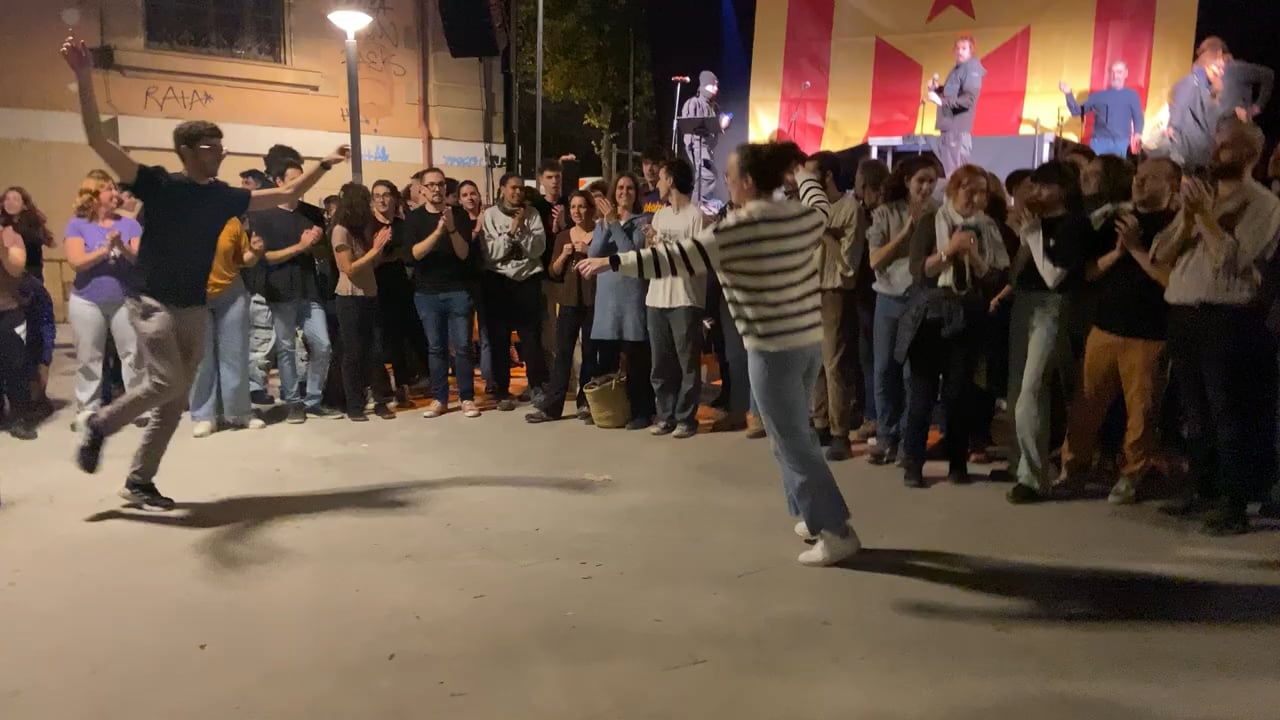
Bullanguera per il Maiorca Day (con Al-Mayurqa)
https://v.redd.it/wbwladsskcuc1
di paniniconqueso

Bullanguera per il Maiorca Day (con Al-Mayurqa)
https://v.redd.it/wbwladsskcuc1
di paniniconqueso
2 commenti
Visca catalunya lliure!
This was last year’s Diada (2023), on the 30-31st of December.
The PP-VOX controlled government of Mallorca has since changed the date of the Diada to the 12th of September, because of reasons that I won’t get into, but this change has been ignored by many (most?) Mallorcans.
The traditional Diada of Mallorca, commemorates the date, 1229, when Jaime I the Conqueror, the King of Aragón, entered into the conquered city of Mallorca. Mallorcan Muslims and Jews, the majority of the population, instantly became subjugated populations living under Christian rule. The Islamic period of the Balearic Islands is fascinating, but I won’t get into that.
The bullanguera is one type of Mallorcan dance. In the bullanguera the woman chooses her partner. In the last few years there’s been changes in the dance to reflect the change in society itself. Now men dance with men, women with women. For more information, [read the Wikipedia page](https://ca.wikipedia.org/wiki/Bullanguera):
>La **bullanguera**, també anomenada **bulla**, o **pastera** (de fet, una de les bullangueres més conegudes és el [So de pastera](https://ca.wikipedia.org/w/index.php?title=So_de_pastera&action=edit&redlink=1)) és una cançó de [compàs ternari](https://ca.wikipedia.org/w/index.php?title=Comp%C3%A0s_ternari&action=edit&redlink=1), concretament una [jota](https://ca.wikipedia.org/wiki/Jota), caracteritzada per la seva llarga duració.
>Acostuma a tenir una instrumentació senzilla, acompanyada de [mamballetes](https://ca.wikipedia.org/w/index.php?title=Mamballetes&action=edit&redlink=1). La lletra de les bullangueres són [gloses](https://ca.wikipedia.org/wiki/Glosa) de jota o de [copeo](https://ca.wikipedia.org/wiki/Copeo), i molt sovint és independent una glosa d’una altra: no guarden coherència en el contingut.
>Aquesta cançó es toca sempre al final d’una [ballada popular](https://ca.wikipedia.org/w/index.php?title=Ballada_popular&action=edit&redlink=1), o de vegades quan manca poc per acabar. La gent fa un rotlo gros i enmig s’hi ballen punts de jota, però només balla una parella. Així com va sonant la cançó, la gent entra dins el rotlo i es prenen la parella els uns als altres, i al qui li han pres la parella ha de sortir del rotlo, de manera que sempre ballen només dues persones. A la bullanguera, ben igual que en la totalitat de [balls tradicionals mallorquins](https://ca.wikipedia.org/wiki/Ball_de_bot), comanda sempre la dona, encara que hi poden haver excepcions quan la parella que balla es coneix.
>La forma de ballar aquesta cançó explica la seva durada: hi ha bullangueres de més de 7 minuts, encara que es pot dir que habitualment dura uns 5 minuts… també n’hi ha de curtes però no solen sentir-se gaire. Aquesta llargària permet que, al ball, pugui sortir-hi molta gent.
>Al contrari del que molta gent pensa, ballar la bullanguera al final de les ballades és una tradició relativament moderna.
Al-Mayurqa is a Mallorcan musical group that plays traditional Mallorcan music as well as makes its own folk music, for example, [Lluitadors](https://www.youtube.com/watch?v=AoB7184fqRQ). The name, obviously, comes from the Arabic name for Mallorca.