Hard-right parties are now Europe’s most popular – but number crunching shows that they have mostly been kept out of power
The origin of Europe’s recent hard-right surge is difficult to pin down. Some theorise that, beginning with the financial crash in 2008-09, voters were driven away from the mainstream and towards the extremes by economic anxiety. But the evidence for this is mixed. Europe is the richest it has ever been. And hard-right parties often win substantial support from the well-to-do. You could hardly look at the Netherlands—one of the wealthiest countries in the world, per person—and cite economic anxiety to explain its hard-right-led government.
Another often-heard argument is that the hard right represents a backlash against the migrant crisis that came to a head in 2015. Irregular immigration to some European countries has remained very high. Again, this theory is imperfect. In Germany, like many other countries, the hard right’s support comes predominantly from areas with little immigration. In fact, the association between immigration rates and support for the hard right is weaker than you might expect. Ireland has one of the largest foreign-born populations in Europe, for example, but no major hard-right party. The inverse is true of Poland.
Instead, the rise of the hard right is probably the result of a mix of factors. A succession of crises from 2008 onwards have weakened confidence in European leaders. And although Europeans are getting richer, many feel anxious about their economic security and social status. This makes them more sensitive to cultural changes such as immigration—even when those changes are happening far away. These trends are compounded by changes to the media landscape, particularly the rise of social media. The hard right’s growing support also has a ratchet: each time the parties increase their representation, they are normalised in the eyes of more mainstream voters.
And yet, despite their growing popularity, our analysis shows that they remain underrepresented in government. Grouping together the hard right as a single ideology across various countries is tricky. We drew on research from the University of Bremen and PopuList, a pan-European dataset of populist political parties, to form a list.
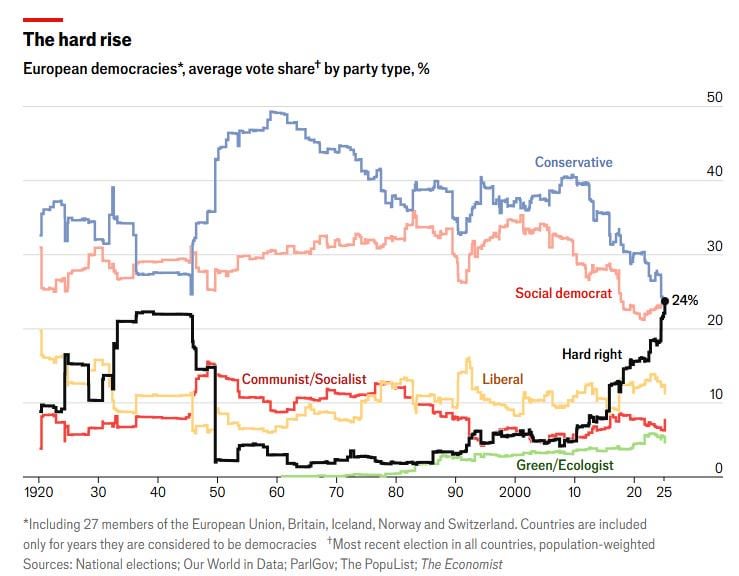
We then tracked their representation since 1920. Based on our list we found that Europe’s hard-right parties received 24% of the vote in recent national elections, winning 23% of parliamentary seats. But they make up just 14% of the seats held by parties that are in power. Just two heads of government—Giorgia Meloni of Italy and Viktor Orban of Hungary—come from the hard-right parties in our list.
This has drawn condemnation from hard-right populists around the world. J.D. Vance, America’s vice-president, has criticised European leaders for “hutting people out of the political process”.
Indeed, in some countries the hard right is locked out of power. In Germany, for example, the AfD is excluded from coalitions by the “firewall” that other parties maintain around it. That has done little to put voters off. But this is hardly undemocratic: more than three-quarters of Germans say that they oppose the country’s biggest party—the Christian Democratic Union—forming a coalition with the AfD. In other words, the firewall is not a stitch-up by liberal elites.
Even with minority support the hard right is disrupting politics across Europe, leaving the question of how other parties should respond. Many mainstream parties have decided that the hard right is simply too big to work around. However, while Germany’s firewall has not prevented the rise of the AfD, evidence from elsewhere suggests that dropping firewalls legitimises them. In Sweden, where mainstream parties have abandoned a firewall against the Sweden Democrats (SD), the hard right props up a minority government. Research suggests that voters now view the SD more favourably.
“Bringing the far right into government is what may cement and expand their vote because of the legitimacy signals it sends, ” says Stuart Turnbull-Dugarte, a political scientist at the University of Southampton. What’s more, there is little evidence that collaborating with hard-right parties encourages them to moderate their more extreme policy proposals.
Another approach for mainstream parties is to woo the hard right’s voters by adopting some of their preferred policies. A succession of European leaders—in countries from Britain to Denmark—have gone down this route, denouncing immigration and pulling back from climate goals. Research by Tarik Abou-Chadi of the University of Oxford shows that when mainstream politicians adopt anti-immigrant positions, it only serves to remind voters why they might vote for hard-right parties in the first place. As Mr Abou-Chadi puts it, “there is no magic formula which will make the far right disappear.”
If the hard right gains as much power as its vote share suggests, Europe stands to become less economically unified, less welcoming for racial and sexual minorities and less committed to fighting climate change.
dustofdeath on
So conservatives just became more conservative.
But as a result, they lost power – because now they are on average at lower % of total.
HuskerYT on
A lot of it has to do with mass migration and the associated problems such as growing violent crime, terror attacks and so on. Only the hard right even pretends to offer solutions, whereas mainstream parties ignore this completely or just say it’s nazi racist conspiracy theories or whatever. I think they are going to lose many future elections to the hard right if they don’t address these issues seriously.
Optimal_Mousse140 on
I have a weird opinion on this. But what I see in my country is a lot of people saying they are tired of immigration, and I’m a driver, I talk to a lot of people, even some immigrants say that.
I’m not one who opposes immigration but I understand why they feel that way. Centrist parties totally ignore what people are saying about the subject, and the far right is taking advantage of this by saying they will do something.
stilgarpl on
At least in Poland, main “Hard right” party, Konfederacja is constantly pretending to be a liberal party. This way they get the votes of both nationalists who blame everything on immigrants and LGBT and people who want to lower taxes.
And the key word here is “pretend” – they don’t event try to propose laws that would actually lower taxes and even voted against them in the past.
WeRegretToInform on
The rise of the Hard Right curve is almost entirely explained by the drop in the Conservative curve.
The main difference is that across Europe, other parties are less willing to form coalitions with Hard Right than Conservative. Moderate voters are less likely to tactically vote Hard Right than Conservative.
Romandinjo on
Despite being the richest, housing prices are still often out of reach for europeans, which hasn’t been really fixed, and that’s a necessity for both reproduction and overall satisfaction. And that is a ticking timebomb after the defense spending increase still – for many question “why are we militarizing instead of solving problems” is very valid.
Grafdelver on
The most important takeaway from this graph is that conservatism and “hard right” (why not call it what it is?) draw from the same pool.
rozsaadam on
Pls dont include hungary in this
potatolulz on
The ordinary right wing parties, “conservatives” if you will, didn’t distance themselves form the extremists.
Everytime you tell a nazi or some weird conspiracy freak to fuck off, they squeeze themselves between regular rightwingers and start yelling that “conservative opinions are being suppressed”, or that “everyone not extreme left is being bullied”, and basically that “rightwingers” are somehow a victim. And those regular completely ordinary right wing parties, the conservatives, don’t say a thing about it. In fact, they often support that fake victim sentiment.
Basically when someone sees a nazi, points their finger and says “fuck off”, the nazi starts hiding behind and pointing fingers at regular rightwingers and scream “you are being targeted!” and the conservatives never say “no, it’s just you, fuck off”. And they used to do it in the 90s, everyone did, and everyone understood why.
But now not so much. So since they can’t distance themselves enough and even platform the nazis and give them more exposure, then they legitimize the extremists’ fake claim that they’re “just conservative” and same as the regular old right wing parties.
Salt-Cold-2550 on
Don’t think it is as simple as migration = far right. There is no migration in Romania, Poland, Hungary. Yet those countries are becoming or are far right.
I think it is more to do with social media and the spread of fake news.
jaegren on
At the first they were nazis. then facist. then racists. then far right. and now “hard right”. Yeah. Thats where we’re going.
EzmegaziS on
People love to hate and the right wing capitalizes on that
SomethingofHungary on
We will never learn, I hope we will but I don’t think that the new genarations will be saved from a nither conflict. What bothers me most is that these 15 year olds and such don’t have controll over their decidions and 70 year old men are sending young people into potential war. I hope we learn but it seems we won’t
Beyllionaire on
Conservatism isn’t dropping, it’s just becoming more and more extreme and turning into what we call the far right.
Intelligent-Room-507 on
It correlates very strongly with the rise of Internet media and thus the breakdown of liberal (in the wide sense of the word) consensus and return of mass propaganda.
I also see a weaker correlation with the implementation of neoliberal reforms from the 80s and onwards. These reforms increased inequalities and unemployment, deteriorated established communities and made life more precarious and competitive in general. They also made the major left-wing parties impotent since no one knew how to effectively pursue socialist goals under these new political-economic conditions.
The turn towards new forms of social justice (antiracism, feminism, climate) seemed to revitalize social democracy for a short time during the 90s but it was not a sufficient substitute for working class power and socialist policies.
mystermee on
Graph probably likely tracks with level of investment in right wing propaganda. Look over here everybody at these fellow poor people and not at us the billionaires who are actually the reason why your society is falling apart.
-------7654321 on
social media
MACREDDIT19 on
What is the difference between liberal and social democrat? (Sorry, dumb American here)
Toffeljegarn on
“First as tragedy, then as farce”
Started by people fueled by hate and revived by people who don’t know any better.
carbonbasedcuriosity on
This makes me sad :/
th3nutz on
I wonder what happened around 2013-2014 in Europe, who financed all these parties. Hmm… nope I cannot think of a country or a common motif between all of them.
Yeah all these extreme right wing parties are against EU, Zelensky, NATO etc, but thats a coincidence, right? Right?
LE: Of course some dumb green policies + migrant crisis helped to boost them
NationalTranslator12 on
This is an interesting rebuttal to anyone that says “liberalism doesn’t work”. Since when was liberalism popular? The argument on the right is dominated by the hard right and conservatives.
Fit-Courage-8170 on
Correlation between when social media networks really took off. Nothing to see here
Helldogz-Nine-One on
Cut off foreign campaigned social networks and imprisson foreign agents in the far right parties and watch how the noumbers fall.
These dudes want “strong man”? – We can deliver!
Reasonable-Aerie-590 on
The conservative decline is almost an exact mirror image of the hard right ascent which is very weird because ,in my country at least, it is very different people who vote for either party. It‘s not necessarily been conservatives flocking to the far right
No_Heart_SoD on
The rise of traitors you mean.
Johnny_Bit on
I’d like to note that the sharp rise of “hard right” coincides with sharp decline of “conservative.”
This also coincides with tendency to label any newly made conservative party as “far right” – just look at the “hard right” now being more popular than in years preceding the WW2, where before WW2 europe had: germany ruled by nazis, Italy ruled by fascists, Spain had rising Franco’s party, Austria was ruled by Fatherland Front…
ristevisar on
people vote for these kind of things because in their twisted minds they are pleasured to be subjugated
munn_ja_mongol on
Drop mass immigration, stop pushing DEI ideology adopted from the US, focus on making energy cheaper and eceonomic growth. The far right will have the wind taken out of it’s sails.
cnio14 on
This graph clearly shows that we were dominated by a kabal of socialist left wingers who wanted nothing else than destroy the western world through immigration and woke culture. It’s time we brought back the good old days!
/s
Electronic-Teach-578 on
Key Ideas Behind the 20% Rule in Political Science:
Critical Mass Theory:
Once a movement, ideology, or belief reaches a certain threshold of committed followers (often around 20-25%), it becomes self-sustaining and begins influencing the majority.
Before hitting this threshold, ideas struggle to gain traction and may die out.
Social Contagion & Network Effects:
When 20% of a population strongly adheres to a belief, they create enough social pressure that others start to conform, even if they were initially indifferent.
This is linked to pluralistic ignorance, where many people may be open to change but only act when they see enough others doing so.
Empirical Studies:
A 2018 study at the University of Pennsylvania found that a committed minority of just 25% could shift the majority’s views in social dynamics.
Historically, many political revolutions, civil rights movements, and ideological shifts have been driven by small but committed groups.
Political Implications:
Authoritarian Regimes: If 20% of a population becomes highly dissatisfied and mobilized, they can create a tipping point that threatens the stability of the government.
Democratic Movements: Activist groups reaching this threshold can push policies, social norms, or political realignments.
Radicalization & Extremism: Fringe groups that grow beyond this point can start shaping mainstream discourse or political landscapes.
Yose_85 on
we are over 1940 decade, that scares me a lot
Budget_Variety7446 on
One analysis, that may offer some perspective
In Denmark the hard-right was on the move from way back. Even before everyone else jumped on the hate train.
The Social Democrats – against much of their own base – adopted a hardline against immigration. That is, they took the concerns of hard-right voters seriously, even at the cost of votes from their more well-educated city-dwelling soft socialist voters.
That crippled the right, and they splintered into several easily ignorable parties.
I’m grossly over-simplifying, but serious politicians taking (more or less) valid concerns seriously, kept decisions of out the hands of the worst crazies on the extreme spectrum.
I’m not saying it would work everywhere, but I find it interesting.
Thalassophoneus on
That’s a way to say that conservatives are pretty much the same as hard right. Where do you think New Democracy got many of its politicians from, here in Greece? Far-right populist parties that cried about chemtrails.
Same with liberals and social democrats.
_CatLover_ on
You can see the hard right getting a small bump in the 70s, start rising in the 90s and exploding after 2008. It’s all down to economics.
Fix the economy and economic inequality.
PM_ME_CRYPTOKITTIES on
Oh goody, we’re about 1935-1945 levels
Miserable-Tackle9732 on
Most of the conservatives jumped to the far right. Not a surprise, tho.
stormcarott on
What happend in the 1930s and 1940s? There is rise and then a sudden steep fall in 1945. Maybe some event like this repeats and show the people, that fascism isn’t that great overall.
TwoplankAlex on
Why ?
Because we refuse to talk to them and adress the issues they are pointing to.
Why ?
Except after trump made the shift to back russia instead of Ukraine, you see that people tend to shift back to conservative instead of the trump loving hard reich…. Euh right
VirgohVertigo on
Why was there a peak in liberal voting in 1990-91?
Terrariola on
Isn’t it even the *slightest* bit suspicious that the far-right started rising rapidly in Europe around the time Russia started throwing its weight around?
IamJustdoingit on
My impression that this graph doesn’t convey in a good way is that the greens basically influenced all the other parties except Hard Right into what i can only call “green communism”.
Immigration is for sure the other variable and incidentally the people who are green is also for “open borders” a lot of the time.
So voters vote Hard Right because of Green policies and immigration.
Artemis_thelittleone on
What’s the difference between Hard right and Conservative ? That was quite similar to me
sendmebirds on
Anyone has a link to the original article? I wish to read it in context
Kafkatrapping on
Its both funny and sad how conservatism is so common, the average person literally suffers from medieval peasant brain.
And yeah, it goes hand-in-hand with right wing extremism. Conservatives always have been and always will be ontologically evil.

48 commenti
Hard-right parties are now Europe’s most popular – but number crunching shows that they have mostly been kept out of power
The origin of Europe’s recent hard-right surge is difficult to pin down. Some theorise that, beginning with the financial crash in 2008-09, voters were driven away from the mainstream and towards the extremes by economic anxiety. But the evidence for this is mixed. Europe is the richest it has ever been. And hard-right parties often win substantial support from the well-to-do. You could hardly look at the Netherlands—one of the wealthiest countries in the world, per person—and cite economic anxiety to explain its hard-right-led government.
Another often-heard argument is that the hard right represents a backlash against the migrant crisis that came to a head in 2015. Irregular immigration to some European countries has remained very high. Again, this theory is imperfect. In Germany, like many other countries, the hard right’s support comes predominantly from areas with little immigration. In fact, the association between immigration rates and support for the hard right is weaker than you might expect. Ireland has one of the largest foreign-born populations in Europe, for example, but no major hard-right party. The inverse is true of Poland.
Instead, the rise of the hard right is probably the result of a mix of factors. A succession of crises from 2008 onwards have weakened confidence in European leaders. And although Europeans are getting richer, many feel anxious about their economic security and social status. This makes them more sensitive to cultural changes such as immigration—even when those changes are happening far away. These trends are compounded by changes to the media landscape, particularly the rise of social media. The hard right’s growing support also has a ratchet: each time the parties increase their representation, they are normalised in the eyes of more mainstream voters.
And yet, despite their growing popularity, our analysis shows that they remain underrepresented in government. Grouping together the hard right as a single ideology across various countries is tricky. We drew on research from the University of Bremen and PopuList, a pan-European dataset of populist political parties, to form a list.
We then tracked their representation since 1920. Based on our list we found that Europe’s hard-right parties received 24% of the vote in recent national elections, winning 23% of parliamentary seats. But they make up just 14% of the seats held by parties that are in power. Just two heads of government—Giorgia Meloni of Italy and Viktor Orban of Hungary—come from the hard-right parties in our list.
This has drawn condemnation from hard-right populists around the world. J.D. Vance, America’s vice-president, has criticised European leaders for “hutting people out of the political process”.
Indeed, in some countries the hard right is locked out of power. In Germany, for example, the AfD is excluded from coalitions by the “firewall” that other parties maintain around it. That has done little to put voters off. But this is hardly undemocratic: more than three-quarters of Germans say that they oppose the country’s biggest party—the Christian Democratic Union—forming a coalition with the AfD. In other words, the firewall is not a stitch-up by liberal elites.
Even with minority support the hard right is disrupting politics across Europe, leaving the question of how other parties should respond. Many mainstream parties have decided that the hard right is simply too big to work around. However, while Germany’s firewall has not prevented the rise of the AfD, evidence from elsewhere suggests that dropping firewalls legitimises them. In Sweden, where mainstream parties have abandoned a firewall against the Sweden Democrats (SD), the hard right props up a minority government. Research suggests that voters now view the SD more favourably.
“Bringing the far right into government is what may cement and expand their vote because of the legitimacy signals it sends, ” says Stuart Turnbull-Dugarte, a political scientist at the University of Southampton. What’s more, there is little evidence that collaborating with hard-right parties encourages them to moderate their more extreme policy proposals.
Another approach for mainstream parties is to woo the hard right’s voters by adopting some of their preferred policies. A succession of European leaders—in countries from Britain to Denmark—have gone down this route, denouncing immigration and pulling back from climate goals. Research by Tarik Abou-Chadi of the University of Oxford shows that when mainstream politicians adopt anti-immigrant positions, it only serves to remind voters why they might vote for hard-right parties in the first place. As Mr Abou-Chadi puts it, “there is no magic formula which will make the far right disappear.”
If the hard right gains as much power as its vote share suggests, Europe stands to become less economically unified, less welcoming for racial and sexual minorities and less committed to fighting climate change.
So conservatives just became more conservative.
But as a result, they lost power – because now they are on average at lower % of total.
A lot of it has to do with mass migration and the associated problems such as growing violent crime, terror attacks and so on. Only the hard right even pretends to offer solutions, whereas mainstream parties ignore this completely or just say it’s nazi racist conspiracy theories or whatever. I think they are going to lose many future elections to the hard right if they don’t address these issues seriously.
I have a weird opinion on this. But what I see in my country is a lot of people saying they are tired of immigration, and I’m a driver, I talk to a lot of people, even some immigrants say that.
I’m not one who opposes immigration but I understand why they feel that way. Centrist parties totally ignore what people are saying about the subject, and the far right is taking advantage of this by saying they will do something.
At least in Poland, main “Hard right” party, Konfederacja is constantly pretending to be a liberal party. This way they get the votes of both nationalists who blame everything on immigrants and LGBT and people who want to lower taxes.
And the key word here is “pretend” – they don’t event try to propose laws that would actually lower taxes and even voted against them in the past.
The rise of the Hard Right curve is almost entirely explained by the drop in the Conservative curve.
The main difference is that across Europe, other parties are less willing to form coalitions with Hard Right than Conservative. Moderate voters are less likely to tactically vote Hard Right than Conservative.
Despite being the richest, housing prices are still often out of reach for europeans, which hasn’t been really fixed, and that’s a necessity for both reproduction and overall satisfaction. And that is a ticking timebomb after the defense spending increase still – for many question “why are we militarizing instead of solving problems” is very valid.
The most important takeaway from this graph is that conservatism and “hard right” (why not call it what it is?) draw from the same pool.
Pls dont include hungary in this
The ordinary right wing parties, “conservatives” if you will, didn’t distance themselves form the extremists.
Everytime you tell a nazi or some weird conspiracy freak to fuck off, they squeeze themselves between regular rightwingers and start yelling that “conservative opinions are being suppressed”, or that “everyone not extreme left is being bullied”, and basically that “rightwingers” are somehow a victim. And those regular completely ordinary right wing parties, the conservatives, don’t say a thing about it. In fact, they often support that fake victim sentiment.
Basically when someone sees a nazi, points their finger and says “fuck off”, the nazi starts hiding behind and pointing fingers at regular rightwingers and scream “you are being targeted!” and the conservatives never say “no, it’s just you, fuck off”. And they used to do it in the 90s, everyone did, and everyone understood why.
But now not so much. So since they can’t distance themselves enough and even platform the nazis and give them more exposure, then they legitimize the extremists’ fake claim that they’re “just conservative” and same as the regular old right wing parties.
Don’t think it is as simple as migration = far right. There is no migration in Romania, Poland, Hungary. Yet those countries are becoming or are far right.
I think it is more to do with social media and the spread of fake news.
At the first they were nazis. then facist. then racists. then far right. and now “hard right”. Yeah. Thats where we’re going.
People love to hate and the right wing capitalizes on that
We will never learn, I hope we will but I don’t think that the new genarations will be saved from a nither conflict. What bothers me most is that these 15 year olds and such don’t have controll over their decidions and 70 year old men are sending young people into potential war. I hope we learn but it seems we won’t
Conservatism isn’t dropping, it’s just becoming more and more extreme and turning into what we call the far right.
It correlates very strongly with the rise of Internet media and thus the breakdown of liberal (in the wide sense of the word) consensus and return of mass propaganda.
I also see a weaker correlation with the implementation of neoliberal reforms from the 80s and onwards. These reforms increased inequalities and unemployment, deteriorated established communities and made life more precarious and competitive in general. They also made the major left-wing parties impotent since no one knew how to effectively pursue socialist goals under these new political-economic conditions.
The turn towards new forms of social justice (antiracism, feminism, climate) seemed to revitalize social democracy for a short time during the 90s but it was not a sufficient substitute for working class power and socialist policies.
Graph probably likely tracks with level of investment in right wing propaganda. Look over here everybody at these fellow poor people and not at us the billionaires who are actually the reason why your society is falling apart.
social media
What is the difference between liberal and social democrat? (Sorry, dumb American here)
“First as tragedy, then as farce”
Started by people fueled by hate and revived by people who don’t know any better.
This makes me sad :/
I wonder what happened around 2013-2014 in Europe, who financed all these parties. Hmm… nope I cannot think of a country or a common motif between all of them.
Yeah all these extreme right wing parties are against EU, Zelensky, NATO etc, but thats a coincidence, right? Right?
LE: Of course some dumb green policies + migrant crisis helped to boost them
This is an interesting rebuttal to anyone that says “liberalism doesn’t work”. Since when was liberalism popular? The argument on the right is dominated by the hard right and conservatives.
Correlation between when social media networks really took off. Nothing to see here
Cut off foreign campaigned social networks and imprisson foreign agents in the far right parties and watch how the noumbers fall.
These dudes want “strong man”? – We can deliver!
The conservative decline is almost an exact mirror image of the hard right ascent which is very weird because ,in my country at least, it is very different people who vote for either party. It‘s not necessarily been conservatives flocking to the far right
The rise of traitors you mean.
I’d like to note that the sharp rise of “hard right” coincides with sharp decline of “conservative.”
This also coincides with tendency to label any newly made conservative party as “far right” – just look at the “hard right” now being more popular than in years preceding the WW2, where before WW2 europe had: germany ruled by nazis, Italy ruled by fascists, Spain had rising Franco’s party, Austria was ruled by Fatherland Front…
people vote for these kind of things because in their twisted minds they are pleasured to be subjugated
Drop mass immigration, stop pushing DEI ideology adopted from the US, focus on making energy cheaper and eceonomic growth. The far right will have the wind taken out of it’s sails.
This graph clearly shows that we were dominated by a kabal of socialist left wingers who wanted nothing else than destroy the western world through immigration and woke culture. It’s time we brought back the good old days!
/s
Key Ideas Behind the 20% Rule in Political Science:
Critical Mass Theory:
Once a movement, ideology, or belief reaches a certain threshold of committed followers (often around 20-25%), it becomes self-sustaining and begins influencing the majority.
Before hitting this threshold, ideas struggle to gain traction and may die out.
Social Contagion & Network Effects:
When 20% of a population strongly adheres to a belief, they create enough social pressure that others start to conform, even if they were initially indifferent.
This is linked to pluralistic ignorance, where many people may be open to change but only act when they see enough others doing so.
Empirical Studies:
A 2018 study at the University of Pennsylvania found that a committed minority of just 25% could shift the majority’s views in social dynamics.
Historically, many political revolutions, civil rights movements, and ideological shifts have been driven by small but committed groups.
Political Implications:
Authoritarian Regimes: If 20% of a population becomes highly dissatisfied and mobilized, they can create a tipping point that threatens the stability of the government.
Democratic Movements: Activist groups reaching this threshold can push policies, social norms, or political realignments.
Radicalization & Extremism: Fringe groups that grow beyond this point can start shaping mainstream discourse or political landscapes.
we are over 1940 decade, that scares me a lot
One analysis, that may offer some perspective
In Denmark the hard-right was on the move from way back. Even before everyone else jumped on the hate train.
The Social Democrats – against much of their own base – adopted a hardline against immigration. That is, they took the concerns of hard-right voters seriously, even at the cost of votes from their more well-educated city-dwelling soft socialist voters.
That crippled the right, and they splintered into several easily ignorable parties.
I’m grossly over-simplifying, but serious politicians taking (more or less) valid concerns seriously, kept decisions of out the hands of the worst crazies on the extreme spectrum.
I’m not saying it would work everywhere, but I find it interesting.
That’s a way to say that conservatives are pretty much the same as hard right. Where do you think New Democracy got many of its politicians from, here in Greece? Far-right populist parties that cried about chemtrails.
Same with liberals and social democrats.
You can see the hard right getting a small bump in the 70s, start rising in the 90s and exploding after 2008. It’s all down to economics.
Fix the economy and economic inequality.
Oh goody, we’re about 1935-1945 levels
Most of the conservatives jumped to the far right. Not a surprise, tho.
What happend in the 1930s and 1940s? There is rise and then a sudden steep fall in 1945. Maybe some event like this repeats and show the people, that fascism isn’t that great overall.
Why ?
Because we refuse to talk to them and adress the issues they are pointing to.
Why ?
In 2013. Russia created [Internet Research Agency](https://en.wikipedia.org/wiki/Internet_Research_Agency), a “troll factory” with objective of spreading internet manipulation & disinformation.
Except after trump made the shift to back russia instead of Ukraine, you see that people tend to shift back to conservative instead of the trump loving hard reich…. Euh right
Why was there a peak in liberal voting in 1990-91?
Isn’t it even the *slightest* bit suspicious that the far-right started rising rapidly in Europe around the time Russia started throwing its weight around?
My impression that this graph doesn’t convey in a good way is that the greens basically influenced all the other parties except Hard Right into what i can only call “green communism”.
Immigration is for sure the other variable and incidentally the people who are green is also for “open borders” a lot of the time.
So voters vote Hard Right because of Green policies and immigration.
What’s the difference between Hard right and Conservative ? That was quite similar to me
Anyone has a link to the original article? I wish to read it in context
Its both funny and sad how conservatism is so common, the average person literally suffers from medieval peasant brain.
And yeah, it goes hand-in-hand with right wing extremism. Conservatives always have been and always will be ontologically evil.