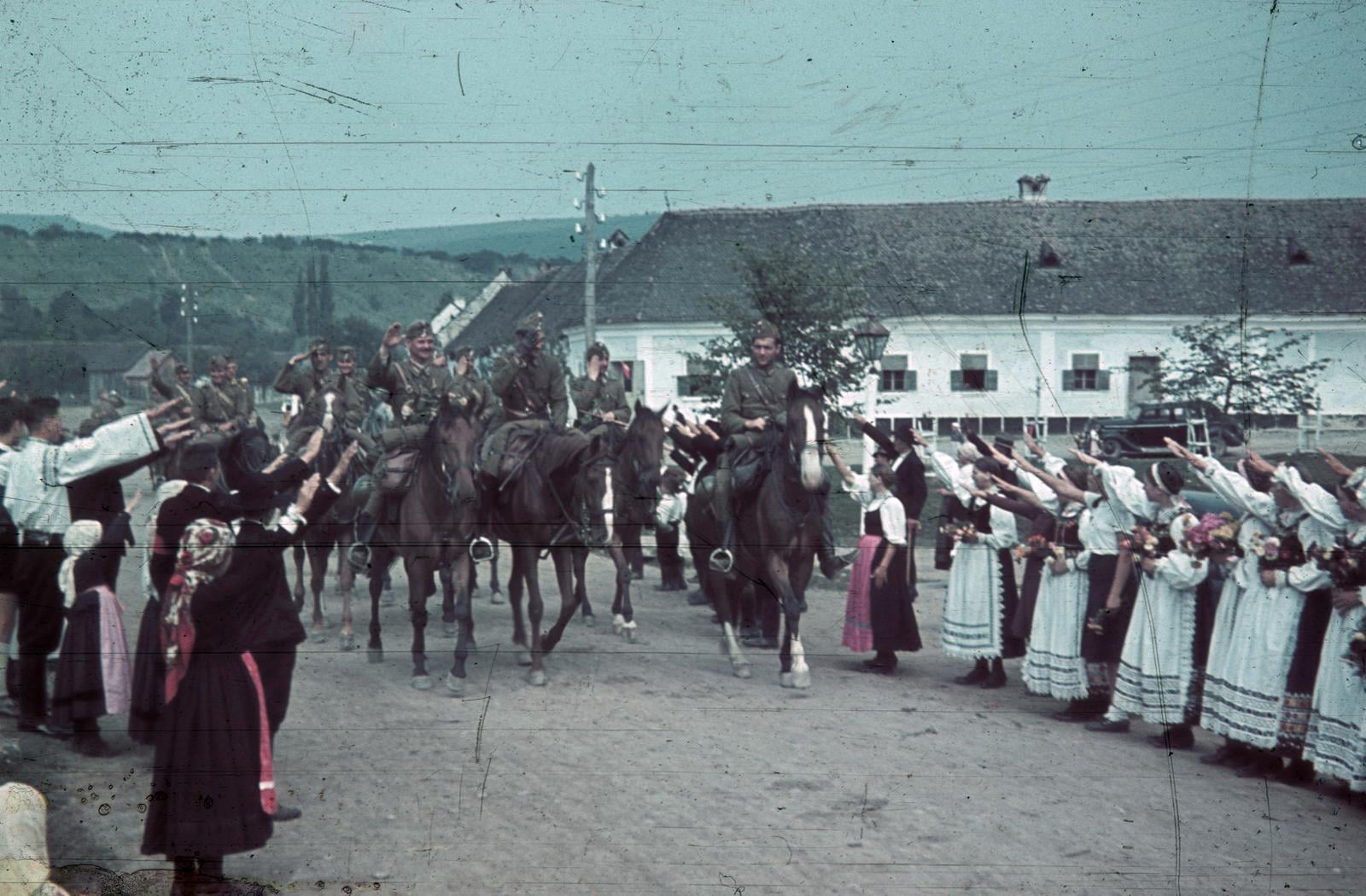
I tedeschi rumeni (sassoni) salutano le truppe ungheresi invasori con il saluto di Hitler. (Dumirta/Nagydemeter/Mettersdorf, Transilvania 1940) (Crediti: Fortepan.Hu)
https://i.redd.it/n02dgyb9grxe1.jpeg
di Pe45nira3

I tedeschi rumeni (sassoni) salutano le truppe ungheresi invasori con il saluto di Hitler. (Dumirta/Nagydemeter/Mettersdorf, Transilvania 1940) (Crediti: Fortepan.Hu)
https://i.redd.it/n02dgyb9grxe1.jpeg
di Pe45nira3
10 commenti
History is full of moments we’d rather forget, but we need to remember them to understand where we are today
The vast majority of the people they call Saxons were not Saxons. It’s just a misnomer being carried for centuries.
I saw the same post minutes ago where the title claimed that these were romanian hungarians saluting
A normal day in the Carpathian Basin
[deleted]
Well, at that point they became Hungarian Germans once again (for about 4 years).
> approximately 95% of the members of the German ethnic group who were fit for military service (Transylvanian Saxons and Banat Swabians) voluntarily enrolled into the Waffen-SS units (approximately 63,000 people), with several thousand serving in the special units of the SS Security Service (SD-Sonderkommandos), of which at least 2,000 ethnic Germans were enrolled in the concentration camps (KZ-Wachkompanien), of which at least 55% served in extermination camps, predominantly in Auschwitz and Lublin.
sources:
Paul Milata: Zwischen Hitler, Stalin and Antonescu. Rumäniendeutsche in der Waffen-SS, Böhlau Verlag Köln, Weimar, Wien 2007, [ISBN](https://en.wikipedia.org/wiki/ISBN_(identifier)) [978-3-412-13806-6](https://en.wikipedia.org/wiki/Special:BookSources/978-3-412-13806-6), p. 262
[Jan Erich Schulte, Michael Wildt (Hg.), Die SS nach 1945: Entschuldungsnarrative, populäre Mythen, europäische Erinnerungsdiskurse](https://books.google.com/books?id=B1xtDwAAQBAJ&dq=Paul+Milata%3A+Zwischen+Hitler%2C+Stalin+und+Antonescu&pg=PA383), V&R unipress, Göttingen, 2018, p.384-385
Of course they had to be on horses. We just can’t stop the rumors of everyone riding horses here
Germans from Transylvania supported the union of Romania with Transylvania very quickly after 1st of December 1918 (when representatives from the Romanian ethnic group had their vote for this in Alba Iulia) as it happened on the 8th of January 1919. The Germans were fed up with the Maghyarization process and were swayed by the Romanian promises in Alba Iulia that promised minority rights and a democratic system with universal suffrage.
However, things started to change in the interwar period. The Alba Iulia promises where not kept in their entirety as there was a process of Romanianization (Oliver Jens Schmitt, among others, argues that the post-imperial states had similar policies regarding ethnicity as the imperial states that were criticized before 1918). For example, universal suffrage was not enacted, rather only universal male suffrage (though this was a very big change when compared with pre 1918 voting systems in both Hungary and Romania). The Romanian state enacted a significant land reform, but that had the effect of confiscating large tracts of land from the Evangelical Church A.B. that the German minority belonged to. Money from those lands were used to finance the Saxon school system that was very good. The gotv. promised them money instead, but payments given were inconsistent and money were not enough, thus church taxes were increased. The dire economic situation post-ww1 had also soured the German’s trust in Romania as the crisis after the war hit Romania hard as it did with the Great Depression too. Thus, Nazism took hold among the community after 1931, in large part reflecting the dissapointment with the Romanian state. No wonder that some Germans welcomed the Hungarian authorities in 1940. In Romania proper, the draft campaigns for the Waffen SS among the Transylvanian Saxons was hugely successful and had the same causes as the ones described above, plus the belief that the survival rate was higher there than in the Romanian Army.
I must highlight something that most Europeans may not know: Transylvania was and still is one of the most multicultural regions of Europe. There are: Romanians, Hungarians, Germans, Jews, Roma. Thise have different religions and denominations: Christian Orthodox, Greco-Catholics, Judaism, members of the Evangelical Church A.B., the Reformed Church and Catholics. While there were ethnic conflicts and the Holocaust, compared with other mixed regions in Europe, those conflicts are quite tame.
Saxons still love to do that in Germany…