
Ciao.
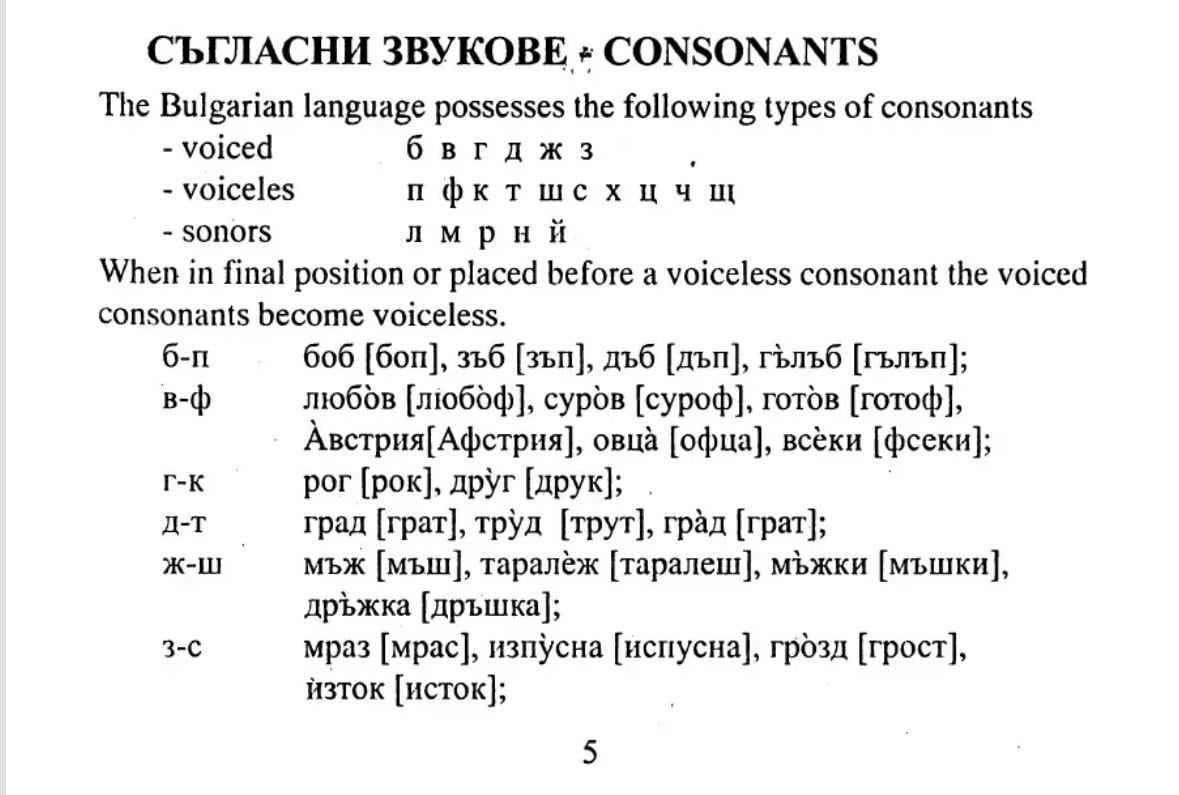
Ho una domanda relativa alle consonanti “doppiate” e “senza voce”. Ragazzi, pensate che sarò compreso se pronuncio una parola esattamente come è scritta? Ho difficoltà a ricordare quelle regole e le pronuncio esattamente come sono.
L’immagine proviene da una foto chiamata “La lingua bulgaro in pratica” di Eleonora Ivanova.
Grazie!
https://i.redd.it/7q2p0hlu2o3f1.jpeg
di countbogdan
11 commenti
From a book called**
Yes no problem at all and I am not very convinced these rules are universal for the whole country either. I know some people that definitely pronounce their ж-s and з-s every time regardless of their position in the word.
It comes natural. You simply cannot easily pronounce words with doubled voiced consonants without putting effort. Nobody will notice, it is a very subtle difference.
You will be understood but you will sound like something is wrong with you. If you pronounce град as граД (where Д is pronounced like in the alphabet, ДЪ like duh in English) you will be essentially be saying граДЪ (gra-DUH) with an inevitable emphasis on the ДЪ at the end. Nobody speaks like this and you will sound strange. The correct way is to pronounce it a lot more softly, like грат, where the emphasis will be on the vowel грАт and the Т sound is a lot softer than an emphasised ДЪ would be.
Wild of you to think that even we remember, or even know, those rules haha, it just comes naturally when you get used to how the words are structured and how some letters “transform” into others when they are being pronounced. Until then, yes, people will definitely understand you if you say “Искам да ям боБ”
You will be understood perfectly, but it would sound
a bit strange.
You don’t have to remember all the rules for pronunciation. We practice something that I like to call “lazy pronunciation”. Basically, a voiced consonant becomes voiceless after it another voiceless, because tge sounds merge due to faster pronunciation.
Example: “всичко”(everything) – you’ll have to make somewhat of a stop between “в” and “с” to pronounce them both clearly.
But “в” is “influenced” by “с” and becomes “ф”, therefore faster pronunciation.
The other way around is exactly the same: where a voiceless consonant becomes voiced, because of another voiced after it.
Example: “сватба”(wedding) – again, for more practical pronunciation, the “т” becomes “д”, because it is “influenced” by the “б” after it, allowing for faster pronunciation.
Just remember that a consonant can be “influenced” only by a latter consonant, never by the previous one. In “всичко” the “в” is “influenced” by the “с”, not the other way around. Same in “сватба”, where the “т” is “influenced” by the “б”, not the other way around.
Sorry for the long comment, but hope you understood everything.
I mean, they “become voiceless” pretty naturally. Say with the град example. Like, record yourself saying it, and you’ll see it naturally sounds more like “грат”. So I think it’s fine to just read them like they’re written, that’s how kids here are taught anyways.
Like… When you pronounce “road”. It kinda sounds like “roat”, right? Because there’s no sound after the “d”, so it just sounds harsher. It’s the same logic.
I mean, probably, but you’ll get weird looks. For some of these words, it’s literally impossible to say them in any other way other than the correct way. Try saying “вторник” as it’s written, if you can manage that, nobody can stop you. If you say “вдорник” or “въторник” or “в-торник”, it doesn’t count. It has to sound like “фторник”, otherwise it just sounds awful and incorrect.
You will get the hang of it eventually with enough exercise, because the rule is consistent.
You’ll quickly find out, that colloquial Bulgarian is oftentimes quite different from standard language, sometimes in very significant ways. I personally really like this trait, as it makes the language richer and more natural, but it can be a bitch for learners. Anyways, we commit all kinds of phonetic “crimes” in our daily speech, so a foreigner pronouncing voiceless consonants as if they were voiced is really no biggie.
Of course, you can, but you will sound like an AI bot
At worst, you will sound weird, like a foreigner. So no