L’Italia e la Grecia suonano l’allarme sulla Libia. Ma gli alleati non si affrettano ad aiutare.
https://www.politico.eu/article/italy-greece-sound-alarm-over-libya-allies-arent-rushing-to-help/
di Axmouth

L’Italia e la Grecia suonano l’allarme sulla Libia. Ma gli alleati non si affrettano ad aiutare.
https://www.politico.eu/article/italy-greece-sound-alarm-over-libya-allies-arent-rushing-to-help/
di Axmouth
25 commenti
tl/dr:
Italy and Greece warn that instability in Libya poses a serious security threat to Europe, with Russia expanding its influence and migration surging across the Mediterranean. Turkey’s maritime deals with Libya also raise tensions. Diplomatic efforts have stalled, and broader international support has been lacking, leaving Italy and Greece largely alone in trying to manage the crisis.
—
Text:
> Rome and Athens have identified Turkish and Russian involvement in a growing security threat from North Africa.
>
> Don’t focus so much on Ukraine that you miss the severe threats to European security brewing in Libya.
> That’s the message Italy and Greece are trying to deliver to their EU and NATO allies, but without much success.
> Migrant flows from Libya are spiking again, at a time Rome is increasingly concerned about Russia’s growing influence in the unstable North African nation, wielded through arms supplies and a potential new naval base in the northeastern port of Tobruk.
> Athens has also sent two warships to conduct patrols off Libya in response to the migration surge and its strategic concerns that its archrival, Turkey, is working with the Libyans to carve up the Mediterranean into maritime zones for energy exploration. The zones claim waters just south of the Greek island of Crete, while Athens deems them illegal under international maritime law.
> Italian Foreign Minister Antonio Tajani has described Libya as “an emergency that Europe must address together,” but a European attempt to make some diplomatic headway last week degenerated into farce.
> EU Migration Commissioner Magnus Brunner, accompanied by ministers from Italy, Greece and Malta, was declared “persona non grata” in Benghazi, the territory of the eastern Libyan strongman Khalifa Haftar. Accused of unspecified “violations,” the delegation was ordered to leave.
> “Russia’s role in Libya continues to expand, using it as the central node in its African strategy,” warned one EU diplomat who follows the dossier closely. The diplomat added that a politically connected smuggling network in Libya was supporting Russia’s strategic efforts, helping Moscow to circumvent sanctions and to weaponize migration.
> Italy and Greece know, however, that tackling a problem as complex as Libya — a country more than three times the size of Spain — will require support from big allies such as the U.S. and France.
> So far, however, the response from those allies has been underwhelming.
> ##Migration again tops the agenda
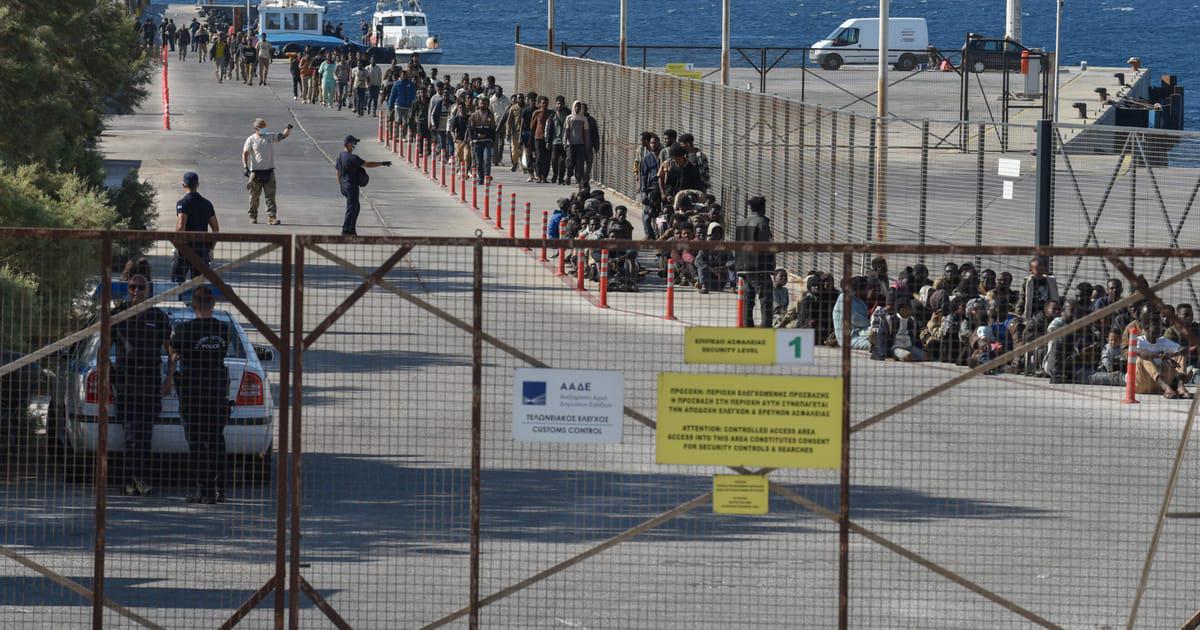
> The Greek government announced tough new migration rules on Wednesday as it struggles to cope with a surge in arrivals from Libya on Crete at the height of the tourist season.
> “An emergency situation requires emergency measures and therefore the Greek government has taken the decision to inform the European Commission that … it is proceeding to suspend the processing of asylum applications, initially for three months, for those arriving in Greece from North Africa by sea,” Greek Prime Minister Kyriakos Mitsotakis told lawmakers.
> Some 9,000 people have arrived in Crete from Libya since the start of the year, most of them in recent weeks, already almost double the number for the whole of 2024.
> In late June Greece deployed two warships in a bid to curb the recent surge of migrant arrivals. Senior government officials doubted their effectiveness, however, warning that naval patrols may encourage migrants to pitch themselves into the water to seek rescue. Sure enough, in the last week alone over 2,000 migrants came ashore in Crete.
> The Greek government is also taking criticism from both the opposition and its own officials for having abandoned the Libya file in recent years.
> Overall there has been a 7 percent rise in irregular crossings in the central Mediterranean in the first part of the year, almost entirely from Libya, compared to an overall 20 percent drop on all the other main routes.
> The Greek crackdown has also triggered fears in Italy that more migrants will be pushed into Italian waters.
> “We are concerned about the situation in Libya and the recent increase in irregular departures,” a European Commission spokesperson said before last week’s EU visit to the country.
> Being concerned is one thing, finding a solution quite another.
> Diplomats described last week’s diplomatic mission as an attempt to determine what solutions could be feasible. EU cash, after all, would likely play some role. The EU struck a highly controversial deal with Tunisia in 2023 in which it paid the authorities to stem migrations, but diplomats doubt such a model could be replicated in a country as destabilized by rival militias as Libya.
> ## Russians at the gate
> A recent display of Russian weapons in Benghazi during a military parade showed the Kremlin’s growing proximity to Haftar.
> Russia wants a stronghold in the Mediterranean, especially after the new authorities in Syria terminated Moscow’s lease at the Port of Tartus after the fall of Bashar al-Assad. Italy’s Tajani issues regular warnings that Libya is the most likely destination for a replacement naval base.
> According to a report by the Agenzia Nova news agency, Moscow also wants to install missile systems at a military base in Sebha in southern Libya, which is controlled by Haftar, and to point the rockets at Europe.
> Many analysts and diplomats are skeptical that Moscow is already at the stage of pointing rockets at Europe from Libya. But even without the missiles, Russia can already use a handful of military bases in Libya for logistics, “which theoretically could hit Europe,” said Arturo Varvelli, a senior policy fellow for the European Council on Foreign Relations.
> So far, Russia has mainly used Libyan bases to run its operations in the rest of Africa, operating mainly through the Africa Corps, backed by Russia’s defense ministry.
> There are also growing fears among southern European officials that Russia could soon be able to harness migration from Libya in a rerun of the hybrid war it launched on the EU’s eastern front, when it forced Middle Eastern refugees over the Belarusian border into Poland.
> Still, not everything is going Russia’s way. One of the diplomats said the costs of the war in Ukraine were depriving the Africa Corps of the funding it needed to pay Libyan militias, creating tensions with its proxies and Haftar.
> “I don’t see the Russians taking over” the migrant smuggling business, said Karim Mezran, a resident senior fellow at the Atlantic Council, but “I see the Russians telling the people: Now I’m the new ruler and you just follow my orders.”
> ##A quest for allies
> Despite the gravity of these threats from Libya, Italy and Greece are struggling to convince their allies to step up.
> Italian Prime Minister Giorgia Meloni discussed Libya with French President Emmanuel Macron at a three-hour meeting in Rome on June 4.
> Libya “is of course a topic of key relevance for both Italy and France,” said an Italian official with direct knowledge of the talks between Paris and Rome, stressing “common concerns, especially on security — as regards also Russia’s increasing presence there — and migration.”
> The Italian official, however, acknowledged that there are “nuances” between the two countries’ positions “on the possible political solutions.”
> Libya is increasingly being added to the agenda of more diplomatic talking shops, but in practical terms little is happening. While Italy desperately wants buy-in from military heavyweight France, the subject simply isn’t as vital to Paris as it is to Rome, and even exposes France’s recent failures in Mali and Niger.
> “For Italy, the question of Libya is more central in the short term than for France,” said Virginie Collombier, a professor at Luiss University in Rome and an expert on Libya.
> “Politically, the French government has little interest in crying wolf on Russia because it highlights the failures of the French government,” she said, noting that France has gradually withdrawn from African countries in the Sahel region while Russia has upped its presence.
> And with the U.S. increasingly looking to the Pacific, there is scant hope that Washington will invest much political capital in stabilizing the country.
> Most tellingly, the most recent NATO declaration, signed June 25 in The Hague, doesn’t even mention Africa.
> “No one wanted divisive issues [included] as NATO now has a very minimalist agenda,” said Alessandro Marrone, head of the defense, security and space program at the Rome-based Istituto Affari Internazionali think tank.
> That’s a bitter pill for the Italians.
> Rome has “now to face this reality,” Marrone added.
On a slightly related matter
https://newsukraine.rbc.ua/news/russia-moves-kalibr-cruise-missile-ship-into-1752378133.html
# But allies aren’t rushing to help.
Dejavu to 2015. Greece was left alone back then to deal with immigrants, and is yet again being left alone now.
Them doing the pikachu face when it starts affecting them
the same italy that joined NATO and killed gaddafi? payback time
In the other Reddit post I AM reading that public support for defense spending in Italy is lowest in Europe …
*Surprised Pikachu face*
Don’t forget all the “European Solidarity” though
As usual. And then everyone wonders why the locals are enraged or why boats are overturned etc…
No I’m not endorsing the behaviour, but I understand why
Funny. Who were allies together with russians with a libyan general against UN recognized government of Libya? This 1984 level doubletalk shit worked before internet. Now archives dont forget.
Just making it more and more obvious that the “migrant crisis” was manufactured by Russia to divide Europe so that they can hopefully get the EU to collapse.
And they’re succeeding. The EU is growing more and more divided, especially over this manufactured “problem”. I wish we could all realize what’s going on and come together, but sadly too many are easily swayed.
Oh no, “the eastern flank is not our problem” allies need help.
Eastern and Northern Europe not giving a flying F. about Mediterranean countries after screaming for their help against Russia for the last two years? No way!
I’m sure this kind of news will definitely convince the average José, Mario and Nikos to go die in Estonia/Poland/Finland when Russia will invade them. /s
Go beg Spain and Portugal maybe? The rest is occupied with Russia.
Great news!
Europe has been complacent for quite sometimes now.
Let the fire light beneath thy white asses.
Step 1: Fill buses with these people. Step 2: Send them to those allies unwilling to help. Step 3: Repeat.
Make it very hard to live illegally in the EU. And return everyone back to their country when they lack sufficient documentation.
But, offer a path to citizenship through hard work and education. Start massive factories for stuff China normally produces on African soil and combine that with mandatory education. They pay for their education through work. If they pass their exams, give them a job in the EU, or in another African country if they so choose.
That might be a better road for many refugees, especially if the illegal route becomes too dangerous and cumbersome.
Woah. People really don’t know what’s going on Libya.
Maybe you guys should check which country is supporting which side 😛
Turkey supporting anti Russian side “GNU” while Greece and Russia is supporting Hafter.
So if Russia is evil, Europe shouldn’t let them win right? But Greece supports Hafter too!!! What should Europe do???? Lol.
Do Europe wants a country that allied it’s self with Russia or she wants one of the member state feels safe?
The countries that were continuously bombing theese areas should be the first to find solution.But the hypocrisy inside EU is too strong.
never should’ve removed gaddafi in the first place.
We came, we saw, he died.
Fucking politicians just. won’t. learn.
Thank you Obama
Europe, and more specifically European countries, like to repeat the same mistakes over and over again.
Seven months ago
https://www.reddit.com/r/europe/comments/1hir9gu/italy_bristles_at_prospect_of_russia_moving_ships/
So not the first time Italy have raised this concern.
Are they actually Libyan or just migrants that entered Libya getting to Europe!